Showing posts with label legends. Show all posts

Wednesday, April 29, 2026

Yellow Death in Yellow Town (Small Town Legends A to Z)

This year my A to Z theme is Small Town Legends. I am exploring folklore from villages and small towns in and around Hungary, bringing you the most entertaining bits. You can plan your next visit around them!

Once again, there is no city or town with Y in Hungarian, so I had to get a bit thrifty. In this legend, the color yellow plays a significant part. But also, the name of the city it was collected in, Szeged, carries a reference to the same color: it is here that the color of the River Tisza changes to a yellow-brown color and becomes szőke ("blonde"). Szeged is a city of about 160,000 inhabitants in southern Hungary.

According to a story collected in the 1800s, there was once a young many who wished to marry Tündér Ilona, the fairy queen. He picked the worst horse from his father's herd, and that nag turned out to be a magic steed. When they neared the queen's palace they had to cross a wide river; the magic horse turned into a boat, and ferried the young man across.

The young man spent two years making merry in the fairy palace, but then decided it was time for him to visit his home again. Crossing back over the river, he found his hometown in ruins, as if it had been deserted for hundreds of years. Only the church was still intact - and filled with coffins. Among the coffins stood a man. One of his legs was yellow, the other red, and the rest of his body green. It was Death himself.

The young man fled from Death, and Death gave pursuit. It almost caught up when the young man reached the river and jumped into his magic boat. Death only managed to get one yellow leg into the boat before it started moving - and, losing balance, Death fell into the river and drowned.

This is why, claims the legend, Death is not visible to humans anymore.

(This story is a mix of two tale types: The Prince Seeking Immortality, and one called The Yellow Death. Source here.)

Friday, May 20, 2022

Sisterhood of the Wolf: The hunt for female werewolves (Girl in the chair)

Girl in the Chair is a blog series on research for storytellers. You can find the details about it in the opening post here. 


I am preparing for this year's Story Camp that my organization (the Világszép Foundation) runs for children in the foster system. This year's theme is Transformations/Shapeshifting. First step is usually for the camp staff to choose folktale roles for themselves, so we can greet the children in character. I have spent the past few weeks researching tales about shapeshifters. When it came to picking my own character, I decided I'd like to turn into a wolf. 
(I recently read the book about Wolf 21 and I am in love with positive wolf representation. In addition, Werewolf is one of my favorite RPGs.)

So, I set out to find folktales or legends or myths about female werewolves or wolf shifters. I set some pretty specific criteria:

1. It has to be a traditional story with a narrative (folktale, legend, myth)
2. It has to be a good story
3. It has to feature a female character who can turn into a wolf
4. This female character has to be portrayed in a positive light, and has to achieve a happy ending
5. Wolves have to be portrayed in a positive (or non-negative) light
6.The transformation should happen at will, not as a curse or a one-time thing

Yeah. The bar was pretty high.

1. Thompson Motif Index

I turned to the motif index first, looking for "transformation: man to wolf" (D113.1). Werewolves do get their own motif number (D113.1.1), but I did not want to dig into those one by one unless I had to - werewolves are almost always male. Since Thompson usually notes when transformation happens to a woman, I filed this away for later. Too broad.

2. Keyword search

I set out with the most obvious search terms on Google Books and Google Scholar: "female werewolf", "she turned into a wolf", "wolf princess", "wolf fairy", etc., combined with "folktales", "legends" and other keywords. I had to work through a lot of fantasy novels (Google autocorrects "folktale" to "story" for some godforsaken reason), and several references to Princess Mononoke and Angela Carter.
No story really jumped out at me, but I did flag a book about the cultural history of female werewolves.

3. She-Wolf

The aforementioned book is a fascinating collection of articles on female werewolves. Only one really goes into folktales, but that one is a treasure trove, about female werewolves in Estonia (apparently, Estonia is unique with its strong female wolf tradition, go figure). I did get a couple of stories from it, but they didn't tick all the boxes: either the wolf was cursed, or evil, or it died in the end, or the story was simply not all that interesting. Still, great book.
(There was also a study on Burgundian werewolf trials, but the women accused of lycanthropy were all executed.)

4. I take to Twitter

When in doubt, tweet about it. The online folklore community rallied around my question, and I received quite a few suggestions from lovely people. Some were literary examples (again, Angela Carter, also Sergeant Angua),but others were promising. 

4A. 

A Croatian friend was kind enough to send me translations of two She-Wolf folktales, both variants of the "swan bride" tale type, with a girl whose wolf fur is stolen by her husband. I loved these, but I couldn't really use them in the story camp setting. 

4B.

Multiple people pointed me to the Werewolves of Ossory. It's an interesting tale, but once again it is short, with nameless characters, and the wolves are cursed. But it did point me to the Irish wolf tradition, which I circled back to later.

4C.

Someone brought up Romulus and Remus. I went on a side quest, looking into the lupa of Rome, and Acca Larentia as a possible wolf goddess - but in the end, Romulus and Remus is not a story that gets me excited either. And I thought a wolf mom to abandoned babies would hit a little too close to home with the foster kids.


4D.

Someone suggested looking into the Wulver, but I couldn't find a tale with a female Wulver. Or any tale, really. Some say this whole thing might be fakelore.

4E.

Someone linked me to a Chinese tale about an old woman who turns into a wolf, and eventually has to leave her family. It was a touching story, but with a sad ending.

4F.

Jürgen Hubert mentioned a tale about a wolf-woman who fell into a trap, and later killed the hunter with his own rifle. I liked this one, but it's not really much to build a character on. Translation forthcoming.

INTERLUDE: Pinkola Estés

Yes, a bunch of people mentioned Women Who Run With the Wolves. While I have a bone to pick (heh) with CPE and her treatment of folktales, I did look up the book to refresh my memory. One of my problems with this book is that it comes with notes, but it does not cite the sources for the stories - and she tends to change them a lot. And then everyone quotes her as a folklore source. I checked both in English and Spanish, and could not find the story she references.

5. Peeira

Fables, 1001 Nights
of Snowfall
My "wolf fairy" search took me to the topic of the peeira, a Portuguese creature of legend often translated as "fairy of the wolves." These women are usually seventh daughters in their family, and at one point they run off to live with wolf packs who take care of them.
It gets a mention in this book (which a Twitter friend kindly looked up for me), but the story itself attached only deals with wolves symbolically (as punishment for an unkind girl). Also this one, which looks fun, but I could't get a copy. Following the trail, I found this video which tells an amazing peeira legend, but it is kind of dark and bloody. I found a source in Portuguese as well, but it didn't really give a full story, just a belief. I found a reference to another (non-peeira) Portuguese female werewolf story, but in this one the girl was definitely evil, and she ate a baby. Boo.
(Here is a blog post on Portuguese werewolves)
All in all, I like the peeira as a concept, but couldn't find any convincing narratives to use.

6. Irish wolves

I circled back to the Irish tradition, as one of the Portuguese sources cited a source about Irish wolves. The source cited is pretty short; it says the Irish word for female werewolf was conoel (which Google promptly autocorrected to colonel), and mentions women who go into wolf shape, but alas no stories. Conoel did not yield any as a search term either.
The mentions of the Werewolves of Ossory led me to look into Laignech Faelad, a legendary figure whose descendants can turn into wolves. Couldn't find a direct reference to women, though.
I did get a few hits here and there. I found a literary poem featuring the warriors of the Fianna, and a Wolf-Girl whose curse is broken by a kiss from Oisín. In one of the folktales collected by Curtin a woman cursed into the shape of a wolf gave birth to a human baby (but then promptly died). The Acallam na Senórach mentions the three wolf-daughters of Airitech who came out of their cave to hunt, but they are murdered by warriors in the end. There was also a tale about a family of shapeshifting wolves, and a man they rewarded for saving and healing one of their pups. The family included a fierce mother, so this tale was a definite maybe.
I also found some references to lycanthropy and women in Ireland, such as this article, but no convincing stories. There was an entire side quest about the wolf-woman to be tamed by Irish kings through marriage (see references here). Some sources that looked interesting I could not track down (like this study from this book. It referenced a 17th century text here, but I did not have the bandwidth to go through it in search of the mention of a female wolf).

7. More keywords

I found a reference to a Persian tale called "The Wolf-Girl and the Fairy", but despite the enticing title, it turned out to be one of those tales were a hero's sister transforms into a monster. You can find it in this book. I also found a reference to ATU tale type 409, "Girl as Wolf", but it was another "woman cursed to be a wolf" story.

8. Wolf Queen

And then it dawned on me that might not have searched for "Wolf Queen" earlier. So I did. Lo and behold: a story! A Cape Malay story, specifically, from Nelson Mandela's Favorite African Folktales. (This is the original source.) It's a version of the Donkeyskin tale type: a girl tries to avoid marrying a sultan by transforming into a wolf - and then occasionally forgets to transform back. In the end, her true love recognizes her anyway. And she has a name! (Amina.) And she lives happily ever after!

WHEW! That was an intense three-day dive into a rabbit hole... wolf den? I am sure there is more to rustle up, but I'm satisfied for now.

The real treasure was the citations I found along the way!


Wednesday, April 27, 2022

W is for the Weise Stone (Gemstone Folklore)

Welcome to the 2022 A to Z Blogging Challenge! My theme this year is Gemstone Folklore. Because I love stories about shiny things. Read the introduction to the project here.

WHAT IS THE WEISE STONE EXACTLY?

Der Weise (originally Die Waise, the orphan) was a famous gemstone set in the Holy Roman Emperors' crown. Some sources (like the Grimm Wörterbuch) claim it was probably a milky white opal. White opals are quite magical looking gems anyway. It was lost sometime in the 14th century, and its alleged place is taken up by a large sapphire in the crown (see top of the left plate in the picture above). Reading the story below, I wondered if the sapphire was the original gem, since the legend resembles other stories about Sri Lanka and its gemstones.

The legend of Duke Ernst
12th century German legend

This story begins with the young Duke Ernst losing his father when he's still a child. His mother, Adelheid, marries the Holy Roman Emperor Otto. The emperor treats the duke (now a grown lad) kindly, but then a jealous count fills his head with lies. The emperor, believing Ernst is trying to take his crown, starts a war against the young duke who holds out for six years but finally has to go into exile. He takes the cross along with a thousand of his knights, and journeys towards the Holy Land. In Constantinople they all board a ship, but a terrible storm takes them out to sea, and they only find land again after three months.
They first land on an island named Grippia, with a splendid city built from colorful marble. They don't find any people living there, so they help themselves to food and supplies. Duke Ernst and his best friend Count Wetzel return to the city in the afternoon to look around. They explore the palace, full of jewels and precious stones, take a bath in tubs that have hot-cold running water, sleep in the royal bed. In the evening they see from the window the people of the city finally returning: they are all finely dressed, but they are human from the neck down and cranes from the neck up. They have kidnapped a princess from India, and they are forcing her to marry the Grippian king (who has the head of a swan). The duke and the count want to attack the wedding but decide against it; instead, they wait to rescue the bride later. However, they are soon discovered, and the Grippians kill the hostage princess. Duke Ernst and Count Wetzel fight their way back to their ship with the help of their men, but lose five hundred knights to Grippian arrows in the process.
Sailing on from the island in a hurry, the travelers encounter the Lodestone (magnetic) Mountain next. It draws in the ship by its iron nails, and they crash and sink. The men swim ashore, but now they are stranded among the various treasures of all the other sunken ships - and no food. Most of them starve to death, until only Ernst, Wetzel, and five others are left. Every time someone dies, griffins fly in and take the corpse. Eventually Wetzel suggests the survivors should wrap themselves in hides, and let the griffins take them too. Him and Ernst go first. In the griffins' nest on the mainland they cut themselves out of the hides, and escape.
Coming down the mountain the survivors encounter a river that flows into a cave. Having no other way out, they make a raft and float inside the cave, which is lit up by precious gems. Duke Ernst reaches out and takes one - a stone of such exceptional, unique radiance that it is later named Lapis Orphanus, the Orphan Stone. It is set into the imperial crown (the writer of the legend notes this proves that the story is true).
After this the duke and his men have more adventures; they befriend a Cyclops king, and help him defeat his warlike neighbors the Flat Hoofs, the Big Ears, a flock of giant cranes that eat the tiny nation of the Prechami, and the Canaanite giants. He collects one of each and eventually (after six years) sails on to Enthiopia with his ragtag band, where he fights for the Christian king against an invasion from Egypt. Then he moves on to Egypt, then Jerusalem, where he gets news from Germany about the emperor discovering the truth and forgiving him. He travels to Rome (losing the Flat Hoof on the way), and then to Bavaria, arriving to the imperial court on Christmas Eve for a big family reunion. He makes peace with the emperor, gets his lands back, divides up his fantastic retinue, and apparently gifts the Orphan Stone to the ruler, who sets it in the imperial crown.

Sources: There is an entire book about the stone (see review here), and also an article here. You can read Duke Ernst's story in this book. By the way, this story sounds a whole lot like Sindbad's journeys.

What gems would you want to grab from a magical cave?

Wednesday, April 20, 2022

Q is for Quartz Crystals (Gemstone Folklore)

Welcome to the 2022 A to Z Blogging Challenge! My theme this year is Gemstone Folklore. Because I love stories about shiny things. Read the introduction to the project here.

ROCK CRYSTAL (QUARTZ)

Quartz is a crystalline mineral composed of silicone dioxide. Clear, transparent quartz is often called "rock crystal".

The legend of Manpupuner
Mansi/Komi legend

In the Ural mountains there is a fascinating geological site that features seven tall stone pillars. They are 30-40 meters high, standing on a plain, and made of schist rock with veins of quartz. A local Mansi (according to other sources, Komi) legend explains their origin.
According to the story, once there lived a powerful chief who had a son and a daughter. They were both brave and handsome, and their people flourished. The chief was on good terms with the spirits, who helped him build a tower (and/or castle) of crystal.
However, the giants that lived in the nearby mountains heard about the beautiful maiden, and their chief decided to take her as his wife. His suit was rejected, so he returned with six of his men to attack the tribe and steal the girl. The chief's son was away on a hunting expedition. People fled to the crystal building, seeking shelter. The giants fell upon the crystal walls and shattered them - scattering rock crystal all over the Ural mountains, where it can still be found.
Eventually the spirits, hearing the cries of the besieged, sent a thick fog. Under the cover of the fog, the people escaped. By the time the fog lifted the chief's son returned with a sword and shield gifted to him by the spirits. They reflected the sun so strongly that the giants, hit by the rays of light, turned into stone. Their king is the seventh pillar that stands apart from the others.

Sources: Read versions of the story here, here, and here. Read more about Manpupuner here and here.

If you built a castle from one gemstone, what would it be?

Tuesday, April 19, 2022

P is for Pounamu (Gemstone Folklore)

Welcome to the 2022 A to Z Blogging Challenge! My theme this year is Gemstone Folklore. Because I love stories about shiny things. Read the introduction to the project here.

POUNAMU

Pounamu (sometimes translated as greenstone) is the Maori term used for green colored stones found in New Zealand that play an important role in its indigenous culture. It includes more than one type of mineral - usually nephrite jade, and bowenite (see the letter B earlier). 

Rata and the First Greenstone Axe
Maori legend

Rata's father, a chief, is killed by another chief called Makutu before the boy is born. When he grows up, Rata decides to set out and seek revenge on Makutu. First he needs to make a canoe for the quest, and for that, he needs an axe sharp enough to fell a giant tree. He seeks out a mythical being called Kahué to ask for a stone axe. Hearing Rata's story, Kahué agrees to split some rocks and provide the strongest greenstone for the axe. However, the axe thus formed is not sharp yet. Rata has to take it to the Whetstone Goddess, and sharpen it over her backbone. Rata seeks out the goddess, prays to her, and she allows him to sharpen his greenstone axe.
(In another variant of the story, the greenstone axe is left to Rata by his ancestors, buried underground until he needs it.)
With the use of the axe Rata manages to create a giant canoe (although he fails at it multiple times, because he doesn't show proper respect to the deities of nature). He sets out to the far east, and reaches the land of the Ponaturi, beings who hide underwater in the day and come to land at night. With the help of a captive woman Rata and his men manage to trap Makutu, cut him, and transform him into a bittern bird. They return home victorious, carrying the bones of Rata's father so they can give him a proper burial.
Rata becomes a famous chief, and teaches all his people how to make pounamu axes. The red-blossoming rata tree is named in his honor.

Sources: Read versions of this story here, here, here, and here. Read more Maori legends about pounamu here.

Have you ever been to New Zealand? Have you read any literature from there?

Friday, April 15, 2022

M is for Moonstone Magic (Gemstone Folklore)

Welcome to the 2022 A to Z Blogging Challenge! My theme this year is Gemstone Folklore. Because I love stories about shiny things. Read the introduction to the project here.

MOONSTONE

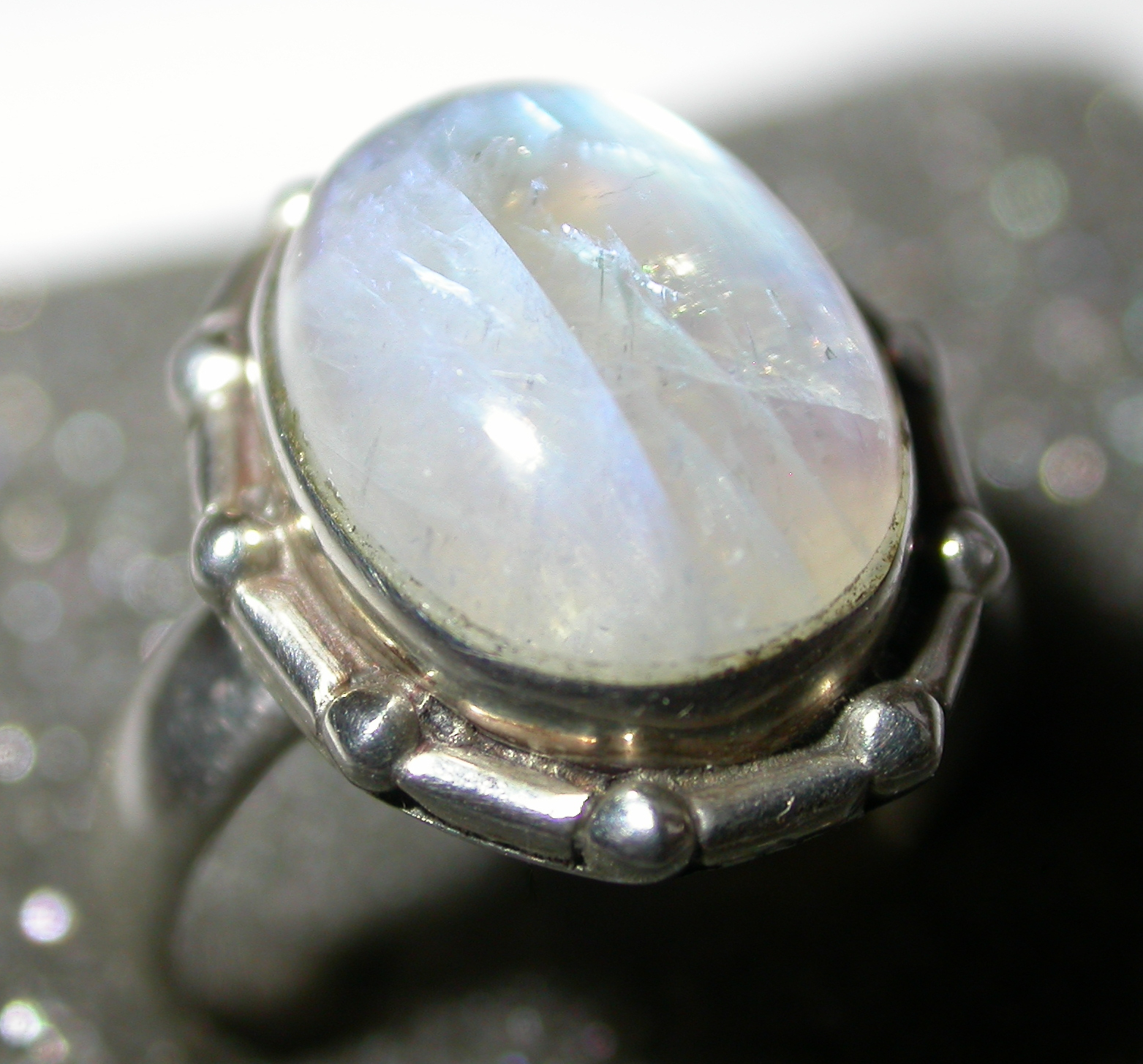
Moonstone is a kind of feldspar with a pearly white sheen that, according to popular belief, resembles moonlight. Pliny the Elder claimed that it changes its brilliance according to the phases of the moon (which is not true, but it sounds fun).

The serpent's moonstone
Spanish/Basque legend

Two churches in Navarre, the Santa María de Eunate and the San Miguel de Olcoz have almost identical Romanesque portals at their entrance, like mirror images - and an old legend to explain the similarity.
The legend says that when the Santa María was built in Eunate sometime in the 12th century as a convent for the Knights Templar (allegedly), the master tasked with the work had to take a leave. He was away longer than intended, doing reparations somewhere else and also due to illness.
In his absence, the monks hired a local stone cutter to make the portal for the entrance, and he did so, in an astonishing three days' time. (Some versions of the legend say he was a jentilak, a Basque giant). When the master returned, he was furious to see someone else had done part of his work. To pacify him, the abbot paid him to make an identical portal - provided he could do it in the same amount of time.
The master, desperate, turned to a witch (or lamiñak) for advice. She told him that every Noche de San Juan (midsummer night) a large serpent appears at the nearby river, and deposits a magic moonstone on the bank while it goes bathing.
The master managed to steal the moonstone, and use its power to create an identical portal before the deadline. He placed it in a golden bowl of clear spring water on San Juan's Eve. As the water reflected the portal in the moonlight, the master said magic words, and the mirror image of the portal appeared on the church wall (except it was a little bit off, for the master jostled the bowl by trembling with excitement).
However, when the local stone cutter / giant saw his work, he grew furious, and hit the entrance with such force that it flew over to the neighboring village of Olcoz. The locals did not look a gift portal in the mouth, and built a church around it. There it remains to this day.

Sources: Read the story here, here, here, here, here, here, or here.

If you had the magic moonstone, what would you use it to build?

Monday, May 17, 2021

StorySpotting: Weather wizards and cloud pirates (New Amsterdam)

StorySpotting is a weekly or kinda-weekly series about folktales, tropes, references, and story motifs that pop up in popular media, from TV shows to video games. Topics are random, depending on what I have watched/played/read recently. Also, THERE WILL BE SPOILERS. Be warned!


Where was the story spotted?

New Amsterdam, season 3, episode 11 (Pressure drop)

What happens?

Dr. Iggy Frome, New Amsterdam's resident psychiatrist, runs into an interesting case: a young man who insists that he can control the weather with his mind. A self-proclaimed "weather nerd", Iggy convinces him to get a scan, hoping to find an explanation for the delusion. While waiting for a scan, he jokes that the man either has a tumor, or "he is a tempestarii." When Dr. Kao asks him what those are, he says "medieval wizards who could control the weather."
(Obviously the guy turns out to have a medical condition in the end.)

What's the story?

Let's say up front that Dr. Frome uses the Latin incorrectly: tempestarii is the plural of tempestarius, storm-maker. We know of these strange medieval wizards from the writings of Agobard of Lyon, a 9th century archbishop who wrote a treatise titled "On Hail and Thunder." And no, that's not the title of the next Thor movie.

According to Agobard the people around Lyon claimed that storms, hail and thunder were raised by storm-makers. These wizards were in league by the people of Magonia, a magic land of sky pirates. Magonians sailed in the clouds on their ships, and under the cover of the storms raised by tempestarii they stole the crops from the fields.

While the good archbishop Agobard rails extensively about the stupidity of people who believe such things, I gotta admit I love everything about this. I am predisposed to: weather wizards are an integral part of Hungarian folklore. I blogged about them here but I want to add some more info.

Hungarian weather wizards are called garabonciás, derived from the Italian word for necromancy. They are mortals who gain their magic powers by going to a secret wizard school abroad, usually in Italy or Transylvania (eat your heart out, JK Rowling). After they complete their studies, they all have to sit on a spinning wheel of fortune, and one of them has to fall down and die so the others can gain their powers. 
And you thought your graduation was tough.


Garabonciás wizards most often deal with the weather. They can summon storms just like the tempestarii. They usually wander from village to village, asking for milk, eggs, bread and other simple foods. If people are rude to them, they create a storm to punish them and destroy the crops. In one story, the garabonciás turns eggs into hail, and milk into clouds. They can also travel inside storm clouds or even in whirlwinds. While they sound terrifying, they are actually often helpful: they can protect villages from hail, and deflect magic storms summoned up by witches.

The garabonciás' most common features are his book and his dragon. The latter are usually aquatic creatures that bring storms when they fly up into the sky. Garabonciás use their magic book to summon up these dragons, tame them, and ride them, creating raging storms, lightning, and thunder. People often called storm clouds 'dragon's tail'. Some believed the wizards ride the dragons to Africa, where they sell their cool meat for protection against the heat.

Garabonciás beliefs lived on well into the 20th century. Some famous Hungarian writers and poets - Petőfi Sándor, Csokonai Vitéz Mihály, Jókai Mór - were rumored to have been garabonciás. Also, in the early days of bicycles, people tended to claim anyone riding a strange metal contraption at breakneck speed had to be a garabonciás too. Makes sense to me.

Conclusion

When someone asks you for a cup of milk or a bite of bread, don't refuse them.


Monday, June 8, 2020

Heroes and prophets (Following folktales around the world 159. - Jordan)

Today I continue the blog series titled Following folktales around the world! If you would like to know what the series is all about, you can find the introduction post here. You can find all posts here, or you can follow the series on Facebook!

Legends of Galilee, Jordan, and Sinai
The Sacred Land III.
Zev Vilnay
The Jewish Publication Society of America, 1978.

This book is part of a series that collects the legends of the Holy Land by region; in Volume III we find stories from Galilee, Jordan, and Sinai. Among them, sixty-three legends are from the historical region of Jordan, grouped by geographical area. Not all of these areas are a part of modern day Jordan, but I read all of them anyway, and learned a lot about the region's geography. Stories are primarily from the Jewish tradition, but there were also a few Muslim and Christian legends. Sadly the volume doesn't have an introduction or foreword, but each story comes with cited sources.
I also read some more Arab legends from this book, because I was curious.

Highlights

The legend of the fight between Moses and King Og was filled with wonder tale motifs. My favorite was the part where the giant king tried to throw a mountain at Moses, so God sent an army of ants to dig through the mountain, and it collapsed on his head. He tried to take it off like a hat, but God grew his teeth so he would get stuck with his head inside the mountain...
I also liked the legend of the sneezing goats, who live in the land of Moab and sneeze from the incense burning in the Temple of Jerusalem.
There were some legends about Petra in the book. One of them was an Arab tale about the Pharaoh who built Petra, and his treasure hidden in a vessel above the door of one of the buildings. Whoever can shoot the vessel and break it can keep the gold. In another Arab legend the Pharaoh's daughter, living in one of the palaces, promised her hand to whoever could bring water to the city. Two young men succeeded, but one credited his own ingenuity and the other the help of God. She chose the latter.
In the Arab legends Ali, the son-in-law of the Prophet made an appearance, alongside Antar, one of my favorite epic heroes.Ali visited Antar on his journey, and then reached the legendary City of Copper. There were also tales about another black Arab hero, Zir, whose story of trial and triumph resembled the "golden-haired gardener" type fairy tales.

Connections


The origin story of Lake Ram was one of those international types where a beggar visits a village and people are rude to him, so he calls down a storm and drowns the place in water, creating a lake. I also found a version of the classic fable about the man with two wives, one of whom pulled out the white hairs from his beard, and the other pulled out the black, until he was left without any beard at all.
The tale of King Solomon's ring did not only mention his wife (who was not the Queen of Sheba) but also fell into the motif of "the ring of Polycrates", being lost and found in the belly of a fish again. The legend of Ghareisah and Zeid was a Romeo and Juliet story here the youth from two warring Bedouin tribes tried to run away together, but they were found and killed. The girl wrote her dying message on a rock, and locals see the print of her hand in the cross of a Byzantine altar stone.
I couldn't help but think of a literary parallel in the legend of the Caesarion tunnel: according to legend the Lord did not allow Moses to enter the Promised Land, no matter how he begged to cross the Jordan or the mountains. He finally asked to pass through the tunnel under the river, but God said "Thou shall not pass!" I wonder if Tolkien knew this story...

Where to next?
Israel!

Saturday, May 30, 2020

Girl in the chair: Grief over a bowl of rice

Girl in the Chair is a blog series on research for storytellers. You can find the details about it in the opening post here. 

CW: Grief for a child


"I'm looking for a story..."

I was teaching a workshop today on research for storytellers, and one of the participants brought in a question about a specific story:

"There is a story about a young woman who loses her child, and a wise man / spirit (?) tells her if she collects a bowl of rice from people who have never experienced loss, she can have the child back... of course she can't."

She asked me if I could find this story. I thought this was going to be easy to answer; I have encountered this tale type before. If only I remembered where...

Step One: Google Books

When in doubt, I usually search in Google Books first. I focused in on the bowl of rice aspect of the story (it was a mistake, see later), and tried search terms such as "bowl of rice" + "grief", "bowl of rice" + "mourning", "gather rice" + "grieving", etc. Random folktales did pop up, but they usually had something to do with rice and nothing to do with grieving. I even tried adding "Buddha", as I vaguely remembered this as a Buddhist story, but no luck.

Step Two: More Google Books

A small change in search terms yielded the first results: I put "grain of rice" instead of "bowl of rice." This brought up versions of the parable, but none of them came with a source. I found simplified texts posted online, such as this one, this one, and this one.

Step Three: Untouched by grief


At this point I was kind of annoyed, so I did a "long shot" search - these are searches were I use terms that are very specific, and it is kind of unlikely that they will yield a result, but screw it, I'm gonna try it anyway. So I typed in "untouched by grief" + "folktales" in quotation marks as a search term for Google Books.
Lo and behold, The Book of Greek and Roman Folktales came up. (Maybe I had the term floating around my brain somewhere, because I reviewed this book for a journal last year, and I highly recommend it to storytellers.) This one has a story actually titled "Untouched by Grief", in which King Darius loses his beloved wife, and Demokritos tells him he can have her back if he writes three names on her tomb: the names of three people in his kingdom never touched by grief. The great king fails, and learns a lesson about loss.

Step Four: Folktale type number

Luckily, the Book of Greek and Roman Folktales comes with a folktale type index, where this story was marked as ATU 844 - The Luck-bringing shirt. I know that story: a king is told he can be happy if he wears the shirt of a happy man, and soon finds out that in his kingdom no one is happy, except for a man so poor he has no shirt. (I'd argue with this message, put let's put that aside).
So, off to the ATU Catalog I go. I get a summary of the lucky shirt, but no mention of grieving mothers or grains of rice anywhere. Technically the same basic idea, but not the same story.

Step Five: Storyseeds

Usually around this point in the research process I take a shot at finding a key motif in the story in the Motif Index. So, I go to storyseeds, where I type in "rice" and "grief", but don't find a motif specifically for this story.
Back to search terms, then.

Step Six: Loss

It occurs to me that maybe the bowl of rice is not the key motif in this story at all. On the whole, this is a parable about grief and loss.
So, I focus on the mother this time, and try search terms such as "lost her son", "lost her child", "son died" + the usual "grain of rice" since it seems to yield better results than "bowl of rice." I get some more hits like the ones above, of short version of this story, but still no direct sources. Still, I'm getting closer.

Step Seven: Search phrase

I shift my search at this point. I still cycle through terms of losing a child, but instead of the rice motif, I try a phrase that would occur in a story like this: "from a house". Because the mother has to collect rice from a house where no one has experienced loss.
BINGO. This combination, finally, comes up in a book titled First Buddhist Women. And here the young mother has a name! Her name is Kisagotami. And she has to find a mustard seed.

Step Eight: Kisagotami

I type the name into Google, and turns out she has her own Wikipedia page (as Kisa Gotami), as a part of a series of articles on Buddhism. It is a pretty good starting point for further research: it has a bibliography, footnotes, and external links to go on.

Extra steps

Just to make sure, I also type "mustard" into Storyseeds to see if I find a motif number, but no luck. I do type "mustard seed" + "grief" + "folktales" into Google Books again, and this time I finally remember why the heck this tale was so familiar to me: I read it only a couple of weeks ago for my post on folktales from Bahrain. Duh.

Step Nine: Tale type revised

This book, by the way, marks the tale as 844A - House untouched by grief, but there is no such tale type listed in the ATU. I get curious, and think maybe it was in the older tale type catalog before the Uther revision, so I put "AT 844A" into Google Books (newer numbers are ATU, old numbers are AT, and sometimes they differ).
I get a hit from El-Shamy's invaluable Types of the Folktale in the Arab World. It is the same story as the one from Bahrain (the source of that one was from El-Shamy's own collection), except this catalog actually lists motif numbers!
[I later discover the Bahrain collection also listed motif numbers, but I got too excited and didn't read the whole paragraph. Pay attention, people!]
BOOM! The key motif here is H1394 - Quest for person who has not known sorrow.

I should have typed "sorrow" into Storyseeds.

Step Ten: This is just the beginning

So now we have a tale type number (AT 844a), a motif number (H1394), and the name of the most well-known version of the story (Kisa Gotami). One can now proceed in a couple of ways:
Follow up on the Wikipedia article (through the sources listed)
Follow up on the type number (through more Google searches)
Follow up on the motif number

Conclusions

TRY A LOT OF DIFFERENT SEARCH TERMS.
Like, a lot. Don't give up.
Don't make assumptions about what the story's key motif is.
Type various words into Storyseeds to search for motifs.
Check footnotes and end notes. (And read the notes all the way through!)
Sometimes, a long shot is worth trying.

Thursday, May 7, 2020

Riina and her Amazons (Feminist Folktales 17.)

Another Thursday, another post for Feminist Folktales! It's a series of traditional stories from around the world that display motifs that reflect feminist values. I am not changing any of the stories, merely researching and compiling them, and posting them here as food for thought. You can find the list of posts here.

Origin: Solomon Islands (Malaita)

The story

Image from Rejected Princesses
Two women are walking on the beach when two gosile swoop down and kidnap them. The gosile are ghosts who can fly, have supernatural powers, and eat human meat and brains. They take the women to their house on a rock in the middle of the sea and want to eat them, but the women cry so miserably that the gosile decide to keep them prisoners instead.
Meanwhile, the husbands of the kidnapped women gather a large amount of bounty for anyone who can rescue their wives. Men set out with a hundred canoes for the rescue, but when the gosile swoop down and eat two of them, they hastily retreat. Soon after, another volunteer appears: Riina, the blonde warrior woman with her group of Amazons from the island of Lumalao. Initially no one thinks they could possibly succeed where men failed, but Riina states that she can easily break the jaw of any gosile, even if it's a male one.
The Amazons set out in their canoe to the ghosts' island. The two gosile attack them on the way, but Riina wrestles one of them into submission, ties him up, and interrogates him about where his powers are hidden. When she finds the magic objects, she steps over the, desecrating them with her "female presence", rendering the gosile powerless. She then befriends him and tricks him into helping her get to the house on the rock. Entering the house she sits in places where a woman is not allowed to sit, angering the two gosile who attack her. Riina kills both of them with her boomerang, and rescues the women. They all return home, and the Amazons get all the bounty.

What makes it a feminist story?

Not only do we have strong, independent woman warriors in this story (who work as a team), but also, they actually win in this story. On a global scale it is hard to find Amazon legends that don't end with the Amazons being defeated, disappearing, or marrying and settling down. Riina and her Amazons succeed where men have failed, and they get appreciation and a reward for it. The latter they take as a team, although Riina asks for an extra gift for herself, and receives a household spirit.
I find it especially interesting that Riina overcomes her enemies by breaking taboos. She takes the first gosile's power by stepping over the magic items that contain it (it is a taboo for women to step over things in various cultures), and she angers the second one by sitting in places where women are not allowed to sit. Riina knows the rules limiting her femininity, and breaks them on purpose to gain an advantage. (This reminds me of the time in first grade when I found out that the boys who bullied me were afraid of cooties. Soon my parents were called in because I was "throwing kisses at the boys" to keep them away. Dunno, I think it was a pretty solid defense mechanism.)
From another story we find out more about the warrior women of Lumalao. We encounter Moaanawalo, Riina's sister and the leader of the tribe. We find out that the "light skinned" warrior women live in a type of house that is usually reserved for men. They form a real society: they hunt, they fish, and they take their wares to market. They make alliances and launch revenge campaigns if they are attacked. At one point Moaanawalo dresses up as a married woman (taboo for unmarried women) to make a plan succeed.

Things to consider

The texts collected by Kay Bauman carry a lot of symbolism and cultural references. The book contains a short introduction for both stories, highlighting some of the exciting elements, but European readers might see these as simpler stories than they really are. It's worth digging deeper into the traditions of Malaita, to understand Riina's legends better.

Sources

Kay Bauman: Solomon Island folktales from Malaita (Rutledge, 1998.)
Bo Flood, Beret E. Strong, William Flood: Pacific Island Legends (Bess Press, 1999.)

Riina appeared in the Rejected Princesses series.

Notes

It actually happens on the Solomon Islands that dark-skinned Melanesian people are born with natural blonde hair.

Image from here

Wednesday, April 22, 2020

S is for Singing Snails (Folktales of Endangered Species)

Welcome to the 2020 A to Z blogging challenge! This year my theme is Folktales of Endangered Species. I am researching cool traditional stories about rare, fascinating animals - to raise awareness of what we might lose if we don't get our collective shit together. Enjoy!

Partulina variabilis, image from here

Species: Lanai tree snail (Partulina semicarinata), Lanai tree snail (Partulina variabilis), Achatinellidae (tree snails)

Status: Endangered to Extinct

Kawelona and Lauka-ie-ie
Hawaiian legend

Lauka-ie-ie is a beautiful girl, raised by her aunt and uncle, who is friends with all the plants, flowers, and animals of her home in Waipio Valley. Her best friends are the singing sails; she sings along and plays with them every day. Lauka-ie-ie is protected by the goddess Hina-ulu-ohia, the red flowered ohia tree, who is also raising her brother.
When she grows up, Lauka-ie-ie sees a dream: she dreams of a handsome young chief whose face is bright like the setting sun. Her snail and plant friends all volunteer to set out to look for him together. They are aided in their search by the Wind, Lauka-ie-ie's brother, who carries the party from island to island, searching for the mysterious young chief.
Meanwhile, on the westernmost island of Kauai, young chief Kawelona also dreams about a beautiful young girl he's never seen. He sets out with the help of his friends, the iiwi birds (scarlet honeycreepers) to find her. The two traveling parties meet on the island of Lehua. They sail back to Waipio Valley on a white cloud and a giant shell, and throw an amazing wedding attended by all plants, kupua-spirits, gods, sharks in human form, and, of course, singing snails.
In some versions of the story Pupu-kani-oe, the singing snail, also falls in love along the way, and settles down on Oahu, only to return for the wedding along with her husband and daughters. 

Sources: Read the story here, here, here, or here. Read more about Hawaiian snails here.

How can I help?

Read about conservation efforts here, here, or here.

What plants and animals would you invite to your own wedding?

Image from here

Tuesday, April 21, 2020

R is for Rattlesnakes (Folktales of Endangered Species)

Welcome to the 2020 A to Z blogging challenge! This year my theme is Folktales of Endangered Species. I am researching cool traditional stories about rare, fascinating animals - to raise awareness of what we might lose if we don't get our collective shit together. Enjoy!


Massasauga rattlesnake

Species
: Massasauga (Sistrurus catenatus), Arizona black rattlesnake (Crotalus cerberus)

Status: Threatened, listed as Endangered is some states of the USA

How the rattlesnake got its fangs 
Akimel Oʼotham ("Pima") and Tohono O'odham ("Papago") legend*

According to legend, when the Creator (Elder Brother) created the rattlesnake, it was very beautiful (as it still is), but it didn't have anything to protect itself with. When people appeared, they played with the beautiful snakes, rolling them into balls, or twisting them around their neck like a scarf. Poor rattlesnake was sore and bruised. It went to the Creator to complain, and Elder Brother put fangs into the snake's mouth. The next person to try to play with it got bitten and died from the venom. EVer since then, Rattlesnake has had a way to defend itself. 
In another version of the story, it was the other animals that kept poking at Rattlesnake, because they liked to hear him rattle. They called him Soft Child (Maik Solath) because his movements were so soft. Rattlesnake went to Elder Brother to complain, and the Creator pulled out a piece of his hair and put fangs into the snake's mouth. Next time Rabbit tried to poke at him, Rattlesnake bit him. Rabbit was the first creature in the world to die. The animals, in order to burn his body, also had to learn how to make fire.

* "Pima" and "Papago" as names are not in use anymore, I included them as clarification.

Sources: Read the story here, here, or here. Read a picture book version here. Read more about indigenous snake lore here.

How can I help?

Read about conservation efforts here, here, or here.


Arizona black rattlesnake (image from here)

Wednesday, April 8, 2020

The Wedding of Sir Gawain (Feminist Folktales 15.)

Another Thursday, another post for Feminist Folktales! It's a series of traditional stories from around the world that display motifs that reflect feminist values. I am not changing any of the stories, merely researching and compiling them, and posting them here as food for thought. You can find the list of posts here.

Origin: England, 15th century

The story

It's Christmas time, and King Arthur goes hunting to Inglewood Forest. He gets lost somehow, and meets a mysterious knight who challenges him to answer a riddle or lose his head: What is it that all women desire the most?
Arthur goes looking for the answer, along with his knights; among them, his nephew Sir Gawain who is hell bent on saving his uncle. Arthur meets a horribly ugly lady in the woods. She claims she knows the right answer, and is willing to tell the king if she gets Sir Gawain as a husband in return. Gawain agrees to the deal to save Arthur, and the loathy lady reveals the answer: What all women desire the most is sovereignty, the freedom to decide their own fate.
Arthur is saved, but now Gawain has to keep his promise, and marry the hag. He does so, and when they are left alone for their wedding night she turns into a beautiful woman, offering her husband a choice: Should she be beautiful by day and ugly by night, or the other way around? Sir Gawain remembers the lesson from the riddle, and offers her the freedom to decide her own destiny. This breaks the other half of the curse, and she remains beautiful day and night.

What makes it a feminist story?

Illustration by Juan Wijngaard
I don't think this one needs much of an explanation. The message is so clear that sometimes I have teenagers in the audience calling me out on telling "feminist stuff." The first time I ask the question "What is it that all women in the world desire the most?", even adult audiences tend to snicker and pass whispered jokes around. Most of the jokes are not very creative, centering on sex and money, which speaks volumes in itself. I especially like the comments that declare that all women in the world want... a certain male appendage the most, because in those cases I can point out it's false, because there are plenty of women who are attracted to the female anatomy instead, or both, or neither. The looks are priceless.
I also like the part where I ask the audience what they think Sir Gawain would choose: a wife beautiful at night, or during the day? I usually have them vote to see the numbers. It speaks volumes how many of them vote for a woman with representational value (beautiful by day) even at the cost of having to sleep with the hag at night. I guess they feel like that option is easier to swing (I have been told multiple times that one can sleep or have sex during the day). At the end of the vote I like to ask the audience if anyone has another, third solution. Someone always says "be beautiful all the time!" as if those magic words could work. But there is also always someone - usually one person, usually a quiet and observant boy or man in the back - who eventually says "Every woman in the world desires the freedom to decide their own destiny..." Those are the ones to look pay attention to. This story spells out the moral for everyone in advance, even highlights and repeats it - and yet, most people immediately forget it amidst the excitement and humor of the story. It is interesting to think about how, while the theory is appreciated (the reveal of the right answer always gets a loud reaction), when it comes to applying it in practice, not many people think of it immediately. For the moral to turn into an understanding and a habit, it requires attention, empathy, and practice.

Things to consider

As a storyteller I feel like it's important to consider how (and why) we describe ugliness. Simply saying "old woman" doesn't equal ugly, and neither does any kind of disability. I usually go with ridiculously over the top descriptions that highlight an unkept appearance, with things like copious amounts of ear wax, mushrooms growing on the head, etc.

Sources

You can find the text and background analysis here.

Notes

I first heard this story from Ed Stivender, but it is a favorite in the repertoire of many storytellers.

Thursday, March 26, 2020

How the women saved Guam (Feminist Folktales 13.)

Another Thursday, another post for Feminist Folktales! It's a series of traditional stories from around the world that display motifs that reflect feminist values. I am not changing any of the stories, merely researching and compiling them, and posting them here as food for thought. You can find the list of posts here.

Origin: Guam (Micronesia)

The story


Image from here
The people of Guam anger the spirits of nature, and one day they wake up to an earthquake: a giant fish is eating the island. They manage to spot the giant palakse (parrot fish), but they can't capture it. The men hold a council but keep the women out, and when they go up against the fish they tell the women to stay behind, because fishing and hunting is a man's job.
Meanwhile, the women have their own council, and come up with a plan. They all cut their hair and use it to weave a large, strong net. A girl notices orange peel floating in the bay, and knows women on the other side of the island use orange peel to wash their hair; this is how they figure out there must be a tunnel under the island. They cast the net at the exit of the tunnel, catch the fish, and manage to pull it ashore with the help of the men and children. The island is saved.

What makes it a feminist story?

This is one of those rare traditional stories where women act as a community. While men try to push them aside in a time of crisis - not letting them into the council, not letting them go fishing - they come together and thing of alternative solutions, since it is obvious that the direct approach is yielding no result. The women's council listens to everyone (in various versions little girls and old women all get a turn to speak), and they pool their knowledge to come up with a solution. Someone discovers the orange peel (observation); someone knows where it's from (knowledge); someone realizes the meaning of their presence (logic); someone suggests possible next steps (strategy); someone suggests tools to use (practicality); and in the end, they all contribute their hair, work together, and catch the fish. (Added bonus that they sacrifice their hear, a symbol of feminine beauty - highlighting that the survival of the community is more important that beauty standards.)
The women of Guam are a symbol of good teamwork and supportive community. At the end of the story, the men join them in pulling the net, admitting that they had made a mistake when they kept the women out of trying to solve the problem. The island is saved, the community comes together.

Image from here

Things to consider

When I tell this story, some things usually need explaining (e.g. the shape of the island of Guam, or what a palakse is). This story only really comes alive in its cultural context.

Sources

Eve Grey: Legends of Micronesia (Department of Education, 1951.)
Bo Flood, William Flood, Beret E. Strong: Micronesian Legends (Bess Press, 2002.)
Bo Flood, William Flood, Beret E. Strong: Pacific Island Legends (Bess Press, 1999.)
Evelyn Flores, Emelihter Kihleng: Indigenous Literatures from Micronesia (University of Hawaii Press, 2019.)
Lawrence J. Cunningham, Janice J. Beaty: A history of Guam (Bess Press, 2001.) https://www.guampedia.com/how-the-young-maidens-saved-guam-folktale/

Notes

It's a great story about the relationship between humans and nature. I had it on my folktales and climate change list.