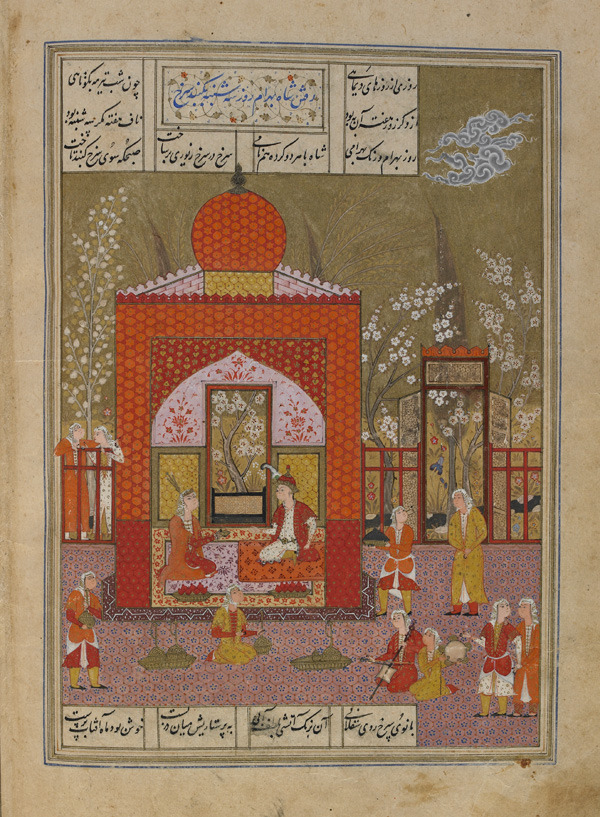
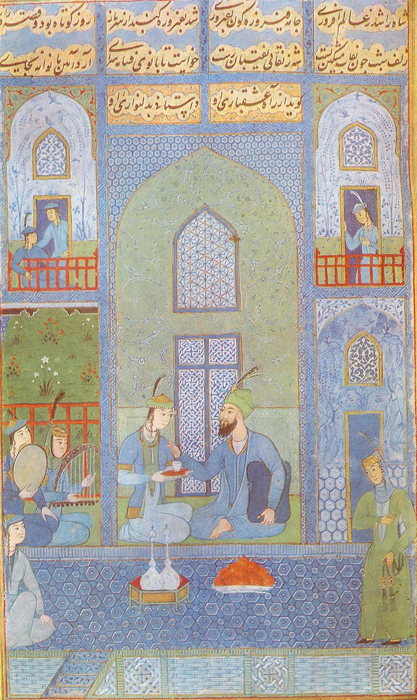
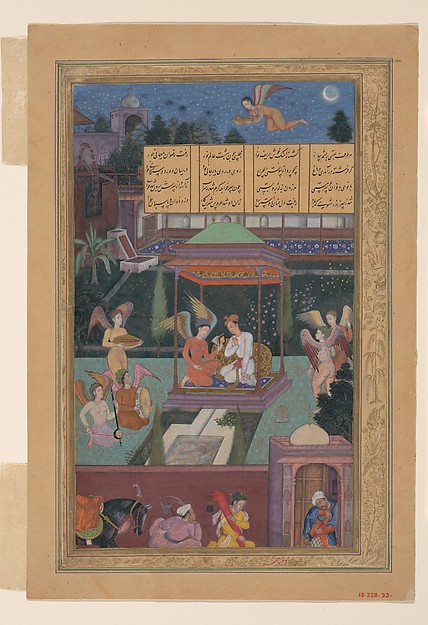
Today we finally meet the last one of the Seven Wise Princesses (after Blue, Ebony, Green, Red, Sandalwood, and White). If I had to choose one favorite out of the seven, this story would be it (although the Red Princess comes in a close second). Looks like the alphabet saved the best one for last.
The inhabitant of the Golden Pavilion of the Sun is a golden-haired princess from Byzantium. She tells Bahram Gur a story of a king who did not trust women. The king, to avoid being cheated and betrayed by the wife, spent his time with slave girls, having a new one brought to the palace every day, but he was not happy at all, because while the girls could provide pleasure, they did not provide companionship. One day a merchant passed through the city, and people instantly started talking about one of his slaves, a legendary beauty from somewhere in the East. Instantly taken with her, the king offered to buy her, but the merchant refused to sell. The king offered an unresistable amount of gold, and the merchant agreed; but after the deal was struck he admitted that the reason why he did not want to sell was that whenever he had sold her before, she was always returned to him. He did not know what was wrong with her, and did not want to cheat the king. The king decided to take his chances.
The slave girl, while she was very polite to the king, refused to let him touch her. He spent days and days wooing her, but she resisted, with a sadness on her face. The king finally took her out on a picnic, and told her a story in order to convince her to talk to him and tell him what was wrong. The story itself is also interesting, it is about King Solomon and the Queen of Sheba, who had a child that could not walk. An angel told King Solomon in his dream that the child will only be cured if he and his wife talk openly about their deepest secrets. Once they both opened up and confessed what they had been hiding, the child was cured. The king explained to the girl that he wanted to understand what was bothering her. She finally admitted that she liked him, but she had long ago resolved never to be with a man, because every woman in her family dies in childbirth. The king, in turn, told her he would marry her despite that, and be content with her as his wife.
(Now here in the original story she still refuses him, after which he gets a bunch of other slave girls to make her jealous, and she gives in in the end. But I don't think that part is either good or fun to tell, and it has no point to the story at this point, so I usually leave it out.)
I like this story because I believe in the importance of talking in a relationship (and all relationships in general). And I like it how the king learns some respect for women in the end. Sounds similar to the frame of the Arabian Nights, which is probably no coincidence either.
Showing posts with label Nizami. Show all posts
Tuesday, April 29, 2014
Saturday, April 26, 2014
W is for the White Princess
The month of April is coming to the end, and so is the line-up of the Seven Wise Princesses of Nizami. But we are not quite done yet! Today's princess lives in the White Pavilion of Venus. She is Persian, from Bahram Gur's homeland, and as such, she is naturally gifted at storytelling.
(I have a thing for Persian stories, can you tell?)
The tale of the day tells us about a young man who owned a marvelous garden where he spent most of his time in serenity. However, one day he decided to leave the garden and go for a walk; and when he returned some time later, he found the garden locked from the inside. Oops. On top of that, he could hear music and laughter from within the garden, which is a dead giveaway that someone is squatting on your property. He took an axe to the fence and got inside... just to be confronted and beaten by a bunch of women until he could get the words out and tell them he was the owner of the place. Oops again. As an apology, the women led him to the wall in his attic and through a crack they showed him the neighbor's property (these women knew their way around the neighborhood) where a bunch of women were swimming in a white marble pool. The man fell in love with one of the beauties, who in turn (when they met) fell in love with him. But wherever they went to consummate their passion, something always botched the mood. In the bedroom the floor collapsed under them, on a tree (hey, desperate measures) the branches broke under them. Finally they got the message: They were not meant for a night of passion, they were meant for marriage. Once the union was blessed, they could... do whatever they wanted to do. Finally.
(I am unreasonably entertained by this story.)
(And now I feel personally insulted that Andrew Lang does not have a White Fairy Book. The post feels unfinished. So there.)
(I have a thing for Persian stories, can you tell?)
The tale of the day tells us about a young man who owned a marvelous garden where he spent most of his time in serenity. However, one day he decided to leave the garden and go for a walk; and when he returned some time later, he found the garden locked from the inside. Oops. On top of that, he could hear music and laughter from within the garden, which is a dead giveaway that someone is squatting on your property. He took an axe to the fence and got inside... just to be confronted and beaten by a bunch of women until he could get the words out and tell them he was the owner of the place. Oops again. As an apology, the women led him to the wall in his attic and through a crack they showed him the neighbor's property (these women knew their way around the neighborhood) where a bunch of women were swimming in a white marble pool. The man fell in love with one of the beauties, who in turn (when they met) fell in love with him. But wherever they went to consummate their passion, something always botched the mood. In the bedroom the floor collapsed under them, on a tree (hey, desperate measures) the branches broke under them. Finally they got the message: They were not meant for a night of passion, they were meant for marriage. Once the union was blessed, they could... do whatever they wanted to do. Finally.
(I am unreasonably entertained by this story.)
(And now I feel personally insulted that Andrew Lang does not have a White Fairy Book. The post feels unfinished. So there.)
Labels:
A to Z,
colors,
love stories,
Nizami,
Persian,
princesses
Tuesday, April 22, 2014
S is for Sandalwood
And here we are once again, meeting one of Nizami's Seven Wise Princesses (for those of you keeping track, we have just visited the Red Pavilion, and the Green, Ebony and Blue ones before her). S stands for Sandalwood. The color of sandalwood can range from dark reddish-brown to neutral beige hues, through a series of different softer shades of brown. In addition, sandalwood is a scented tree, often used in many Eastern cultures, which is probably why the Thursday pavilion is called the Sandalwood Pavilion, rather than just plain Brown.
The Chinese Princess (actually the text calls her "Chinese Turk" and in some translations "Tartar") in the Sandalwood Pavilion tells Bahram Gur the following story:
Once upon a time two men, called Good and Bad, traveled together across a desert. After a while Good ran out of water, and as the day grew hot he begged Bad to give him some from his own. Bad would not take any of the jewels Good offered as payment, claiming that water was life, and life deserved something more important. Finally he got desperate Good to offer his eyes in exchange for water. After giving him a drink, he carved his eyes out, stole the jewels, and left Good in the desert to die.
Fortunately for Good, a Kurdish tribe happened to pass by, and the chief's daughter found him. She put his eyes back and healed his wounds, and the Kurds took him in, slowly nursing him back to health. He married the girl that saved his life, and started a family of his own. One day he came across a sandalwood tree, and gathered some leaves, knowing they could cure many diseases. He kept the medicine a secret until he heard that a king nearby had a daughter on the verge of death; healing the daughter, he received her hand in marriage as a second wife. Healing with sandalwood proved to be a lucrative business: He did not only end up with three wives (two of them princesses he saved and one that saved him), he also became a king in his own right, and ruled over a country for many years. One day Bad showed up to pay the court a visit, not knowing who the king was; when he found out he begged for forgiveness, and Good forgave him for his crime.
The Kurdish father-in-law, however, did not. When Bad left the court, he followed him, and cut off his head.
The story ends with stating that Good, when he became king, wore sandalwood-colored clothes only, and decorated his palace with the soft colors of the sandalwood, to remind himself and everyone of the healing power of the tree, and the adventures he lived through.
If you are keeping count: Two more princesses coming up before the end of the month (White and Yellow). Stay tuned!
The Chinese Princess (actually the text calls her "Chinese Turk" and in some translations "Tartar") in the Sandalwood Pavilion tells Bahram Gur the following story:
Once upon a time two men, called Good and Bad, traveled together across a desert. After a while Good ran out of water, and as the day grew hot he begged Bad to give him some from his own. Bad would not take any of the jewels Good offered as payment, claiming that water was life, and life deserved something more important. Finally he got desperate Good to offer his eyes in exchange for water. After giving him a drink, he carved his eyes out, stole the jewels, and left Good in the desert to die.
Fortunately for Good, a Kurdish tribe happened to pass by, and the chief's daughter found him. She put his eyes back and healed his wounds, and the Kurds took him in, slowly nursing him back to health. He married the girl that saved his life, and started a family of his own. One day he came across a sandalwood tree, and gathered some leaves, knowing they could cure many diseases. He kept the medicine a secret until he heard that a king nearby had a daughter on the verge of death; healing the daughter, he received her hand in marriage as a second wife. Healing with sandalwood proved to be a lucrative business: He did not only end up with three wives (two of them princesses he saved and one that saved him), he also became a king in his own right, and ruled over a country for many years. One day Bad showed up to pay the court a visit, not knowing who the king was; when he found out he begged for forgiveness, and Good forgave him for his crime.
The Kurdish father-in-law, however, did not. When Bad left the court, he followed him, and cut off his head.
The story ends with stating that Good, when he became king, wore sandalwood-colored clothes only, and decorated his palace with the soft colors of the sandalwood, to remind himself and everyone of the healing power of the tree, and the adventures he lived through.
If you are keeping count: Two more princesses coming up before the end of the month (White and Yellow). Stay tuned!
Labels:
A to Z,
colors,
Nizami,
Persian,
princesses
Monday, April 21, 2014
R is for Red, and not just Riding Hood
And once again we are on solid ground. R is for Red, and the many folktales associated with this color.
First up, we have yet another one of the Seven Wise Princesses (if you are keeping track, we have met Blue, Green and Ebony so far). The Red Princess is from Russia (or, rather, the historic Rus), and lives in the Red Pavilion dedicated to Mars. The tale she tells to Bahram Gur is probably my favorite out of the seven. It is about a Russian princess who did not want to get married, but her father pressured into agreeing that she can set whatever task she wants to set, as long as she marries the man who completes it. In turn, the princess built a fortress surrounded by killing machines and traps, and declared that whoever can sneak in an meet her in the inner courtyard, and answer her riddles after that, can marry her. As stories usually go, after a while a hero shows up who is capable of sneaking in, and also capable of solving the riddles. Whatever. I like this story mostly because of the active part the princess plays in shaping the hero's task, and because all the riddles are pretty much constructed in a way that there is only a right answer to them if she accepts is as a right answer. Plus, she does magic. Very cool.
Other tales that include the color red are:
Little Red Riding Hood (I don't think I need to introduce this one)
Snow White and Rose Red (Much more entertaining than Snow White if you ask me, and also masterfully adapted in the Fables comics)
The Red Shoes (A classic Andersen story, gruesome and depressing in true Andersen fashion. A little girl loves her red dancing shoes and doesn't pay attention in church, therefore an angel curses her to dance forever, a sentence she only gets away from by having her feet chopped off, and then she prays until God takes pity on her and lets her die. This, boys and girls, is why I don't tell Andersen.)
The Red Dwarf of Detroit (one of the most entertaining urban legends in the USA)
The Little Rabbit who wanted red wings (a cute Southern folktale that children especially like, about a little rabbit that wishes for bits and pieces of other animals to be more like them)
For more folktale goodness, check out Andrew Lang's classic Red Fairy Book.
First up, we have yet another one of the Seven Wise Princesses (if you are keeping track, we have met Blue, Green and Ebony so far). The Red Princess is from Russia (or, rather, the historic Rus), and lives in the Red Pavilion dedicated to Mars. The tale she tells to Bahram Gur is probably my favorite out of the seven. It is about a Russian princess who did not want to get married, but her father pressured into agreeing that she can set whatever task she wants to set, as long as she marries the man who completes it. In turn, the princess built a fortress surrounded by killing machines and traps, and declared that whoever can sneak in an meet her in the inner courtyard, and answer her riddles after that, can marry her. As stories usually go, after a while a hero shows up who is capable of sneaking in, and also capable of solving the riddles. Whatever. I like this story mostly because of the active part the princess plays in shaping the hero's task, and because all the riddles are pretty much constructed in a way that there is only a right answer to them if she accepts is as a right answer. Plus, she does magic. Very cool.
Other tales that include the color red are:
Little Red Riding Hood (I don't think I need to introduce this one)
Snow White and Rose Red (Much more entertaining than Snow White if you ask me, and also masterfully adapted in the Fables comics)
The Red Shoes (A classic Andersen story, gruesome and depressing in true Andersen fashion. A little girl loves her red dancing shoes and doesn't pay attention in church, therefore an angel curses her to dance forever, a sentence she only gets away from by having her feet chopped off, and then she prays until God takes pity on her and lets her die. This, boys and girls, is why I don't tell Andersen.)
The Red Dwarf of Detroit (one of the most entertaining urban legends in the USA)
The Little Rabbit who wanted red wings (a cute Southern folktale that children especially like, about a little rabbit that wishes for bits and pieces of other animals to be more like them)
For more folktale goodness, check out Andrew Lang's classic Red Fairy Book.
Labels:
A to Z,
colors,
folktales,
German,
Grimm,
Nizami,
Persian,
princesses,
Russia,
urban legend
Tuesday, April 8, 2014
G is for Green, and some mysterious princesses
This post will be short and sweet, since I just tumbled home from a road trip down south to Tennessee. To honor the fact that I have seen green for the FIRST TIME IN FOREVER, G is for Green today.
First off, we have yet another one of the Seven Princesses to visit: The Tartar princess of the Green Pavilion. This princess tells Bahram Gur a story about a scholar whose only joy in life was his daily walk in the park; other than that hour or so, he spent all his time studying and reading, and was too busy even to take a wife and start a family. But one day on his walk a woman passed by him, and as a breeze lifted her veil he caught a glance at her face, and instantly fell in love. He spent weeks searching for the mysterious woman, but never saw her again. In his desperation he decided to take a pilgrimage to Jerusalem.
When it was time for him to leave the holy city, a local scholar persuaded him not to wait for the caravan, but rather set out with him as a guide through the desert. As anyone can suspect, this proved to be a very bad idea. The scholar got completely lost, and after a few days tumbled into a well and died. Our man finally made his way home and went seeking the scholar's house to give the bad news to the family. And guess who opened the door... That's right.
Sometimes even these princess stories have a happy ending.
Another green story is a Hungarian folktale titled Green Peter. I have included it in my book on superpowers under "Heightened Senses" because it tells about a princess who could see through walls and as far as she wished. Green Peter, the tale's male hero, is challenged to hide from this princess in order to win her hand in marriage. Obviously this is no easy task, as anyone could testify who ever attempted to play hide and seek with Superman. Just when Peter starts to get desperate, magical things come to his help... and of course, all is well in the end, just for the single reason that super sight does not help you notice things that are too close to you.
I am sad to say for this theme, the story never actually reveals why he is called Green Peter. If you would like to see a colorful cartoon version of this tale, click here.
For a great (folk?)tale collection of Irish stories, read The Green Hero by Bernard Evslin.
First off, we have yet another one of the Seven Princesses to visit: The Tartar princess of the Green Pavilion. This princess tells Bahram Gur a story about a scholar whose only joy in life was his daily walk in the park; other than that hour or so, he spent all his time studying and reading, and was too busy even to take a wife and start a family. But one day on his walk a woman passed by him, and as a breeze lifted her veil he caught a glance at her face, and instantly fell in love. He spent weeks searching for the mysterious woman, but never saw her again. In his desperation he decided to take a pilgrimage to Jerusalem.
When it was time for him to leave the holy city, a local scholar persuaded him not to wait for the caravan, but rather set out with him as a guide through the desert. As anyone can suspect, this proved to be a very bad idea. The scholar got completely lost, and after a few days tumbled into a well and died. Our man finally made his way home and went seeking the scholar's house to give the bad news to the family. And guess who opened the door... That's right.
Sometimes even these princess stories have a happy ending.
Another green story is a Hungarian folktale titled Green Peter. I have included it in my book on superpowers under "Heightened Senses" because it tells about a princess who could see through walls and as far as she wished. Green Peter, the tale's male hero, is challenged to hide from this princess in order to win her hand in marriage. Obviously this is no easy task, as anyone could testify who ever attempted to play hide and seek with Superman. Just when Peter starts to get desperate, magical things come to his help... and of course, all is well in the end, just for the single reason that super sight does not help you notice things that are too close to you.
I am sad to say for this theme, the story never actually reveals why he is called Green Peter. If you would like to see a colorful cartoon version of this tale, click here.
For a great (folk?)tale collection of Irish stories, read The Green Hero by Bernard Evslin.
Saturday, April 5, 2014
E is for Ebony
Ebony is a kind of wood known for its shining black color. Because we already used B for Blue. Also, ebony sounds better!
And with this letter we return once again to the palace of Bahram Gur, the Persian King with the Seven Wise Princesses. After visiting the Turquoise Pavilion in B for Blue, we no visit the Black Pavilion of the Ebony Princess.
The Ebony Princess is from India. She tells a tale about a king who comes across a town during his travels, a town where everyone is dressed all in black, but no one is willing to tell him why. Finally, after spending a year there and gaining the trust of a butcher, he is show in secret to the ruins outside the city, from where he is transported to the realm of the fairies. There he falls in love (or, rather, desire) for the fairy queen, but is refused; when he finally tries to force himself on her, he gets kicked out, returns to the city, and dresses all in black in mourning for his stupidity (poetically called "unrequited love").
A less rape-y and more delightful tale, one of my favorites, is that of the Ebony Horse from the Arabian Nights. It is about a Persian magician that invents a mechanical flying horse, just to have it stolen by the king's son, who goes on all kinds of adventures before he learns how to steer the creature. I also included this tale under Technomancy in my book, Tales of Superhuman Powers (a collection of folktales with superpowers in them). A lot of fun to tell.
(Incidentally, the Ebony Horse is also a Magic: The Gathering card, from the time they did an Arabian Nights run)
And with this letter we return once again to the palace of Bahram Gur, the Persian King with the Seven Wise Princesses. After visiting the Turquoise Pavilion in B for Blue, we no visit the Black Pavilion of the Ebony Princess.
The Ebony Princess is from India. She tells a tale about a king who comes across a town during his travels, a town where everyone is dressed all in black, but no one is willing to tell him why. Finally, after spending a year there and gaining the trust of a butcher, he is show in secret to the ruins outside the city, from where he is transported to the realm of the fairies. There he falls in love (or, rather, desire) for the fairy queen, but is refused; when he finally tries to force himself on her, he gets kicked out, returns to the city, and dresses all in black in mourning for his stupidity (poetically called "unrequited love").
A less rape-y and more delightful tale, one of my favorites, is that of the Ebony Horse from the Arabian Nights. It is about a Persian magician that invents a mechanical flying horse, just to have it stolen by the king's son, who goes on all kinds of adventures before he learns how to steer the creature. I also included this tale under Technomancy in my book, Tales of Superhuman Powers (a collection of folktales with superpowers in them). A lot of fun to tell.
(Incidentally, the Ebony Horse is also a Magic: The Gathering card, from the time they did an Arabian Nights run)
Labels:
1001 Nights,
A to Z,
colors,
Nizami,
Persian,
popular culture,
princesses,
superpowers
Wednesday, April 2, 2014
B is for Blue Princesses, Blue Oxen, Blue Coats, Blue Belts, Blue Roses...
Two by two, tales are blue.
When I revealed my theme for this year, a surprising number of people indicated in the comments that they have a special place in their heart for the color blue in its many shades. I can't really argue with that. I love blue as well. And guess who else loves blue?
Stories!
Instead of telling one selected story today, I will just make a squirrel pile of all the blue tales I can think of. Everyone is happy. Here we go.
The Blue Princess
Today is also the first stop on our journey into the tale that gave the theme to my challenge: Nizami's enchanting Persian epic poem, Haft Paykar (known in English as The Seven Wise Princesses). Barham Gur, the King of Persia, is courting seven princesses who live in the seven pavilions he built for them, each in a different color. He visits one princess every day of the weak, and each princess in turn tells him a story related to the color they chose for their pavilion. I will get to all of them in time by the end of April.
The resident of the Blue Pavilion (sometimes called the Turquoise Pavilion) is Piruza, a princess from... well. Some sources say Morocco, some sources say Maghreb, some sources say Khwarezm. She has blue eyes, and her pavilion is dedicated to Mercury. She tells a tale to the king about a young man who was lazy and a drunkard, until one night he was lured on a mysterious journey to an enchanted garden that turned out to be the lair of demons. After miraculously escaping for this predicament, he vowed to wear only blue, the symbol of clarity and salvation from evil.
Babe the Blue Ox
I adore Babe the Blue Ox. I realize that Paul Bunyan stories are generally considered "fakelore," but they are still tons of fun to tell. Especially to audiences outside the US who have never heard them before.
I love asking my audiences (American and non-American) if they know what made Babe blue. Do you?
(Also, the Jack of Fables comic book series did wonders with Babe's character.
The Blue Rose
A Chinese folktale that says a lot about the nature of Love. A princess vows to only marry a man who can bring her a blue rose. I love this story because it is a creative take on how fairy tale quests can be manipulated by a clever princess who wants to pick her own husband...
The Blue Light
A classic Grimm fairy tale. I remember loving it when I was little, especially because of the dogs with eyes of various sizes guarding the treasure underground. Lovely tale to tell.
Bluebeard
He does not need an introduction. Although, sadly, we never find out why the beard is blue...
The Blue Belt
Norwegian folktale. Giants. Need I say more.
The Blue Coat
A Jewish folktale that storytellers adore. Nothing is ever completely useless.
The Blue Lily
A very creepy Hungarian folktale where a girl accidentally flirts with the devil. Oops. Once she finds out who the handsome stranger at the ball really is, she tries to get away, but it is too late. The devil keeps showing up at her house until she dies from the curse. A blue lily flower grows on her grave; the lily is picked by a prince, whose love will eventually transform the girl back into her original form. This folktale also exists in Russia.
The Blue Jackal
A folktale from India, included in the Panchatantra. A jackal falls into a pit full of indigo dye, and then passes himself off as a divine being. A very entertaining story to tell.
Okay, that's enough blue for one dye. I mean, day.
When I revealed my theme for this year, a surprising number of people indicated in the comments that they have a special place in their heart for the color blue in its many shades. I can't really argue with that. I love blue as well. And guess who else loves blue?
Stories!
Instead of telling one selected story today, I will just make a squirrel pile of all the blue tales I can think of. Everyone is happy. Here we go.
The Blue Princess
Today is also the first stop on our journey into the tale that gave the theme to my challenge: Nizami's enchanting Persian epic poem, Haft Paykar (known in English as The Seven Wise Princesses). Barham Gur, the King of Persia, is courting seven princesses who live in the seven pavilions he built for them, each in a different color. He visits one princess every day of the weak, and each princess in turn tells him a story related to the color they chose for their pavilion. I will get to all of them in time by the end of April.
The resident of the Blue Pavilion (sometimes called the Turquoise Pavilion) is Piruza, a princess from... well. Some sources say Morocco, some sources say Maghreb, some sources say Khwarezm. She has blue eyes, and her pavilion is dedicated to Mercury. She tells a tale to the king about a young man who was lazy and a drunkard, until one night he was lured on a mysterious journey to an enchanted garden that turned out to be the lair of demons. After miraculously escaping for this predicament, he vowed to wear only blue, the symbol of clarity and salvation from evil.
I adore Babe the Blue Ox. I realize that Paul Bunyan stories are generally considered "fakelore," but they are still tons of fun to tell. Especially to audiences outside the US who have never heard them before.
I love asking my audiences (American and non-American) if they know what made Babe blue. Do you?
(Also, the Jack of Fables comic book series did wonders with Babe's character.
The Blue Rose
A Chinese folktale that says a lot about the nature of Love. A princess vows to only marry a man who can bring her a blue rose. I love this story because it is a creative take on how fairy tale quests can be manipulated by a clever princess who wants to pick her own husband...
The Blue Light
A classic Grimm fairy tale. I remember loving it when I was little, especially because of the dogs with eyes of various sizes guarding the treasure underground. Lovely tale to tell.
Bluebeard
He does not need an introduction. Although, sadly, we never find out why the beard is blue...
The Blue Belt
Norwegian folktale. Giants. Need I say more.
The Blue Coat
A Jewish folktale that storytellers adore. Nothing is ever completely useless.
The Blue Lily
A very creepy Hungarian folktale where a girl accidentally flirts with the devil. Oops. Once she finds out who the handsome stranger at the ball really is, she tries to get away, but it is too late. The devil keeps showing up at her house until she dies from the curse. A blue lily flower grows on her grave; the lily is picked by a prince, whose love will eventually transform the girl back into her original form. This folktale also exists in Russia.
The Blue Jackal
A folktale from India, included in the Panchatantra. A jackal falls into a pit full of indigo dye, and then passes himself off as a divine being. A very entertaining story to tell.
Okay, that's enough blue for one dye. I mean, day.
Subscribe to:
Posts (Atom)