Showing posts with label Central America. Show all posts

Saturday, December 7, 2019

StorySpotting: Skin and bones (Terminator: Dark Fate)

StorySpotting is a weekly or kinda-weekly series about folktales, tropes, references, and story motifs that pop up in popular media, from TV shows to video games. Topics are random, depending on what I have watched/played/read recently. Also, THERE WILL BE SPOILERS. Be warned!


I really wanted to do a Terminator post about strong women and female warriors and whatnot, but then this random tidbit was so funny that the post just wrote itself. Sorry.

Where was the story spotted?

Terminator: Dark Fate (2019)

What happens?

In this movie we see a new type of terminator, the REV-9, which is designed as an infiltrator. As Wikipedia so eloquently put it: the REV-9's "primary feature is the ability to split its mimetic polyalloy exterior and endoskeleton into two separate units." Basically, its skin separates from its (carbon-based) bones, and goes walking around separately, taking on other people's form.

What's the story?

The first one that came to mind was a folktale from Palau, titled Budel and Iuesel. They were brothers, the children of the same woman; Budel was just an empty skin, and Iuesel was a skeleton. Iuesel went fishing every day, but one time Budel wanted to go too. The skeleton carried his skin-brother down to the seashore, where he could sit on a rock and spear fish. However, suddenly they saw an enemy war canoe coming in. They had to run back to their village, but as Iuesel ran, Budel kept flapping behind him like a cape. Eventually, to make things easier, the skeleton slipped his brother on himself like a sweater - and skeletons have been wearing skin ever since.
(Find the story here.)
Taking off your skin and putting it back on is a surprisingly common thing in folktales. In a folktale from Liberia, titled Tola and the Sea Monster, a girl declares that she will only ever marry a man with perfect skin. A sea monster, hearing this, borrows the smooth, perfect skin of a sea goddess, puts it on, and seduces the girl, carrying her away into the underwater realms. (She is eventually rescued by her brother). There are also many stories in the Central American and Caribbean region about people (especially women) who take their skin off, and go flying around at night. In many cases someone (often the husband) eventually finds out, and rubs the empty skin's inside with salt and/or chili peppers, so when the person comes back, they can't put the skin on anymore. There are many variants of this story in Elsie Clews Parson's collections, and I also found some from Nicaragua and Belize.

Conclusion
Don't try this at home, kids.

Thursday, April 25, 2019

V is for Vanilla Love (A to Z Challenge 2019: Fruit Folktales)

Vanilla is indigenous to Central America, more specifically, to the areas of Mexico originally inhabited by the Totonac people. Until modern times, they were the main producers of vanilla (more information in Spanish here).


I found two distinct Totonac legends about the origins of vanilla.

Xanath and Tzarahuin

Legend says there was once a princess named Xanath (Hidden Flower), who fell in love with a musician named Tzarahuin. However, the Fat God of Happiness also loved her, and demanded her hand in marriage from her father. The father, of course, favored the deity over a mere artist, but Xanath refused to consent. As punishment, she was transformed into a sweet-smelling white flower.
When Tzarahuin found out what happened to his beloved, he took his own life under the flowering plant. He turned into a gentle, stingless melipona bee (xunan kab). The bee still appears every year to pollinate the flowers, and help them produce the sweet-tasting fruit known as xanath - vanilla. Flower and bee go together so perfectly that for the longest time vanilla didn't even grow anywhere where the bees could not be found.

Take this one with a grain of salt - it has been making the rounds on the Internet, but I could not locate a primary source.

(Read about the story here, here, or here.)

Tzacopontziza and Zkatán-Oxga

In another legend, Tzakopontziza (Morning Star), the daughter of King Teniztli III, was consecrated to serve the goddess of the fertility of crops, Tonacayohua. As time passed, the young woman fell in love with a prince named Zkatán-Oxga (Young Deer). However, it was forbidden for her to take a lover, a sacrilege punishable by death; only virgins could serve the goddess. The young lovers ran away together into the forest, but didn't get far before they were confronted by a monster that surrounded them with flames, and ordered them to return home. Upon their return, the princess and the prince were executed by angry priests, their hearts cut out in the temple, and their bodies thrown into a canyon.

Some time later, out of the resting place of the two lovers grew a tree, and from the tree grew an orchid. The orchid had beautiful lowers and sweet-smelling fruit - the fruit we know as vanilla today. In Totonac tradition, it was sacred to the gods.

(Read about the story here and here.)

Both love stories end in tragedy and transformation. Which one speaks to you more? I personally really like the image of the flower and the stingless bee...

Monday, October 9, 2017

Guardians of Nature (Following folktales around the world 46. - Belize)

Today I continue the blog series titled Following folktales around the world! If you would like to know what the series is all about, you can find the introduction post here. You can find all posts under the Following Folktales label, or you can follow the series on Facebook!


If Di Pin Neva Ben
Folktales and legends of Belize
Timothy Hagerty & Mary Gomez Parham
Cubola Productions, 2000.

The stories in this book have been collected in the 1970s, mostly by the two editors, in Spanish and Creole, and then translated to English. The volume has two parts: legends and folktales, grouped into smaller sections by topic. They mention in the Introduction that they considered grouping them by culture, but too many motifs reach across cultural groups to make that distinction. In the ten folktales included in the second part they left the dialogues in Creole, to show the flavor of the original language; once again, I had to read aloud to understand what was being said... Every story came with a source, as well as the place of collection, and the age of the storyteller.

Highlights


There are many legends in the book about guardians of nature, beings responsible for keeping people from torturing animals, or killing more than what they need. One of them was Tata Balam, the "owner" of nature; Burucat, his helper (a donkey with a man's face) watched out for animals specifically. Warri Massa was responsible for wild pigs (and whipped a hunter for shooting all over the place). Nohochtat, the Lord of the Forest, chastised a hunter for wounding animals without killing them - but was also willing to show him a grow of valuable gum trees. Coconut groves also had their guardian, but the most important of all was Tata Duende, the guardian of the forest, who watched over all of nature (and sometimes kidnapped children).
Another, chilling and beautiful legend was that of the Day of the Dead (Los Finados), when people lay a table full of food for the returning souls of their deceased relatives (and a separate place for the forgotten souls). In this story, a sick little girl saw the ghost-women come to the feast, even though no one else could see them.
Out of all the folktales, one of the best was that of the Bird of Seven Colors, a Belizean variant of Cinderfella (yes, there is a male Cinderella tale type). In this story, a a farmer's peanut-field was being eaten up by a magic bird, until the youngest son managed to catch it - and then the bird talked him into letting it go, and they stuffed a parrot with peanuts instead, to trick the father. The bird helped the boy through various adventures - including a test where people riding a horse at full speed had to slip a ring onto a princess' finger (but she only held the finger straight for the one suitor she liked).
There was also an amusing pourquoi tale about Why mosquitoes buzz in people's ears (there are various story-answers for this question around the world). In this story, Mosquito lent money to his friend, Wax, but Wax never paid it back; it hid in people's ears instead, and Mosquito has been demanding his money ever since... Ew.

Connections

Belize also has beliefs of female demons haunting the riversides. Here they are known as Xtabay, and they don't only punish men, they also have a protective role: One of them scared a little boy away from shooting randomly at birds. There were also witches that could take off their skin and fly around at night (here called Heg).
The Sisimite monster that kidnapped people reminded me of the Sisimiquí story from Costa Rica; and so did the story of Rabbit and the Giant, which was a local variant of the same Costa Rican tale. There were also several Anansi stories among the folktales; I suspect that we have seen the last of Anansi until we cross over into Africa...

Bonus: If you'd like to know more about the Beliezan oral tradition, and how it can be used in education, I highly recommend storyteller Kristin Pedemonti's book on the subject!

Where to next?
With Mexico, we officially arrive to North America!

Monday, October 2, 2017

Trickster Jesus and corn spirits (Following folktales around the world 45. - Guatemala)

Today I continue the blog series titled Following folktales around the world! If you would like to know what the series is all about, you can find the introduction post here. You can find all posts under the Following Folktales label, or you can follow the series on Facebook!


According to our ancestors
Folk texts from Guatemala and Honduras
Mary Shaw
Summer Institute of Linguistics, University of Oklahoma, 1971.

This volume contains stories from Mayan storytellers (and lorekeepers), mixed in with a few Carib and Jicaque texts. All were collected by linguists working with various groups in Guatemala (crossing over to Honduras and Belize). The book contains a total of 103 stories in the original language and English translation, as well as a long and detailed introduction, and copious footnotes and references. Stories (of which most are folktales, with the occasional myth, historical legend, and folk belief) are grouped by language, divided by illustrations. It is a detailed and informative collection, with a lot of good stories.

Highlights


I was struck by the legend of the Food of the Holy Earth. It told that when people first began to cultivate the land, the earth cried out and complained, and trees and plants that were cut down screamed in pain. They went to God to complain about the people torturing them, and God made them a deal: They would feed His children, but in exchange the earth can eat them when they are dead. The teller claimed that diseases and disasters happen because people put their dead in coffins and mausoleums, instead of giving them back to the earth as agreed.
I also found  the story of the Man and the Buzzard interesting; in it, a lazy farmer switched places (bodies) with a buzzard, because he thought it would be easier to be a bird. He was wrong.
The true highlights of the volume, however, were the local Biblical legends. In one, Jesus Christ's name got tagged onto a local trickster; the story told about how he repeatedly outwitted the Jews that persecuted him (once by throwing chili into their eyes and running away). In the origin story of the copal, two men visited Jesus' pregnant sister (!) and brought incense; the smoke colored the face of one of them black (a picture of the Three Wise Men?). Also Biblical was the legend of Adam (sic) and the Flood, in which not only rain fell from the sky, but also resin, and it trapped hiding people underground - a story explaining urn burials unearthed by people in the mountains. The origin of domesticated animals was explained with Jesus planting the bones of animals his brothers (!) had eaten, and reviving them after three days. Some escaped the farm, however, and those became the wild animals....

Connections

Obviously, there was a race between animals (Frog and Deer this time), and multiple Magic Flights (with objects thrown over the shoulder, and a princess born from a grapefruit). There were also common tale types such as Open, sesame!, and the Contest between magicians.
Quetzal, Guatemala's
national symbol
Last week in Salvador there was a myth about God hiding the corn from people, and the leafcutter ants finding it; that story was included in this volume too. The Guatemalan version also noted that since corn is the most important food source, and it has a soul, hiding it meant all other food ceased to exist as well. Similar to Honduras, Guatemala had its vengeful female demons too - a girl that made men disappear if they treated their wives badly, and a woman with horse legs and horse eyes who lured men into the river if they beat their wives. I was reminded of North American myths by The serpent and the angels of lightning, in which angels shot (with guns) at a snake that caused rivers to overflow (in the North, they are Thunderbirds). In the legend, a mortal hunter joined them too, to take part in defending the world.
Illustration from the book
I was reminded of Loki by the legend where the three goddesses of corn chained the giant Sipac under a mountain. He had been moving mountains around, and selling land to the whites, so they tricked him into captivity - whenever he tugs on his chains, he causes earthquakes. And talking about earth: After Thailand, I once again encountered a mythical person who could swim in the soil as if it was water. This time, it was Yew Achi, the evil, cannibal king of the Quiche.
Among the tricksters, Pedro Urdemalas made an appearance (here called Pedro Tecomate, Pedro Gourd), as well as Rabbit, who once again fell for the usual tar baby trick (but eventually pawned it off on Coyote). Rabbit was the protagonist of various trickster classics such as "Trickster seeks endowments", and "Trickster rides his enemy like a horse." The suffering party was usually Cougar, Tiger, or Lion.

Where to next?
Belize!

Monday, September 25, 2017

Ants digging up folktales (Following folktales around the world 44. - El Salvador)

Today I continue the blog series titled Following folktales around the world! If you would like to know what the series is all about, you can find the introduction post here. You can find all posts under the Following Folktales label, or you can follow the series on Facebook!


Leyendas, cuentos y adivinanzas de El Salvador
Victoria Díaz de Marroquín
BANCASA, 1995.

The volume contains five legends and six folktales, along with several riddles and rhymes. Most stories have been re-told by the author, but she makes sure to note the original tellers and sources as well. It was a short, but entertaining read, with most legends taken from indigenous traditions, and most folktales showing motifs from European and African sources alike.

 Highlights


I immediately liked the opening story of the volume, in which the gods decided to hide corn from the people who were not respectful to them anymore. Luckily, the zompopo ants (giant winged leaf-cutter ants) dug up the corn, for which the gods tried to punish them by trying them to a tree. The insects broke free, but during the struggle their ties cinched their waists tiny. I liked how the introduction to the book compared the ants digging up life-giving corn to storytellers digging up stories.
I also found the tale of two best friends of supernatural descent, Ifraín and Mausimolú, very exciting. They set out together to find a princess, but then had to go through all kinds of adventures, shipwrecks, and strange islands, to finally find her.

Connections

The legend of the Siguanaba had much in common both with La Llorona, and La Sucia from Honduras. She was a careless mother who left her child alone to admire herself in the water; Tlaloc, god of the waters, cursed her into a demon that haunts riversides and seduces careless men.
The story of Money and Luck was another common one - this time with the twist that the two powers competing by making or breaking a man's life were actually husband and wife. There was, of course, a variant of the Singing Bones, called Flor de Olivar - except this time the youngest prince was not actually killed by his brothers - rather, beaten senseless, and he learned about his own past from the song of the magic bush.
The local trickster is Tío Conejo, Rabbit, who managed to trick Coyote with the age-old tar baby move while stealing some watermelons.

Where to next?
Guatemala!

Monday, September 18, 2017

Horror from Honduras (Following folktales around the world 43. - Honduras)

Today I continue the blog series titled Following folktales around the world! If you would like to know what the series is all about, you can find the introduction post here. You can find all posts under the Following Folktales label, or you can follow the series on Facebook!


Cuentos y Leyendas de Honduras
Jorge Montenegro
Litografía López, 1976.

One hundred and fifty ghost stories, urban legends, folk beliefs, and other tales from Honduras, representing some of the most popular spooky tropes around the world - from tormented souls to vanishing hitchhikers, from witchcraft to demonic possession. It is real, living-breathing 20th century folklore, peppered with motifs from more ancient traditions.
This extremely popular collection was gathered by author and journalist Jorge Montenegro, who has been sharing them in a radio program since 1964, and published the first volume in 1972. The book now has a 50th anniversary edition. Most of the stories can be found all over the Internet (including the La Prensa newspaper's archive here); since I don't have access to ILL anymore, I read them online.
And the cherry on top: Some of these stories were turned into a horror movie in 2014!

Highlights


Ocote, or Montezuma pine
My favorite story in the book (and one of the few non-spooky ones) was that of the Ocote Tree, in which a young boy learned from his grandma that people should talk to trees, and invited a giant pine to their house for Christmas.
My little feminist heart also loved the Old Man in Love, who was not in love at all, but rather a notorious cat-caller, at least until a pretty young girl seemed to give in to his propositions, and asked him to meet by the river at night. Of course she was not a girl at all, but rather the La Sucia female demon, there to teach the old lech a lesson about "compliments"... A similar lesson was taught to the Mocking Girl, who liked to scare people at night, hiding behind a window and pretending to be a ghost or the devil. One day, she accidentally scared someone to death, so the real Devil showed up, and turned her into an old woman as punishment. And while we are on the topic of morals: the legend of the Grumpy Gravedigger (heh) told the story of how a mean old man was taught a lesson about the spirit of Christmas by being scared half to death by the souls of the dead (Christmas Carol much?).
The story of The Worms was an interesting reverse take on Bluebeard or Mr. Fox: This time, the young wife found hidden treasure in the basement of her husband, and decided to kill him for it... but when she succeeded, the Devil turned all the money into worms in front of her. Similarly, there was an interesting variant of the Vanishing Hitchhiker (the Moramulca cliffs) where someone rescued a girl from a car wreck, only to find out later that the wreck had happened ten years earlier...
Tegucigalpa, site of most stories
Some stories were dark, but also meaningful. In the tale of the Cruel father, a young man was abused physically and verbally. When he fell in love, the father killed his girlfriend to keep her from taking the boy away. Of course her ghost returned - she beheaded the father, and took her lover with her. Similarly, in the story of the Girl from Catacamas, a child was beaten regularly by both parents, until she subconsciously cursed their home, and turned it into a place full of terrifying occurrences.
Some ghosts, however, were nicer than others. For example, there was the Nurse that kept visiting and treating patients in the hospital where she worked, long after her death; and also the Girl with the flowers, who befriended a lonely woman who visited the cemetery every day.

Connections


There are few "real folktales" (magic tales) in the book, but several stories contained recognizable motifs from older traditions - for example, that of the Serpent Bride, where a young pianist fell in love with a woman, just to see her turn into a serpent on their wedding night (reminiscent of Melusine, and other serpent bride tales). There were several versions of classic urban legends and ghost stories, such as The Ring (where grave robbers try to cut off a dead woman's ring with her finger, just to find out she was not actually dead); grateful ghosts pointing out the place of buried treasure; Vanishing Hitchhikers (several of them); and even a ghost bus, this time filled with nuns for some reason...
I have already encountered stories about loyal dogs that protected their owners even after death; Angelina's Dog was one of them, attacking and mangling men who had killed it to get close to the defenseless girl.

Where to next?
El Salvador!

Monday, September 11, 2017

The Amazons of Corn Island (Following folktales around the world 42. - Nicaragua)

Today I continue the blog series titled Following folktales around the world! If you would like to know what the series is all about, you can find the introduction post here. You can find all posts under the Following Folktales label, or you can follow the series on Facebook!


Cuentos, leyendas y mitos de Nicaragua
Pedro Alfonso Morales
Ediciones Distribuidora Cultural, 2014.

This volume contains a total of 24 stories: 12 folktales, 11 legends, and 1 myth. Nine out of the folktales have been collected by students from their families; three are re-tellings by various authors and researchers. Similarly, the legends are longer or shorter depending on the version. The volume itself is visually eclectic: It was printed on color paper, so the stories are told in pastel blues, yellows, greens, and pinks, and complete with illustrations that range from simplistic to annoyingly childish. The book comes with an introduction about Nicaraguan oral tradition, as well as a study guide for students; all in all, it is more an educational project than a folklore publication. With that said, I am still a fan of having children collect stories from their own family traditions - and in this case they came up with some really great ones.

Highlights


The most memorable story in the book is, without a doubt, the legend of The Women of Corn Island. It is a classic Amazon tale, in which the island is ruled by a women-only society; they hunt, fight, work the land, and only allow men to visit once a month, in order to make babies (amazing detail: Women know they are pregnant because at the moment of conception a glowing butterfly emerges from their belly button).
Women and men marching for
indigenous rights, source here
Male babies are sent to their fathers, while the girls are raised by the women, and their roles are determined by moles that are found on their body (on the back for farmers, on the thigh for hunters, and on the belly for potential mothers).
Legend says that when the white colonizers arrived, the women, rather than being killed or taken as slaves, all walked into the ocean, and turned into sea foam, leaving their island abandoned.
I also had a soft spot for the story of a girl who loved swimming in the ocean so much that she even did so on Holy Week, despite her mother's warnings. In the water, she turned into a mermaid, and swam away, singing. I am not sure it was a punishment for her.
On a darker note, there was the bone-chilling tale of María Angustia, a young wife who refused to cook, and kept pestering her neighbor for food and for feeding her husband. In the end, the neighbor lady told her that she should bring some intestines from the cemetery to supplement pork in the dinner - which María did, except the deceased owner of said intestines began haunting her, and dragged her away in the dark of the night.

Connections

Similar to most other South- and Central American countries, there was a legend about the La Llorona; and similar to many Caribbean islands, there was also a legend about a woman that peeled her skin off to shapeshift. In this case, she turned into a coyote every day, until her husband sprinkled salt inside her discarded human skin, and she could not put it back on.
I also encountered familiar tale types such as Cricket the Fortune-teller, the Loquacious Princess, and the Extraordinary Helpers (with a flying steamboat!). And of course there was another Devil husband with golden teeth, who in the end got lured into a bottle by his mother-in-law, the way djinn are usually tricked... Ever since then, when the Devil shows up in the shape of a whirlwind, people just have to yell that his mother-in-law is coming with a bottle.
Picture from here
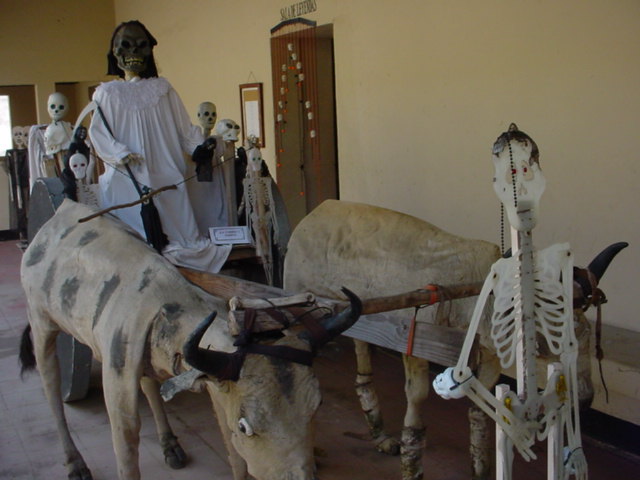
Another classic legend also made an appearance: That of the Procession (or in this case, Cart) of the Dead, which appeared in three or four stories in the book. It is a ghostly procession of skeletons, penitent souls, and other dead things. In one story, a man who lived a sinful life made fun of the procession, saying it was a hoax - but then it came for him, and he had to follow them, carrying a candle made of a human bone, for all eternity.

Where to next?
Honduras!

Monday, September 4, 2017

The knight in shining armor is a bunny on an armadillo (Following folktales around the world 41. - Costa Rica)

Today I continue the blog series titled Following folktales around the world! If you would like to know what the series is all about, you can find the introduction post here. You can find all posts under the Following Folktales label, or you can follow the series on Facebook!

I have been looking forward to Costa Rica; one of my all-time favorite story collections is from this country! 


Las semillas de nuestro rey
Leyendas de los aborigenes de Costa Rica
Carlos Luis Sáenz
Las Americas, 1958.

This tiny volume collects 27 tales from the indigenous traditions of Costa Rica. The author grouped them by culture, so we can find separate chapters representing the stories of the Bribri, Brunka, Chorotega, Guatuso, and Miskito peoples. Some of the stories come with footnotes and glossaries attached, while others are prefaced with quotes from anthropologists, travelers, or folklorists. The book is a short read, but a fascinating one - especially because it manages to show a glimpse of the cultural diversity of the country's indigenous peoples.

 Highlights


Illustration from here
My favorite story from the collection is that of Nandayure and his magic wand. The power of the wand is that it can make anything that contains lime evaporate - shells, limestone, and people's bones (accidentally). I have  never heard of another magic item quite like it. Another story close to my heart is the Sisimiqui, which is a part of my repertoire and one of my top favorite folktales. In it, a brave rabbit riding an armadillo fights and defeats a terrifying monster via a game of whack-a-mole.
There were various stories about heroes being kidnapped by giant eagles. My favorite was the Brave in the seven baskets, in which a warrior hid himself inside seven baskets, and the man-eating eagles carried him up to their nest. He managed to kill one eagle and the chicks, and then climbed down the mountain - but his rope ran out halfway, and his people had to help him down the rest of the way. Interestingly, the morning after the victory feast the hero disappeared; it is possible that he was taken by the other eagle, but the story ended at this point abruptly.

Connections


Golden pigs, from pre-colombian
Costa Rica
I have already encountered legends from other cultures in South America in which a hunter followed a wounded animal and ended up in its kingdom, where he was forced to heal the wounds he had caused. In this case, a clumsy archer was kept by the King of Pigs. The King was not opposed to hunters - he just demanded that his subjects should be killed with one shot, without suffering.
I was reminded of a Dominican tale by the legend of the Boy with hands of fire, in which all the hunters of a village turned into snakes after eating the meat of a giant snake. A boy tried to save them, and then tried to help their loved ones save them, but people only listened to his advice after he sacrificed himself...
After Southeast Asia, I once again encountered Tiger People (who are not actually tigers, rather jaguars or maybe pumas, but they are called tigers). They appear as humans, but turn back into their feline form at night and eat people, or sometimes marry mortal girls and eat them on the wedding night.
There was also a legend about the birth of the first hummingbird; it was about two young people from warring tribes, but instead of a Romeo and Juliet tale, the man tried to abduct the girl, who was shot dead by a stray arrow in the fight, and turned into a bird.

Where to next? 
Nicaragua!

Monday, August 28, 2017

Zombies in a matchbox (Following folktales around the world 40. - Panama)

Today I continue the blog series titled Following folktales around the world! If you would like to know what the series is all about, you can find the introduction post here. You can find all posts under the Following Folktales label, or you can follow the series on Facebook!


Leyendas chiricanas
César Samudio
Imprenta Universitaria, 1994.

This book is a collection of stories from one province of Panama, called Chiriquí. Unlike most of the previous books in the series, this one does is less a volume of folktales, and more a display of various urban legends and folk beliefs, often with names, dates, and places proving that people telling them believed firmly that they really happened. Usual creatures of belief, such as ghosts, witches, fairies, gnomes, and the Devil make appearances, as well as curses and hauntings. Not much information is provided for the stories other than a short introduction, and the illustrations are quite disturbing - and yet, the book was definitely an intriguing read.

Highlights


Picture from here
I enjoyed the tale of Orik and the Washer Girl, in which a poor girl who went to  the river to do laundry made friends with a fairy/gnome creature named Orik. Orik gave her a gold coin every day, which she used to help her family, but eventually her relatives became worried that the mysterious benefactor would take their child, and used some tricks suggested by an old aunt to chase Orik away.
There were also some classically creepy, horror-like stories, such as the Ghost Bus, which appeared and disappeared on the roads at night, sideswiping other buses (I heard about a ghost street car in New Orelans) - and also Zombies in a matchbox, a series of tales about people who owned a matchbox with seven small zombie creatures in it that fulfilled their every command (including hijacking and airplane), and fed on the blood and tongues of live cows.

Connections

I once again met the Crying Woman here in Panama; she is known as the Tulivieja. According to the legend, she was a young woman fond of dancing and parties, and she left her crying newborn at the side of a water gorge so that she could sneak out to a dance. Her horse stumbled, she fell, died, and turned into the Tulivieja, who goes around every night along waterways, looking for her child. Another classic legend also made an appearance: The tale of The man who danced with Death told of a guy who danced with a beautiful young woman at a party and then walked her home, only to find out the very next day that she had been dead for years - a car-less variation of the infamous Vanishing Hitchhiker. (Anyone reminded of the pilot episode of Supernatural yet?)
The Man with Golden Teeth (aka. the Devil) also made an appearance. This time, he pretended to be a well digger, and made a bet with a widow that if he could dig a well in one night, she would marry him. Noting that he was the Devil, she put her rooster in front of a mirror, and the rooster became so agitated that it crowed well before dawn, breaking the Devil's deadline.


Where to next?
Costa Rica!