Showing posts with label Malaysia. Show all posts

Wednesday, April 2, 2025

B is for Bidasari (Women's Epics A to Z)

This year my theme for the A to Z Blogging Challenge is Women's Epics. My goal was to read 26 traditional epics from around the world that have women as their heroes. Because epics like this do exist, and they are fascinating! Read the intoduction post here.

Bidasari: Jewel of Malay Muslim culture

Malaysia

The story of Bidasari is one of the most popular epics in Malaysia (it was even turned into a movie in 1965). It is a "romantic syair", almost always written and performed in verse, although it has existed in the oral tradition for long enough to also have prose versions (in the 19th century syair was so popular a storytelling form that even prose stories were retold in verse). These long poems were written down in the early 19th century. Their form is traditionally recognizable, written in specific metre, rhyme, and style - the introduction to the book goes into detail on these.
The book I read presents a Malay-English mirror translation side by side. Translation is also explained in detail in the introduction, since syair texts were created to be performed with music, instead of read in silence. The translation is based on one version of the epic, but occasionally includes stanzas from other versions where the original narrative or wording was fractured or unclear. The English text is translated in prose, focusing on story rather than wording, but the pantun parts - songs embedded in the story to express emotional high points - are translated closer to the original wording. Pantun in performance gave an opportunity to inject more humor and folk art into the story through a minor character (such as a court lady). The book also includes a long study on the different versions of Bidasari, and the forms of oral performance that gave it birth. The translator specifically chose a manuscript that included pantun parts, as well as the side quest of Raja Putra and a more detailed history of the wicked queen.

What is it about?

TL;DR: Basically a Snow White type story, except a lot more elaborate. Young, beautiful maiden is persecuted by jealous queen, falls into a death-like sleep, but the king eventually takes her as a second wife and exiles his wicked first queen.

CW: References of abuse, domestic violence, dubious consent

A warlike garuda bird descends from the heavens and devastates a kingdom. The sultan flees with his wife, who is seven months pregnant. In exile, hiding from the garuda, the queen gives birth to a baby girl on an abandoned boat, with the help of her husband. With a heavy heart they decide to leave the baby behind - wrapped in precious jeweled fabric - and trust her to the will of Allah. The baby is found by a rich merchant named Lela Jauhara. He happily takes her home to his wife, and they name her Siti Bidasari. They place the girl's semangat (soul) in a fish, and they hide the fish in a strong box. They raise Bidasari as their own and she grows up to be a beautiful maiden.
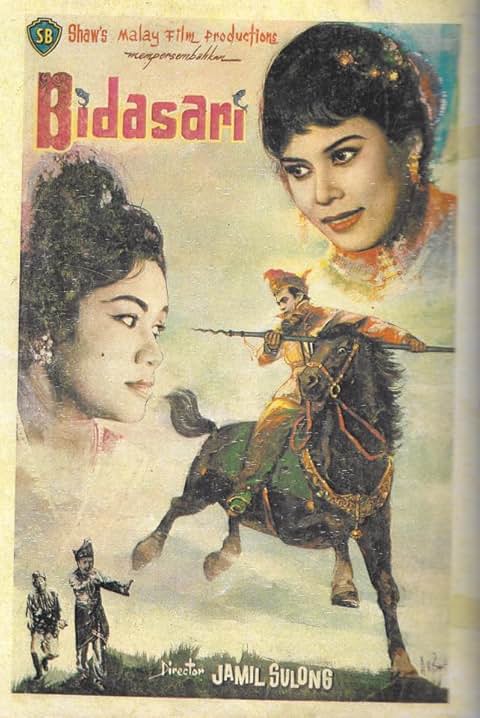
In this other kingdom lives a sultan named Johan Mengindera, with his beloved wife Lela Sari. He dotes on her, madly in love. The queen, however, is insecure, and she keeps asking her husband whether he would take a second wife if he found someone prettier than her. The sultan tries to placate her by saying he would only take a second wife as a friend to her - obviously the queen is not placated. She decides to preemptively order a search, to see if she has a rival to fear. She sends out four of her handmaids to offer bejeweled clothes to young women, and watch closely to see if any of them is beautiful enough to be a threat. The four ladies encounter Bidasari. They immediately see how radiant she is. When she offers to buy the treasures, her mother, the merchant's wife expresses her suspicion, but Bidasari doesn't heed her warning. Her doting father buys her the goods. The four ladies report back to the queen.

The queen orders the ladies to kidnap Bidasari for her. However, the ladies have grown to like the young maiden, and they know their queen is cruel and jealous. They sing Bidasari's praises, trying to convince her not to hurt the girl. The queen resorts to trickery: she declares that she wants to adopt Bidasari as her daughter (she is still almost a child), and has her brought to the palace. Bidasari's parents let her go reluctantly, full of love and worry.

The queen locks Bidasari away in a small cell. She cries alone, distressed, and the queen decides to cover the noise up by punishing her. She beats and abuses her with extreme cruelty. To her husband she says she is just disciplining a servant (to which the king replies with worry that she migh tire herself out too much...). Seven days pass, and Bidasari's parents worry about her. The queen doesn't pass on their gifts and messages. Finally, exhausted by the abuse, Bidasari reveals the secret of her soul-box to the queen, wishing her suffering to end. The queen orders a lady to steal the box for her, and hangs the fish around her own neck, thus stealing Bidasari's life force. The girl falls into a death-like sleep: she is still breathing, but otherwise she appears dead. 

The court ladies take her body back home. Her parents are obviously distressed - especially when her father tries to revive her, and discovers that the box with the fish is gone. However, at night Bidasari wakes up. She tells her parents what happened, then falls into a faint again in the morning. Her father decides to build her a house in the woods to hide her from the queen and other prying eyes. From that day on, Bidasari lives in the house, awake at night and in death-like sleep during the day. Her only companion is a storytelling parrot (who doesn't get as much screen time in this story as it should).

Meanwhile, King Johan has a dream about the moon falling in his lap. It is interpreted as him getting a new wife, even though he resists the idea, claiming the queen is the only one for him. Then he goes on a hunt, and predictably comes across the house in the woods by accident. The parrot tries to ward him off, calling the place a house of spirits and devils, but he enters anyway, and finds Bidasari asleep. He is equal parts stunned by her beauty, and distressed that he can't wake her up. Eventually, he laves. Bidasari wakes up in the evening, and discovers signs of someone having visited her house (her betel had been chewed). She grows scared and worried. The king, on his part, can't help but visit again, and once again finds her asleep. He figures she must be a fairy, only awake at night, and decides to stay after dark.

The scene that follows is intended to be romantic, but for me it made a difficult read. Bidasari wakes up and is scared by the presence of a stranger, who pursues her reletlessly around the house, voicing his longing and lust for her. She curses him and he laughs, he pulls her onto his lap and she tries to break free. She tells him in no uncertain terms to leave, but he doesn't. She even spits in his face. He finally discloses he is the king, but she replies that she is only a daughter of merchants. She weeps, terrified what the queen would do to her if she returned to the palace. She tells him she fears the queen, but he immediately chides her, telling her the queen is above reproach. However, finally, she tells him the whole story of what happened, and he believes her. He is overcome by anger at his wife's wickedness. He returns home, and pretends to be kind to his wife to ascertain that she has the fish around her neck. The next morning he tears the necklace from her, and returns to the woods.

This time, the king intends to marry Bidasari. He meets with the merchant and his wife. In order to keep Bidasari from the queen, he has a fortress built for her in the woods. Eventually Bidasari convinces him to go home and visit his wife. They have an epic fight, and the king basically exiles the queen, telling her she will be provided for and taken care of, but she has to pay for what she had done. At the end of the poem, she is still living alone, "resenting herself above all." (There are other versions, however, where the two are reconciled).

Meanwhile, Bidasari's birth father regains his kingdom, and doesn't cease mourning his lost daughter. The couple has a son, Raja Putra, who grows up and finds out he used to have a sister. He immediately wants to find her. He talks to merchants from all parts of the world, until by chance he encounters a young man who used to be Bidasari's playmate. His name is Sinapati. He recognizes Bidasari's features in the prince. They figure out that Bidasari might be the lost princess, and set out together so that Raja Putra can meet her.

The travelers arrive to Bidasari's fortress where they are greeted with excitement. After some subterfuge, the siblings are reunited. It soon becomes clear that Bidasari is born royalty. Even the queen finds out, and she laments her mistakes (at one point Bidasari talks her husband into visiting the queen again to try to reconcile. "You did jerk her necklace - perhaps you injured her neck!" she claims as an extenuating circumstance). Sinapati is sent as an ambassador with a letter back to the sultan to invite him and his wife to meet their daughter and son-in-law. The whole family is reunited in celebration.

To continue the festivities, the sultan suggests they should all take a trip to the island of Nusa Antara. They set out in decorated yachts and make camp on the island. The men set out to hunt. Raja Putra pursues a deer and comes upon an enchanted pavilion. This is a whole side story where he fights evil demons and rescues a princess named Mandudari. In the end, everyone is married, and everyone lives happily.

The highlights

Image from here
I was touched by the care the merchant and his wife showed Bidasari. When she is taken to the palace, they worry about her. When she is brought back home, they set servants to guard her so she's not taken again, and they sit beside her, warming her and stroking her and hoping she wakes up. They feel guilt that they trusted the court ladies. The epic was very realistic in that she was brought home with bruises and wounds, and her parents immediately knew she had been abused (although they asked "what did you to anger the queen?" first). When she is sent to the woods, her father says "I am not getting rid of you, my darling, I am protecting you from death." Her father regularly visits her in the little house. When the king proposes to Bidasari, they express their worries that the queen might hurt her again. When Bidasari finds out that she is a sultan's daughter, she "clicks her tongue in disapproval" and says "the merchant is my only father." The mother even worries when Bidasari tries to reconcile the king with the queen, saying she is too naive.

It was a touching moment that the king embraced the merchant when they first met, calling him brother. Later on he called him "father to madam Bida". However, the most beutiful moment is when the reunited family retires to sleep on their first day. The queen, Bidasari's birth mother, lies down in bed next to her and tells her the whole story of their exile and wandering. Later on, when they arrive to the island, mother and daughter "dangle their feet" in the water together.

There were a lot of great descriptions of beauty throughout the epic; one of my favorites was "her heels resemble chicken's eggs". At the king's wedding feast, drunken revelry is described as "floral hair pieces drooped over ears."

There was a strong scene where Bidasari woke up the first time, seeing the king's traces in her house. She noted "it  was perhaps the work of evil spirits", because - she argued - if a human had been there, they would have raped her, and if her father had visited, he would have left supplies.

The fight scene between the king and the queen is pretty epic too, feature a lot of choice words and accusations. It is good to see a story like this with the villain being called out on her actions. I also liked it that the prince called his parents out on abandoning his sister for "no good reason". His father described how he was also born in the woods in exile, but nursed in turn and protected from mosquitoes by both his parents. After that, the prince insists they should have done the same for his sister. The king, on the other hand, explains to Bidasari that she can't judge her birth parents for abandoning her, because their life in exile was hard. Later on, when taking their leave, the birth parents tell the king to feel free to "correct" Bidasari if she doesn't behave; "even a beating will bring her no shame." However, the king takes offense and rejects the idea of hurting her.

The description of Bidasari's fortress is pretty epic. It has three levels, and the princess' bower is made of 24 carat gold. The first gate is made of steel, guarded by genies and "corps of cannibal ogres". The second is made of brass, guarded by a cannon and gun post, manned by "mischievous spirits". The third gate is made of silver. The entire fort is lit with shining bezoar stones.

THIS EPIC PRESENTS AN INTERNALTIONALLY FAMILIAR PLOT IN A WHOLE NEW FORM.

What changes do you think result from the details of telling it as an epic? What is it like to look at it from a contemporary perspective?

Tuesday, April 11, 2023

I is for Incisors (Body Folktales)

 This year, my A to Z Challenge theme is Body Folktales. Enjoy!


The wonderful brocade (Zhuang people, China)

A beautiful story about a poor woman who weaves her dreams into a brocade. When the brocade is stolen, her youngest son sets out to find it. However, he needs a magic horse for the voyage, that only comes alive when he takes out his own two front teeth and puts them in its mouth. The boy makes the journey to Fairyland and back safely, and even gets his teeth back in the end.

King Peacock (Louisiana, USA)

A very interesting Snow White variant. A queen rejects every suitor because none of them are beautiful enough, and she is cursed by one to have a daughter more beautiful than herself. She tries to get a nurse to kill her, but the nurse gives the girl magic seeds instead, and helps her escape. She ends up in an ogre's house, but she is so pretty the ogre decides not to eat her. Still, fearing her mother's anger, she takes the seeds and falls into a death-like sleep. King Peacock finds her, and in his attempts to revive her finds the seeds between her front teeth.

The fanged king (Malaysia)

A cook accidentally serves a cruel king spinach tainted with blood - and once the king gets a taste of it, that's all he wants to eat. His incisor teeth grow long and pointy, and he demands to devour a person's blood every day. Eventually he is overthrown and exiled. In the wilderness, he marries a woman and has a child. Later on, the child becomes his successor. The exiled king eventually twists out his own fangs and throws them away, creating various landscape names.

The decoying of Kae (New Zealand)

This story is part of a larger one about Maui's sister Hina and her husband Tini-rau. Tini-rau has whale friends, among them Tutu-nui. When Hina and Tini-rau have a child, they invite a man named Kae to conduct his naming ceremony. After the ceremony Kae asks to borrow Tutu-nui for the voyage home - however, upon arrival he kills and eats the whale. A team of women sets out to track down and capture the murderer. Kae has two front teeth missing so he never smiles; the women resort to various tricks to make him laugh and pick him out of a crowd.

Dragon-child and Sun-child (Armenia)

A long and elaborate love story where a girl falls in love not once, but twice - first with a dragon-turned-prince, and then with a man cursed by the Sun. While saving the dragon prince she breaks a front tooth, and he replaces it with gold. Later on, after many adventures, he finds her again by that golden tooth.

Iváshko and the wise woman (Russia)

Iváshko is a boy who is lured into a trap by an evil witch. He manages to get away and climb a tree, but she starts gnawing it down. When her front teeth break, she has the smith make iron teeth for her again and again, gnawing on the tree. (The boy does get away in the end).

Quite a few different stories about love, happiness and adventure... Which one would make the best movie?

Monday, November 15, 2021

Goodnight stories for headhunters (Folktales of Asian minorities 24. - Iban / Sea Dyak)

As a sequel to the Following folktales around the world reading challenge, I decided to start reading minority and indigenous folktales. First up are the minority peoples who live in Asia. You can find previous posts here, and you can follow the challenge on Facebook here.

The Girl Sudan Painted Like a Gold Ring

Folktales from the Sea Dyaks of Sarawak, Borneo
Theresa Fuller
Bare Bear Media, 2022.

The Iban (Sea Dyak/Dayak) people number about one million, and live on the island of Borneo in the area of Sarawak, along the seashore and rivers. They live in longhouses that house several families, and until recently they had a tradition of headhunting.
The author, storyteller Theresa Fuller, sent me an ARC copy of this book. I was happy about it, because I like folktales from Borneo and I have not read any from the Dyak tradition before. The book contains ten stories, many of them multiple chapters long; they are interspersed with shorter legends and trickster tales. Each comes with a short cultural introduction, and the re-told texts contain many fascinating details about Dyak everyday life. The author added two parts to two longer stories that came from her own imagination, describing parts of the narrative from the women's point of view. These (carefully noted) sections were more novel-like than the folktales, but very beautiful, and rich in detail. At the end of the book we also get a glossary, and a chapter on Dyak culture.

Highlights

The title story was beautiful and fascinating. The protagonist, Siu, was one of those hunters who accidentally wander into the spirit realm and learn that animals are also human in their own world. He marries the daughter of the king of spirits, and promises never to hunt birds again. When he inevitably breaks his promise, she leaves him. He goes on a  journey, raising their son in the wilderness. After many exciting adventures, they find her again, and the (now grown) son has to prove that, as a half-spirit, he is worthy of being a member of her family. One of the challenges was a spinning top competition, which I especially liked.
Another person who wandered into the spirit realm was Pulang-Gana, who followed a porcupine, and fell in love with another spirit princess. When he returned home, and his brothers treated him badly, he became the god of the earth that everyone has to respect.
Headhunting played an important role in the tale of Danjai and the Were-tiger's Sister. Here the tiger killed a young woman, and her husband, Danjai, set out to take revenge. Entering the tiger's realm he met his sister, who was kind, and helped the hero behead her evil brother. They fell in love, she returned the dead wife's head, and the hero set out to find another head - as a wedding present.
I liked the apocalyptic tale where people tortured a dog, and in punishment a terrible storm turned them all into stone (except for one kind family). In another story, girls made fun of innocent animals, and met the same fate.

Connections

The trickster in residence was our favorite Mouse Deer, here known as Akal Pelandok (Ageless Mouse Deer). He was featured in multiple trickster tales, such as Pelandok and the Giant (where he outwitted a giant that stole fish from the animals), or Pelandok, Sambar and Pig (where the animals fell into a pit, and Pelandok used the others to get free). In the latter, the two outwitted animals tried to hunt him down, but Mouse Deer tricked them with classic tricks he also uses on Tiger in other stories. In a third tale, Pelandok and Kikura the Tortoise mutually played tricks on each other, and also on a monkey and a bear.


Monday, March 29, 2021

Visiting Kanchil (Following folktales around the world 195. - Malaysia)

Today I continue the blog series titled Following folktales around the world! If you would like to know what the series is all about, you can find the introduction post here. You can find all posts here, or you can follow the series on Facebook!

Kanchil the Wily One
Tales of the Malaysian Mouse-Deer
Stuart Dickens McHugh
Thornhill Press, 1977.

This was a fairly short book, and not written by a Malaysian person, but I definitely wanted to read about Kanchil for Malaysia. The book contains 9 folktales (9 is a lucky number in Malaysian culture, apparently), and all nine are about the wily Mouse Deer. In case you have missed the signs on this blog, I am a huge fan of Mouse Deer. This made me like this book despite its imperfections.
There were a few imperfections. One is that the tales are clearly re-told by the author. He claims the tales were told to his father by Malaysian sailors, and he translated them to English, telling them to his children and grandchildren. The tales were shaped through many re-tellings. The author notes that he loves Kipling's tales, and these nine stories sounded a lot like them. I could still recognize the folktale types in them, and while they were worded in a literary way, they are still likable and enjoyable as traditional stories.

Highlights

Have I mentioned Mouse Deer?
I have read many a Kanchil story in my storytelling career, but this book had some that were new for me. There is a good version of Kanchil in the Pit where Mouse Deer falls into a pit (go figure) and lures a bunch of other animals down too, so he can climb out on their backs. I also liked Kanchil and the Crocodiles (I knew another version of this, with fewer casualties). I appreciate that despite the re-tellings the author did not try to conceal the fact that Kanchil's tricks often end with other animals dying or captured (although he made heroic efforts to explain this fact). Kanchil and Mongoose, on the other hand, was a nice story that revolved around Kanchil making a friend and helping a human family.

Connections

All stories were classic trickster tales - sometimes Kanchil tricked others, and sometimes he himself was made a fool of. The most well-known story was Kanchil and the Snail, where our trickster ran a race with a water snail and lost, repeating the whole Tortoise and the Hare situation. 

Where to next?
Singapore!

Friday, April 5, 2013

E is for the Elephant Princess

Today's princess is brought to you from Malaysia, by the author if this neat little collection.

The story starts out with ("the prophet") Adam and Eve having a fight. Start at the Beginning, right? With a capital B.
Well, this fight ends in a breakup because Eve decides to move "across the sea" and become "the queen of the other side." In addition to that, she also has a daughter, a princess. Princess soon grows curious about what is across the sea, and defying her mother's orders to leave people's fields alone she crosses the water and stomps around until she is turned into an elephant for her carelessness. Oops.

The prince that lives nearby sees her in her new form, and, guess what, he has never seen an elephant before. When he sees the monster "with tails on both ends" he hits in on the forehead with an iron pike and breaks the tip of the weapon off into the elephant's skin. Elephant princess runs home, and the prince follows, suspecting that it was not just an ordinary monster. The rest is pretty standard: he finds the princess, removes the iron blade from her forehead, brings her back to life and health, and marries her.

BUT.

The moment the princess and her thirty-nine attendants set foot on the Prince's fields after the wedding, on their way to their new home... they turn into elephants.

End of story.

So, the prince now has forty great elephants instead of a wife. Some would call that a good deal. I suspect this story was supposed to explain the origin of elephants. It certainly did it in a very original way.

Moral of the story: Treat elephants well, one in every forty is a princess.

(The picture has nothing to do with the story, it is a TV show aptly named "Elephant Princess." I was amused.)