Showing posts with label Ministerio del Tiempo. Show all posts

Wednesday, July 20, 2016

Meanwhile in Spain, television history is STILL happening

I will keep saying this until my head explodes: WATCH. THIS. SHOW.

A lot of things happened since I last blogged about El Ministerio del Tiempo (The Ministry of Time), Spain's new hit TV show:
- The second season concluded, with 13 stellar episodes
- A book was published, containing 3 additional episodes from the second season (because transmedia storytelling is a thing)
- The rights for the show have been bought/optioned by several other countries, including China, Portugal, and France

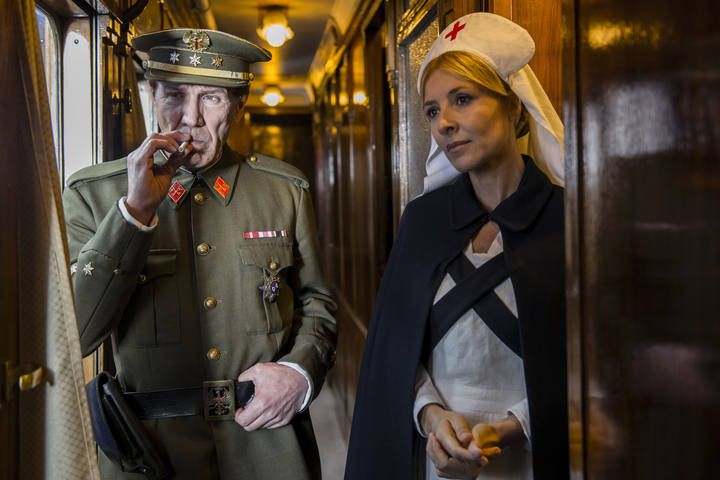
They also broke out the wigs
By the second season, the show has found its footing and its audience - not that the first one wasn't amazing, but this time, every single episode delivered quality TV that you rarely ever see, especially when it comes to historical topics. The show navigates between entertainment, historical authenticity, emotional impact (without crossing over to melodrama), and presents an admirable sobriety when it comes to facing Spain's own history with all its ups AND downs. 

Here are some things that I absolutely loved this season (with minor spoilers):

1. THEY STILL HAVE CULTURE SHOCK.
26 episodes into a show, the main characters, who have been working for the Ministry and traveling in time for years, still have problems adjusting to the modern era, and their own sentiments and values still show at odd places. For example, Amelia, the team's history-savvy, early feminist leader fights for women's rights at every turn, BUT since she comes from the 19th century, sentences like "only women can be kleptomaniacs, it is in their nature" still fall out of her mouth occasionally. Alonso, our 16th century softie of a soldier, gets told halfway through Season 2 that maybe he should start bathing (even though he's just mastered the microwave). Pacino, the new guy on the team from the 1980s, is as amazed by modern technology as the medieval guy is (and the 19th century lady explains to him what a flash drive is). The show is FULL of small details like this, highlighting that these characters, time travelers as they may be, still have ingrained habits and values that can't just be flushed out from one day to the next.
A 19th century lady, Diego Velazquez, and a 16th century soldier
watch Terminator 2


Evil Americans trying to buy the
manuscript of Don Quixote
2. The Americans are evil - and have bad accents
Okay, so I don't think Americans are evil, but GOD IT IS REFRESHING to watch a show where a (badly done) American accent means that someone is an evil businessman who wants to make time travel into a source of wealth. The show takes several hilarious jabs at Americans and their knowledge of European history; and I am pretty sure that having a Spanish actors portray J. Edgar Hoover and Charlton Heston is one of these intentional jabs... Why hire a native speaker if one of our actors can do a passable accent, riiiiight?

3. The ministry works about as well as any ministry would
Disaster is usually only avoided because the people working there are bending the rules into pretzels - otherwise, the Ministry has some serious issues with its logistics. It is not perfectly equipped with high tech, or operating in complete secrecy. Things leak all the time, and they have to scramble to mitigate the situations; funding is cut all over the place, and they don't have enough agents to cover all their bases, which repeatedly leads to security breaches and administrative problems. The new boss they get knows nothing about history, but has 3 online degrees... All in all, they take at least as many jabs at their own administration as they do at the Americans.
They even get audited by the IRS. And spend an episode doing paperwork. (And still make it exciting)

There are entirely too many guns in this  "Ministry of Public Transport"

4. They definitely had more budget this season
Still not as much as HBO, obviously, but they ventured into larger concepts, compared to Season 1. We saw larger sets, more costumes, more extras, war camps, castles, and even part of New York City in the 1920s...

5. They go into WHAT IF stories and alternate history
New this season, we actually see the modern world change a couple of times due to historical events being altered. Some of them are minor, while the season finale delivers a whole alternate world - excellently done and heartbreaking at the same time. I don't want to spoil it, but I'll tell you that it was an amazingly well done episode, and it put our GOOD protagonists through internal struggles between their own privilege and the suffering of others. If you do alternate history, this is how you do it.

+1. Hungary was briefly featured!
Okay, so only Hungarians are gonna get excited about this, but the characters briefly visited Hungary at the end of the 19th century - and, unlike the American characters, the actress speaking Hungarian in this episode had no accent at all. And was singing an actual Hungarian song. It was perfect.

All in all, Season 2 presents El Ministerio del Tiempo at the height of its potential. It is entertaining, educational, exciting, and LOVABLE. And it shows no sign of slowing down. I can't wait to see what they come up with for Season 3.
(They still owe me some Romans. Apart from the ones they locked into the bathroom during inspection, that is.)

Eat both your hearts out, Doctor.


Wednesday, June 17, 2015

5 Things to Love about El Ministerio del Tiempo, and 5 I Wish to See in Season 2

I have written previously about the pilot episode of Spain's new hit time-travel TV show, El Ministerio del Tiempo (The Ministry of Time). Since then, the first 8 episode season has concluded, and the show has been renewed for a second season by clamoring popular demand. I did a lot of the clamoring. In my opinion, it was one of the best TV shows I have watched this year, and believe me, I watch a LOT of them.

Here are 5 things I absolutely loved about the Ministry:
(Mild spoilers)

1. The team
The characters I gushed about in the pilot only got better as the season progressed. Amelia, the 19th century Spanish version of Hermione Granger, got to be the official boss of the trio, which I found really cool (usually "brains" and "leader" are two separate characters). An added bonus is that she knows the most about history, even though she is not the most "modern" of the three.
Next to Amelia, the "boys" also showed their very best. Alonso, the 16th century soldier, became the heart and soul of the team - a really lovable big softy. Julián, the 21st century guy, took a graceful supporting position, respecting the higher competence of his teammates whenever the situation required it. The group dynamic was not only excellent between the tree, but also between the rest of the ministry staff.

2. The continued culture shock
Unlike in other time-travel shows (I'm looking at you, Sleepy Hollow), culture shock accompanies the characters all the way through the season, and shows up in delightful small details. Alonso never learns to open vacuum packaging, and doesn't understand why women can vote; Amelia is shocked into silence by the sight of an airplane. The writers even paid attention to which changes they would take to more easily - the 16th century soldier learns to ride a motorbike and shoot a gun fairly quick, but struggles with changes in ethics and society. Amelia adjusts well to culture, but has trouble following government policy. All in all, their adjusting to the 21st century is a work in progress that does not get handwaved away.

3. The cameos
Since there is a definite educational aspect to the show, many famous characters from Spanish history make guest appearances, from Queen Isabel (played by the same actress as in the hit show Isabel) to a slightly neurotic and very lovable Velázquez who works as the ministry's sketch artist. Each episode is full of historical Easter eggs, and characters that inspire their own memes (such as Fifty Shades of Lope de Vega).

4. The humor
The show doesn't take itself very seriously, even if it pays close attention to historical detail. It is peppered with witty one-liners and off-hand history jokes, as well as well-placed time-travel situation humor. One of my favorite scenes is the glance at the Ministy's "smoking room" - a time-gate that leads to a theater's back door where people from all historical eras can stand around smoking in their various costumes, and no one bats an eye. All episodes, even the most action-oriented ones, are balanced out by delightful writing, and the obvious fun the creators had with it.

5. The costuming
Once again, attention to detail. Time agents visiting another era have to dress accordingly - but on top of authenticity, the designers also went for fun, and each mission brings up some new surprises in the fashion department, whether they travel into the 15th century, or the 1980's.

My favorite episode of the eight was probably No. 4, which was an awesome mix of (very meta) Isabel-references, some serious jabs at the Spanish Inquisition, and a medieval Groundhog Day.
With that said, I have seen most of the show twice by now, and I plan on watching it all over again.

And here are 5 things the fangirl in me hopes to see in Season 2:

1. Jaime el Conquistador and Queen Violante
This is the Hungarian in me speaking, but I would definitely lose my mind if Queen Violante made an appearance. She was a Hungarian princess married to one of the most famous kings of Aragon in the 13th century. She was a remarkable woman, and I would love to see her cross path with the Ministry.

2. Romans
The show has not gone to the Roman era yet, but it has been established that it's possible. Clearly, as a Classics person, I would pay to see that.

3. Crossover with Carlos I
TVE is currently working on a follow-up show to Isabel, based on the life of Charles V, Isabel's grandson and Holy Roman Emperor. Since the Ministry has already crossed with Isabel as a joke, they might do it again with Carlos.

4. The other ministries 
It has been established that the Spanish government is not the only one that can travel through time. I hope they will elaborate on that. In my mind, other European countries would get their own Ministries too, and we'd end up with glorious spinoff series all over the place. *cough*Hungary*cough*

5. Moorish Spain
I would love to see an episode take place in Granada or Andalusia before the Reconquista. TVE has been known to shoot its shows inside the Alhambra and other historical sites. I could watch more of that all day, every day.

Conclusion: Watch. This. Show.
Five stars.


Wednesday, February 25, 2015

The best time-travel TV show you are probably not watching this season

Eat your heart out, Ichabod Crane.

Following the resounding success of Spain's high-profile, three-season historical TV show Isabel (also available on Hulu now), Spanish TV has once again gone and done it: This week sees the premiere of a brand new series that ambitiously encompasses the entirety of Spanish history through time travel. And damn do they do it right.

El Ministerio del Tiempo (Ministry of Time) is the story of a secret government agency that oversees the "doors of time" that lead to various points and places in Spanish history. The agents, recruited from many different eras, are responsible for keeping the country's history on track in the face of unforeseen complications, such as rival (French) time travelers trying to change the course of past events. The three main characters are Julián, a 21st century paramedic, Amelia, a 19th century early feminist and university student, and Alonso, a dashing 16th century soldier. They are all picked for their unique qualities and struggle with their own problems in their own eras, but come together as a team for missions to save the past and present of Spain. "Without them, the future is history."

The show is remarkable for a number of reasons:
(Mild spoilers)

1. It gives its audiences the benefit of the doubt. Instead of trying to spell out everything repeatedly ad nauseam, they allow the viewers the courtesy of assuming they all graduated a high school history class. The writers throw themselves with obvious enjoyment into their own country's culture, and drop names and references like they are hot; all needed explanations are made by the three protagonists, who often have to explain things to each other as well (and it's not always the 21st century guy that knows the answer).

2. It does culture shock and does it well. While Sleepy Hollow was dubbed by some of my friends as "the 5 minute culture shock," MdT pays attention to detail. Characters awkwardly try to figure out whether they should kiss, shake hands, or bow. Alonso is endlessly mesmerized by cars, but in return Julián has to admit on the first mission he doesn't know how to ride a horse. The absolute winning moment for me, however, was when Amelia was taken into the 21st century, and her (female) boss started her training by introducing her to the miracles of tampons. Apparently feminine hygiene products are even exempt from the Ministry's "no objects allowed outside their own time" policy. Brownie points.

3. It has a sense of humor. There were several moments where I burst out giggling; MdT doesn't take itself too seriously, and that makes the whole show endearing. Good acting adds to moments of humor, and some throwaway lines make the Ministry all the more likable. Because who else would you want as a sketch artist to catch potential suspects if not Diego Velázquez?...

4. It combines entertainment with education. Since it is based on Spanish history, once again RTVE is using the power of entertainment to teach viewers more about their heritage. The website, just like Isabel's, is full of extra information, social media links, timelines, interviews, the works. There is clearly a lot of effort that went into linking the adventures on screen to what really happened. According to historians, obviously.

Long story short: Time (heh) to brush up on your high school Spanish and crack open some history tomes. I'll definitely be a regular viewer.