Showing posts with label teamwork. Show all posts

Thursday, March 26, 2020

How the women saved Guam (Feminist Folktales 13.)

Another Thursday, another post for Feminist Folktales! It's a series of traditional stories from around the world that display motifs that reflect feminist values. I am not changing any of the stories, merely researching and compiling them, and posting them here as food for thought. You can find the list of posts here.

Origin: Guam (Micronesia)

The story


Image from here
The people of Guam anger the spirits of nature, and one day they wake up to an earthquake: a giant fish is eating the island. They manage to spot the giant palakse (parrot fish), but they can't capture it. The men hold a council but keep the women out, and when they go up against the fish they tell the women to stay behind, because fishing and hunting is a man's job.
Meanwhile, the women have their own council, and come up with a plan. They all cut their hair and use it to weave a large, strong net. A girl notices orange peel floating in the bay, and knows women on the other side of the island use orange peel to wash their hair; this is how they figure out there must be a tunnel under the island. They cast the net at the exit of the tunnel, catch the fish, and manage to pull it ashore with the help of the men and children. The island is saved.

What makes it a feminist story?

This is one of those rare traditional stories where women act as a community. While men try to push them aside in a time of crisis - not letting them into the council, not letting them go fishing - they come together and thing of alternative solutions, since it is obvious that the direct approach is yielding no result. The women's council listens to everyone (in various versions little girls and old women all get a turn to speak), and they pool their knowledge to come up with a solution. Someone discovers the orange peel (observation); someone knows where it's from (knowledge); someone realizes the meaning of their presence (logic); someone suggests possible next steps (strategy); someone suggests tools to use (practicality); and in the end, they all contribute their hair, work together, and catch the fish. (Added bonus that they sacrifice their hear, a symbol of feminine beauty - highlighting that the survival of the community is more important that beauty standards.)
The women of Guam are a symbol of good teamwork and supportive community. At the end of the story, the men join them in pulling the net, admitting that they had made a mistake when they kept the women out of trying to solve the problem. The island is saved, the community comes together.
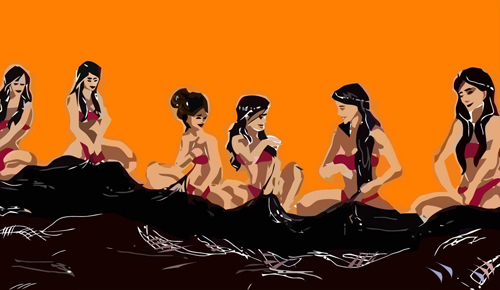
Image from here

Things to consider

When I tell this story, some things usually need explaining (e.g. the shape of the island of Guam, or what a palakse is). This story only really comes alive in its cultural context.

Sources

Eve Grey: Legends of Micronesia (Department of Education, 1951.)
Bo Flood, William Flood, Beret E. Strong: Micronesian Legends (Bess Press, 2002.)
Bo Flood, William Flood, Beret E. Strong: Pacific Island Legends (Bess Press, 1999.)
Evelyn Flores, Emelihter Kihleng: Indigenous Literatures from Micronesia (University of Hawaii Press, 2019.)
Lawrence J. Cunningham, Janice J. Beaty: A history of Guam (Bess Press, 2001.) https://www.guampedia.com/how-the-young-maidens-saved-guam-folktale/

Notes

It's a great story about the relationship between humans and nature. I had it on my folktales and climate change list.

Monday, March 28, 2016

The Multicolored Lady's Minions of Might & Magic

The April A to Z Challenge starts next week! It is not too late to sign up yet. We have already announced our themes, and everyone is hyped and ready to roll.

Once again, I am co-hosting this year. Co-hosts would not get anything done without their minion teams, so today I'll introduce you to the wonderful, enthusiastic people who make all the blogging magic possible!

They are, in more ways than one, my very own


Minions of Might & Magic!
(*confetti*)

Erica is a lover and practitioner of Music, Meditation, and Storytelling. You might remember her from her amazing theme of Hindu mythology last year! I hear she will have something equally fascinating for this year's challenge. You can find her blog here.

Freya writes about herself thus: "Incurable Drama Queen, Mind-Vagabond, OCDed Control Freak, Innate Traveler, Proud-Softie Dog Mama, Insatiable and Irregular Blogger. I'm Freya and I live in Bangalore, India. I love to read, that's my thing. I'm a housewife and have 5 dogs who fill up my life along with the husband. Mostly that's what my blog is about too."
You can find her blog here, and you can also connect with her on Twitter or Instagram. 

Lancelot is 25 years old, and describes himself as "a foodie who loves to eat (not so much love in the cooking department), part-time wanderer, blogger since 2014, an A to Z survivor and basically trying to live 100% a life without regrets since 2015!" You can find his blog here, and follow him on Twitter here.

Last, but not least, the team would not be complete without our Everyday Fangirl, Patty. She is from Michigan, and lives disguised as a mild mannered data analyst for an advertising firm. You can find her blog on all things fandom here, follow her on Twitter here, or check out fandom blogs The Cantina Cast and The Bearded Trio where she also regularly posts. 


The Minions of Might & Magic will be visiting participating blogs over the course of the Challenge, helping us make sure everything is in order and everyone is having a great time.

See you all in April!

*disappears in another shower of confetti*

Saturday, June 6, 2015

Story Saturday: Heroes Assemble!

Who's your favorite Argonaut?*

I'm a sucker for teams of heroes. I am not sure why, but ever since I started reading legends and mythology, I can not get enough stories about groups of warriors, bards, demigods and other misfits teaming up for great adventures. I am enchanted by group dynamics. Fascinated with combat cooperation. And just all-around happy that I could find stories where interesting characters got together for a gig.
(In case you were wondering: I read mythology way before I read comics, so I guess I liked the X-men and the Avengers because I liked team myths, not the other way around)

So, for today's Story Saturday post, here is a list of my all-time favorite hero teams from world folklore and mythology. In no particular order.

1. The Fianna
People following this blog are probably starting to get the idea that I have a Fianna fixation. They are right.
Culture of origin: Celtic (mainly Irish, but there are a lot of Scottish stories too)
What I like about them: They walk between worlds like I walk to the grocery store. Also, they need to know fighting AND poetry to get in.
Favorite members: Oisín, Fionn, and Caoilte, in THAT particular order.
Book recommendations: Lady Gregory's Gods and Fighting Men, and Rosemary Suttcliff's High Deeds of Finn mac Cool

2. The Argonauts
I always had a soft spot for sailing, and also for all-star Greek hero team-ups. Honestly, half of Graves' Greek Mythology was on that ship. Including Hercules.
Culture of origin: Very Greek
What I like about them: Mostly the fact that so many famous characters ended up on one ship. Also, their adventures are pretty awesome too.
Favorite members: Atalanta (the only female Argonaut), Orpheus, Kalais and Zetes
Book recommendations: Robert Graves' The Golden Fleece

3. The Knights of the Round Table
I grew up on these stories, and I am extremely picky about how they are told and adapted (which is why I might be the only person in the world who broke out in hives from BBC's Merlin).
Culture of origin: Welsh / British
What I like about them: It is one of the most epic stories ever told, and it still has a hold on people.
Favorite members: Sir Kay (hands down, no contest), and Sir Gawain, but I really like Arthur too.
Book recommendations: T.H. White's Once and Future King

4. Dietrich of Bern
This is a fairly new one, I read the Norse saga version for this year's A to Z Challenge post.
Culture of origin: German
What I like about them: It is an awesome lineup of diverse characters with interesting background stories. Also, someone gets fished out of the mouth of a dragon.
Favorite members: Hildebrand, Sistram, and Wittich (Vidga)
Book recommendations: The saga of Thidrek of Bern

5. Water Margin
Also known as Outlaws of the Marsh. One of three great Chinese epics, this one takes the cake in number of heroes: There is 108 of them, 105 men and 3 women.
Culture of origin: Chinese
What I like about them: All the heroes have their own backstories, skills, fighting styles, and trials. And very colorful personalities.
Favorite members: Lin Chong (Panther Head), Shi Jin (Nine Tattooed Dragons)
Books recommendations: Shi Nai'an's Water Margin

In addition, honorable mentions are due to Robin Hood and his Merry Men (recently planned for a shared universe movie series by Sony, God help us all), Charlemagne and his knights, the Jómsvikings, and Journey to the West. I could go on and on and on about hero teams... Which one would you rather belong to? ;)

*The correct answer is: NOT Jason.

Friday, April 17, 2015

O is for Ogier the Dane (Epics from A to Z)

I remember reading the story of Holger Danske in a picture book when I was little: The story said that he was a great knight who now sleeps under the castle of Kronborg in Denmark, waiting to wake up and return when he is needed.

Origins
Ogier the Dane (French), or Holger Danske (Danish) is a hero from medieval romances of chivalry. While the stories claim he was a Danish prince, most of the romances in which he is featured are French and Italian. I read a prose version of his story based on a French romance (Chevalerie d'Ogier de Denamarche) written in the early 13th century.

The Hero
Ogier is the firstborn son of the king of Denmark. At his birth he is visited by "six ladies of ravishing beauty" who each grant him a gift (and, surprisingly, none of them curses the child). The last of the six is none other than Morgana le Fay, who takes her chance to call dibs on the little hero (after he has been gifted bravery, strength, and handsomeness).
Ogier grows up as a hostage in Charlemagne's court and becomes one of his greatest paladins (and makes friends with legendary characters such as Roland and Olivier). If you like the legends of King Arthur and the Knights of the Round Table, definitely read more about this court as well!
Ogier is strong, brave, and honorable - the very image of chivalry. What is even more important, though, is the gift given to him by the fourth fairy: “Lest all these gifts serve only to betray, I give you sensibility to return the love you inspire.” That's a very good quality for a hero.

The Highlights
The legend of Ogier the Dane has pretty much everything you would expect from a medieval romance of chivalry: Epic battles, daring duels, enchanted love, magical voyages, and even a trip to the Holy Land.
One of my favorite parts is the duel between Ogier (merely a day after he has been knighted) and the King of Mauritania, the Saracen Carahue. The son of Charlemagne, Charlot (who is very Mordred in a lot of ways) is also scheduled to duel with Carahue's cousin, but he decides to plan an ambush instead and get rid of the enemy, as well as Ogier (because he is jealous of his father's love for the young knight). Seeing the ambush Ogier and Carahue stop their duel and fight side by side - for chivalry, and against treason. They end up saving each other's lives and becoming best friends. Carahue keeps showing up over the course of the romance to save Ogier or help Charlemagne against other Moorish armies. It is a remarkable moment in the legend where honor and friendship trumps cultural and religious differences.
Another favorite character of mine is Turpin, who "occasionally recalled to mind that he was an archbishop." He is a priest, but also a knight and a warrior, and a very clever man - Charlemagne's most trusted adviser. He saves Ogier's life when he is imprisoned: The king plans to starve him to death by only allowing a quarter loaf of bread and a quarter cup of wine a day. Turpin, keeping to the word of the law, starts making loaves from two bushels of flour, and makes a cup the size of a barrel, keeping Ogier well fed. He is a fun, clever, likable character, and I have loved him since I read a folktale about him saving Charlemagne from enchantment (Aix-la-Chapelle: The Magic Ring).
Ogier has a wife, and a hundred-year enchanted love affair with Morgana, but the most touching love story happens at the end of his tale: After missing almost two hundred years of French history, he returns from Avalon to find Hugh Capet on the throne. He is introduced to the young queen, who is very curious about Ogier's stories and the history he lived; he tells her all of his life, and they fall in love through long conversations. When Hugh Capet dies, Ogier proposes to the queen... But sadly, the marriage never comes to pass.

Saturday, April 11, 2015

J is for the Jómsvikings (Epics from A to Z)

Short version: The Jómsvikings are the Avengers of the 10th century.
More accurately: The Avengers are the Jómsvikings of the 21st century.


The Jómsvíkinga Saga is an Icelandic saga written sometime in the 13th century. It takes place in Denmark, Norway, Wales, and Jómsborg, and ends with the Battle of Hjörungavárg in 986 AD. It details the (long and complex) family background, deeds, and eventual downfall of a group of select Viking heroes known as the Jómsvikings. Much like the Fianna of Ireland, they are a brotherhood of elite warriors, the best of the best, not admitted based on anything else but bravery and personal prowess. Both of which there is a lot to go around in this story.

The Heroes
The heroes of the saga are the Jómsvikings, living in their own walled city (Jómsborg) under strict rules - men only, loyalty to each other, no preferential treatment, equal distribution of booty, that kinda stuff. The founder of the place is Pálna-Tóki, and after his death Sigvaldi, who is not as good a leader, and manages to let the whole thing crumble on a drunken bet (great job, Sigvaldi).
One of the most notable characters is Vagn, who shows up at the water-gates of Jómsborg at the ripe old age of twelve, demanding entry into the brotherhood. He is refused on grounds of creeping everyone out, and also the fact that he is underage (rules only allow membership to men between eighteen and fifty). He proceeds to soundly beat Sigvaldi in a naval battle, and gains admission anyway.

Highlights
Apart from your usual run-of-the-mill fighting and pillaging, the saga offers a few remarkable moments, especially towards the end. They mostly involve fighting:
1. Much of the end of the saga (I'm not giving out spoiler alerts here, the story has been out since the 13th century, deal with it) involves the captured Jómsvikings being executed by their enemies. It is a fascinating lineup of warriors going to their death, each one making a different joke or proposing fun little experiments. One of them insists that his long and fabulous hair has to remain clean and intact; then, just when the executioner swings the sword, he yanks his head down, and the sword takes off the arms of the man who had been holding the hair out of the way. The kid (barely 18) looks up and asks with a shit-eating grin: "Whose hands are in my hair...?" He gets to live, Vikings appreciate a good practical joke.
2. Another battle-related moment of epic is delivered by Búi, one of the Jómsvikings, who loses both his hands in the last battle of the company. Instead of being fazed by this at all, he puts the arm-stumps through the hoops of a chest of gold, and jumps overboard with it, transforming into a dragon.Yup.
3. And still on the topic of lost appendages - I'm sensing a theme here, you guys - there is some bravery on the opposite side as well: Geirmundr, the commander of a town attacked by the Jómsvikings, jumps out of a building, gets an arm cut off by Vagn, and then manages to run through the woods all the way to the earl's court to warn him of the impending danger. He does it in a calm, collected and professional manner, reporting on numbers first, before the earl asks him if he has any proof. To which Geirmundr responds, "Oh yeah, they cut off my arm, see?" and follows up by providing information on the enemy's best warriors. "One of them got my ring."

Ain't no party like a Jómsborg party.

The Real Jómsborg
Although contested by some historians and archaeologist, it is generally believed that Jómsborg stood somewhere in the place of modern day Wolin, Poland. Every year the town celebrates this fact with Europe's largest Viking festival, involving historical reenactors from all corners of the continent and beyond. Definitely worth a visit.

Friday, April 26, 2013

W is for the Wind Princess

Again from Hungary.

Wind Princess is actually called Szelike, and is not translated "wind" because she is some kind of a weather fairy - she is translated "wind" because she is faster than the Flash on caffeine. Anyone who wants to marry her has to outrun her in a race, and of course the odds are stacked against them. I like this folktale because Szelike is not also a fast runner, but apparently she also has a childish, impatient and hasty personality that goes very well with her supernatural powers.

Did I just say powers?

Heck yeah, this story is also included in the upcoming book!

(I swear we are almost done)

I would like to take a moment here to muse about the many princesses in tradition who have to be outrun. There is Atalanta and the trick with the golden apples, then there is Camilla and her divine gift of speed (also included in the book), and then there is Szelike and her sisters, a whole array of folktale princesses who run as fast as the wind.
First things first: mind you, these princesses are not running to get caught. They have to be outrun, and a goal reached first, be it the water of life or just a shiny stone on a nearby mountain. It is not a tale of chasing the girl, it is a tale of keeping up with her.
There is a slight but important difference when the suitors have to complete some unrelated task to win the princess, and when they are pitted against the princess herself. Many people complain that folktales are "outdated" because women are given as nameless-colorless prizes for heroic deeds. While that is true in many cases, let's not skip over the fact that many times it is the princess herself who has to be outwitted, outrun, or wrestled down (we have seen all of those before through A to Z). Many times it is even stated in the tale that it was the princess' choice to set those challenges. To make sure whoever married her could hold his own.

Just something to think about.

Saturday, April 21, 2012

S is for Ship, of the Land-and-Water kind

Once again shhort post, I am not even blaming it on the thesis this time, because it is about my thesis.

One of the stories featured in my thesis in Folktale Type AaTh 513 - The Extraordinary Companions. This is the folktale where the hero (who usually is either poor, dumb, rich and spoiled, lazy, or simply a jerk) sets out on a quest and ends up running into people with strange magical abilities who then help him out until he kills the giant, saves the princess, gets the treasure, etc.

In the past few weeks I have collected 23 versions of this folktale from many countries around the world: Italy, Sweden, Thailand, Korea, Iceland, USA, France, India, Mongolia, Hungary, Czech Republic, Ireland, Germany, Norway, Ukraine and Russia - and I have no doubt that there is more of it hidden in story collections and folklore articles.

What really fascinating though, apart from the universal nature of this story, is the variety of superpowers that are featured in it. In my 23 versions I found 28 (!) different abilites, from overkill ones like "he can run as fast as lightning" and "he knows everything" down to weirdness like "he can pee a waterfall". I made a list of these,  and also made a list of quests that need to be accomplished, from "rescue princess from evil sorcerer" to "defeat crickets that are as big as elephants".

Fun!

What seems really interesting to me is that literature claims this story type is directly related to the myth of the Argonauts - a ship full of people with magical abilities with a useless leader going to get rich and ending up rescuing a princess. Pretty accurate if you ask me (yes, I don't like Jason, but then again I don't really like Medea either). Seems legit to me, especially because the story almost always features a magical flying ship.

It is also a great story to teach teamwork, and talk about finding ways to use your special talents effectively. I'll muse about it later.

Not I have to go watch Legend of Korra...
... I mean, continue working on my thesis.

Friday, April 6, 2012

F is for the Fianna. Obviously.

This is going to be super dorky, but whatever, I am writing these around midnight.

I first read Fianna stories when I was about 12 years old, and one of my many roots as a storyteller is miles deep in them still. I know I know, shame on me for being a 100% Hungarian storyteller and not coming up with something right off the back of a horse on the steppes, but then again, things you don't grow up with are always much more fascinating when you are a kid. I remember being absolutely enchanted by Gods and Fighting Men (usually skipped straight to the Fianna parts), to the extent that the first imaginary crush I ever had was Oisín (and the rest of the class could have Leonardo DiCaprio all to themselves). I also wanted to be a bard, on the side, and this was about 10 years before I found out I can actually be a professional storyteller. I filled notebooks with my retellings of the Fianna legends, even though I had no clue why I was writing them.

Gods and Fighting Men was not translated to Hungarian back then, and I could only read it painfully slow in English. But I did anyway. A few years later in high school I was digging around in the back of the library where all the foreign-language books were piled up without any semblance of order, and I found Rosemary Sutcliff's book, the High Deeds of Finn Mac Cool, and I was in love once again. I actually told a Fianna story for an English competition, but I didn't win anything (they told me the story was too serious for my age. Right after my music teacher told me my voice was too deep for singing Eric Clapton songs).

When I actually decided that I wanted to tell stories to people Fianna legends were among the first I have ever told - to kids in the sailing camps, to classmates, to anyone who would stay put long enough to listen. I still tell them, and they make me feel all warm and fuzzy every time. I have spent the last 14 years with these guys, I want to see anyone top that. Quoting Dolores Hydock: "They don't make men like that anymore..."

Also, yay to White Wolf for making the Fianna a werewolf tribe for Werewolf: the Apocalypse. They are tons of fun to play!