Tuesday, April 30, 2019

Z is for Zarzamora and the Fire Bug (A to Z Challenge 2019: Fruit Folktales)

This story comes from the Pemon people of Venezuela. Zarzamora is often translated to English as blackberry, but in Venezuelan Spanish it can mean a variety of similar fruits, such as the Rubus floribundus (zarzamora andina), Rubus glaucus (zarzamora azul, Andean raspberry), Rubus ulmifolius (thornless/wild blackberry), Rubus bogotensis (black mulberry), or the Rubus caesius (zarzamora pajarera, European dewberry). The story itself didn't specify the species.

Once upon a time there was a cocuyo beetle (glowing click beetle) who set out to visit some relatives. He made the appropriate preparations, prayers and invocations for safe travel, and began his journey. One time along the way, night found him on a hill, where he found the house of a zarzamora. He asked for shelter for the night, and she invited him in. She was old, leafless and bent, with some very ugly features, but she was a great hostess. She offered food and drinks, hung a hammock for him, they had a nice conversation - and the zarzamora fell in love with the beetle. The cocuyo, however, wanted nothing from her; he told her she was old and ugly, and the next morning, he went on his way.

The beetle reached his destination, visited with his relatives for a while, and then set out on the journey home. On the way back, he happened to stop on the same hill where the zarzamora lived. Surprise! She was completely changed now: She stood straight, rejuvenated, with fresh leaves and beautiful flowers. The beetle instantly fell in love with her, but she kept ignoring him. Eventually he started begging for her to at least tell him how she became young again.

"Some people passed this way, and they set fire to me. It was the fire that rejuvenated me." - responded the zarzamora. The cocuyo immediately wanted to be rejuvenated too. So, despite the zarzamora's warnings, he flew straight to the place where people were camping, and threw himself into the fire. He was badly burnt, and turned black from the smoke forever. He returned home, ashamed of himself. His descendants have the same tendencies ever since: When they see fire, they try to fly into it, and when they see zarzamora in bloom, they can't stay away from the beautiful flowers.

(The story comes from this book.)

This was the last story for this year's A to Z. Thank you all for another fun Challenge! See you in May for the Reflections. And don't forget to eat fruit!


Monday, April 29, 2019

Y is for Yellow Mombin and Cannibals (A to Z Challenge 2019: Fruit Folktales)

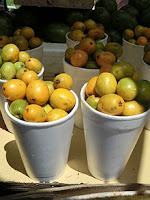
The yellow mombin (Spondias mombin), also known as the jobo fruit, is native to the tropical areas of the Americas. Our story for today comes from the Cariña people of Venezuela.

Be warned, this one gets dark.

The story begins with a woman pregnant with twins from the Moon. Heavily pregnant, she sets out to the Moon's house to give birth. On the way, however, her unborn babies keep demanding various things, so she has to leave the path to pick flowers and fruit that they want. Eventually whey demand fruit from a tree. She climbs up, falls down, and becomes angry at the twins, who, in turn, become offended at their mother. Soon she reaches a fork in the road: One side leads to the Moon, the other to the land of man-eating monsters. She forgot which way to go, and the twins refuse to tell, so she takes the wrong turn.
The mother ends up in the house of an old woman, Ataluyma. The woman pretends to be friendly and gives her shelter for the night... but then she eats the mother, and keeps the twins as her own children. The boys grow up, become great hunters, and never learn that Ataluyma is not their grandmother. As they get older, however, they notice that she does strange things (for example, uses a toad to cook food). Eventually one day, out on the hunt, a large bird tells them the story of their mother. The twins make a plan to take revenge on Ataluyma.

The next day, they ask their "grandmother" to come out to the fields and call the crops. Suspecting nothing, she complies, climbing the platform in the middle of the fields, and summoning rice, corn, maize, melons, bananas, etc. As she is doing this, the twins set fire to the platform, and she burns to death. The fields magically bear crops the very next day.

The story goes on. A few years later one of the brothers encounters a mysterious woman while hunting. She is also a cannibal, and while the brothers are spying on her, she discovers them, and chases them through the woods. The twins climb a tree, but she summons strong winds to knock them into a lake. As they fall, one of the twins turns into a jobo fruit, and another into a frog with red marks. The woman puts them both in her basket; the fruit to eat at home, and the frog as a pet for her daughter. However, as she walks, the fruit rolls around in the empty basket on her back, and keeps bumping against her tailbone, so she eventually takes it out and eats it.

Caruto fruit
(Genipa americana)
From this point on, the story follows the one remaining brother. He convinces the cannibals to let him turn back into a human, and he will hunt for them. He even marries the daughter and they have a child. Eventually, however, hunting for meat becomes too hard, so he cuts up a ceiba tree, throws the pieces into a lake, and they all turn into piranhas. He also throws in a radish, which becomes a caiman. He then tricks the mother into going in the lake, and the piranhas eat her. When the daughter goes to search for her, the hunter escapes - but she eventually catches up, calling after him to stop and pick some caruto fruit for their child. When he climbs a tree, she cuts his leg, and leaves him for dead. She eventually turns into a prickly pear cactus (holding up her baby to the sky), and his skeleton is carried to the sky by a vulture.

(You can find the story in Spanish in this book.)

Were you familiar with any of these fruits before?
What kind of plant or animal would you turn into to escape a monster?


Saturday, April 27, 2019

X is for Xigua Lady (A to Z Challenge 2019: Fruit Folktales)

Xigua is Chinese for watermelon (in case you were wondering why I didn't use watermelon for W). The story I have for today is fairy well known, considered one of the Four Great Folktales of China. It is generally known as Meng Jiang Nü, or, in English, Lady Meng Jiang.

The story begins with two neighbors, Meng and Jiang, who live very comfortable next to each other. One day, Meng plants a watermelon seed in his garden. The seed sprouts, the vines creep over the fence, and the plant bears a single watermelon in Jiang's backyard. The two friends have a bit of an argument over who should have the fruit - each one of them wants to give it to the other. Eventually they decide to share. However, when they cut the watermelon open, they find a baby girl inside. The two childless couples decide to raise the girl together, so she becomes a daughter of four parents - taking both family names, she is called Meng Jiang Nü.

The girl grows up and marries a man she loves, named Wang Chi-liang. They live happily for a while... until one day soldiers show up in the village, rounding up men and taking them away to serve as laborers on the building of the Great Wall. They are marched away without goodbyes or provisions. Lady Meng Jiang, worried that her husband would freeze in the winter, makes warm clothes and shoes for him, and sets out alone on the long journey to deliver them to her beloved.

The young woman travels for a long time, crosses mountains and rivers, and searches tirelessly until she finally arrives to the Great Wall. However, seeking Wang Chi-liang, she finds out that he is already dead. Like so many others who died from exhaustion during the work, he was buried inside the wall. The young wife wails and mourns so pitifully that the heavens take pity on her; with thunder and lightning, a portion of the wall collapses, revealing the bones of her husband so that she can bury them. She identified his bones by dripping her own blood on them, seeing if they would soak it in.

According to some versions of the legend, the cruel emperor sees the beautiful widow, and wishes to marry her. She agrees only on condition that they first bury her husband, and hold a ceremony in his honor on a high cliff above the river. When everything is ready, she curses the emperor, jumps into the river, and drowns herself.

(Read about this story here or here.)

Is there a canon of Great Folktales in your own culture? 
What stories would be included in it?


Friday, April 26, 2019

W is for the Wood Apple Princess (A to Z Challenge 2019: Fruit Folktales)

The fruit known in India as bilva, bel, or bél (Aegle marmelos) was unceremoniously renamed by English colonizers as "wood apple." It is a fruit of great importance in Hindu mythology and folklore, sacred to Shiva and Parvati among other deities (more information here). In a book titled Indian Fairy Tales, collected by Maive Stokes in the late 19th century, I found a story called The Bél-Princess. For our purposes she shall be incorrectly called the Wood Apple Princess.


Once upon a time there was a king with seven sons. The six older sons were married, but the youngest wasn't, and he had a bad relationship with his six sisters-in-law. One day, they started mocking him by saying he will only ever marry a Bél-Princess - so the prince, mostly out of spite, set out to find one.

Traveling for a long time, he encountered a fakir who was asleep for six months of a year, and awake for another six. When he woke, the prince told him what he was looking for, and the fakir directed him to the land of fairies and demons, giving him a handful of dust to make him invisible. In the middle of the fairy garden was a tree, and on that tree a single bél fruit, with a princess inside. The task was to knock the fruit off the tree, catch it before it hit the ground, and then ride away, pursued by fairies and demons, without looking back. The prince failed at the first try (he looked back) and turned to stone, but the fakir revived him, and gave him a second chance. The bél fruit was successfully acquired.

The fakir also told the prince not to open the fruit until he was home in his father's house - however, he once again failed to follow instructions, and opened the wood apple in the royal gardens. A beautiful and graceful princess appeared. The prince grew tired, admiring his new bride, and fell asleep. While he slept, an ugly woman came across the princess, tricked her into exchanging clothes and jewels, and pushed her into a well. When the prince woke, he found himself with an ugly and unkind bride, and no explanation.


From this point, the story progresses through a series of transformations. The princess in the well turned into a lotus flower, but the new fake queen tore it apart. From the remains of the lotus grew a bél tree and bore a single fruit, which the queen threw away. From the fruit came a baby girl, whom the gardener adopted and raised. The queen tried to have her killed, but the girl killed herself instead, her eyes turning into birds, her body into a palace, her heart into a water tank. Eventually, the prince found the palace and spent five nights in it; at last, he found a trap door, and in a hidden room, the princess herself. The truth came to light; the fake queen was killed, and the royal couple lived happily ever after.

Transformation tales like this always carry a lot of deep symbolism - and like all traditional stories, they say a different thing to everyone. 
What meanings do you see in this story?


Thursday, April 25, 2019

V is for Vanilla Love (A to Z Challenge 2019: Fruit Folktales)

Vanilla is indigenous to Central America, more specifically, to the areas of Mexico originally inhabited by the Totonac people. Until modern times, they were the main producers of vanilla (more information in Spanish here).


I found two distinct Totonac legends about the origins of vanilla.

Xanath and Tzarahuin

Legend says there was once a princess named Xanath (Hidden Flower), who fell in love with a musician named Tzarahuin. However, the Fat God of Happiness also loved her, and demanded her hand in marriage from her father. The father, of course, favored the deity over a mere artist, but Xanath refused to consent. As punishment, she was transformed into a sweet-smelling white flower.
When Tzarahuin found out what happened to his beloved, he took his own life under the flowering plant. He turned into a gentle, stingless melipona bee (xunan kab). The bee still appears every year to pollinate the flowers, and help them produce the sweet-tasting fruit known as xanath - vanilla. Flower and bee go together so perfectly that for the longest time vanilla didn't even grow anywhere where the bees could not be found.

Take this one with a grain of salt - it has been making the rounds on the Internet, but I could not locate a primary source.

(Read about the story here, here, or here.)

Tzacopontziza and Zkatán-Oxga

In another legend, Tzakopontziza (Morning Star), the daughter of King Teniztli III, was consecrated to serve the goddess of the fertility of crops, Tonacayohua. As time passed, the young woman fell in love with a prince named Zkatán-Oxga (Young Deer). However, it was forbidden for her to take a lover, a sacrilege punishable by death; only virgins could serve the goddess. The young lovers ran away together into the forest, but didn't get far before they were confronted by a monster that surrounded them with flames, and ordered them to return home. Upon their return, the princess and the prince were executed by angry priests, their hearts cut out in the temple, and their bodies thrown into a canyon.

Some time later, out of the resting place of the two lovers grew a tree, and from the tree grew an orchid. The orchid had beautiful lowers and sweet-smelling fruit - the fruit we know as vanilla today. In Totonac tradition, it was sacred to the gods.

(Read about the story here and here.)

Both love stories end in tragedy and transformation. Which one speaks to you more? I personally really like the image of the flower and the stingless bee...

Wednesday, April 24, 2019

U is for Ugni Berries and Ulmo Trees (A to Z Challenge 2019: Fruit Folktales)

This one was not easy at all, but I managed to pull a few fun things out of Google Books! Get ready, I am going to hit you with some little known flora.

The fruit for today is the Ugni molinae, known in South American Spanish as uñi, murta, or murtilla, and in English as strawberry myrtle or Chilean guava. It belongs to the myrtle family. Ugni fruit was introduced to Europe in 1844, but has been a staple in indigenous Araucano and Mapuche cuisine for centuries. The fruit is used for making desserts and liquor (chicha), and it is famous for being a favorite delicacy of two important people: Queen Victoria of England, and the thrauco.

Picture from here
The thrauco (trauco or chauco) is a mysterious being of Chilean folklore and mythology. It is a small creature, usually between 50 and 85 cm tall. He wears clothes woven from quilineja (Luzuriaga radicans), and a cap or hat made from the same material. He always carries his stone axe (toki), and usually walks leaning on a twisted walking cane. He might be small, but he is certainly not weak: Using his stone axe, he can fell a three in three strokes, even if it is a gigantic ulmo (Eucryphia cordifolia). In fact, the sound of three axe chops is what usually signals to people that a thrauco is nearby.

The thrauco loves two things more than anything: Climbing trees, and eating ugni berries. As for climbing, he enjoys being high up in the branches of tique (Aextoxicon punctatum) trees. He surveys the landscape from up there, as he really loves looking at nature. He hates people, however. If he sees a human from his perch, his evil eyes might twist the person's mouth permanently.
As for the ugni berries: It is his main source of sustenance, and his favorite delicacy. People in rural Chile warn their children about going into the ugni bushes to pick berries. The thrauco scares children away from his favorite food - but even worse, if he encounters a maiden, he might get her pregnant (pregnancies out of wedlock are often blamed on the thrauco).

(You can read - in Spanish - more about the thrauco here, here, and here.)

Guardian of Nature? Story to scare the children? Mythical being to blame for pregnancies?
And why ugni berries, out of all the things that grow in the forest?...


Tuesday, April 23, 2019

T is for Tamarind Tree (A to Z Challenge 2019: Fruit Folktales)

Sampaloc Lake is the largest of seven lakes near San Pablo City in the Philippines. There is a legend about how the lake was born, and that legend just happens to be tied to a tamarind tree.

The legend tells of a greedy couple who lived nearby once upon a time, and owned a huge tamarind tree. On a hot day, an old woman stopped at their house, begging for some tamarind fruit from the tree; she was sick, and only the sour taste of the fruit could cure her. The couple, however, rudely told her that the fruit was not for sale, and they would definitely not give it away for free. The old woman kept begging, and even tried to pick a fruit, until the evil couple set the dogs on her.

Chased away from the tree without any fruit, the old woman cursed the owners. They laughed at her words... but soon after an avalanche was unleashed, and it buried them, house and all. The avalanche was followed by a deluge, and a new lake was formed where the house had once been.
Legend says that the huge tamarind tree still stands on the bottom of the lake, full of fruit. Legend also says that the lake claims a life every day, so people should not be swimming in it.

The lake is called Sampaloc Lake - sampaloc is the Tagalog word for tamarind.

(Read the legend here or here.)