Tuesday, April 19, 2022

P is for Pounamu (Gemstone Folklore)

Welcome to the 2022 A to Z Blogging Challenge! My theme this year is Gemstone Folklore. Because I love stories about shiny things. Read the introduction to the project here.

POUNAMU

Pounamu (sometimes translated as greenstone) is the Maori term used for green colored stones found in New Zealand that play an important role in its indigenous culture. It includes more than one type of mineral - usually nephrite jade, and bowenite (see the letter B earlier). 

Rata and the First Greenstone Axe
Maori legend

Rata's father, a chief, is killed by another chief called Makutu before the boy is born. When he grows up, Rata decides to set out and seek revenge on Makutu. First he needs to make a canoe for the quest, and for that, he needs an axe sharp enough to fell a giant tree. He seeks out a mythical being called Kahué to ask for a stone axe. Hearing Rata's story, Kahué agrees to split some rocks and provide the strongest greenstone for the axe. However, the axe thus formed is not sharp yet. Rata has to take it to the Whetstone Goddess, and sharpen it over her backbone. Rata seeks out the goddess, prays to her, and she allows him to sharpen his greenstone axe.
(In another variant of the story, the greenstone axe is left to Rata by his ancestors, buried underground until he needs it.)
With the use of the axe Rata manages to create a giant canoe (although he fails at it multiple times, because he doesn't show proper respect to the deities of nature). He sets out to the far east, and reaches the land of the Ponaturi, beings who hide underwater in the day and come to land at night. With the help of a captive woman Rata and his men manage to trap Makutu, cut him, and transform him into a bittern bird. They return home victorious, carrying the bones of Rata's father so they can give him a proper burial.
Rata becomes a famous chief, and teaches all his people how to make pounamu axes. The red-blossoming rata tree is named in his honor.

Sources: Read versions of this story here, here, here, and here. Read more Maori legends about pounamu here.

Have you ever been to New Zealand? Have you read any literature from there?

Monday, April 18, 2022

O is for Onyx (Gemstone Folklore)

Welcome to the 2022 A to Z Blogging Challenge! My theme this year is Gemstone Folklore. Because I love stories about shiny things. Read the introduction to the project here.

ONYX

Onyx is a silicate mineral, a variety of chalcedony that is usually known for its deep black color, or black and white parallel layers. People associate it with the color black, although it also exists in various other colors.

Rostam and Sohrab
Persian legend

There is a story in the Persian Book of Kings about the great hero Rostam and his son. One day, Rostam goes out hunting, and his famous horse Rakhsh is stolen. Searching for the horse he ventures into a city where a princess named Tahmineh falls in love with him. They marry, and on their wedding day Rostam gives her an onyx armband "that was known unto all the world" as one of his treasures. He tells the princess that if they have a daughter, put the onyx in her hair ("it will shield her from evil"), and if they have a son, let him wear it as an armband.
The princess gives birth to a son and names him Sohrab. When he grows up, he decides to lead an army to Iran to overthrow the king and put his father Rostam on the throne. The king of Turan, his mother's country, has long been an enemy of Iran, so the king supports the venture (although they are mutually planning to overthrow the other after the campaign). Sohrab takes a castle on the border after an epic fight with the woman warrior Gurdafrid. Hearing the news of the attack, the king of Iran sends out Rostam to deal with the invaders.
Rostam sneaks into Sohrab's camp, but doesn't recognize the young warrior as his son. Sohrab, in turn, asks about the enemy, but he is not told how to recognize Rostam, because people fear he'd challenge the hero to a duel. Sohrab issues a challenge to the king, who sends out Rostam to duel in his name. Rostam feels sorry for the young warrior and tries to avoid the duel, hiding his true identity to lessen the challenge. Tragedy ensues: not recognizing each other, Rostam and Sohrab fight to the death, and though they are almost evenly matched, in the end Rostam breaks his son's back. Dying, Sohrab asks about his father, and Rostam realizes too late that he's killed his own son - proven when he opens Sohrab's armor, and finds the onyx armband underneath.

Sources: Read this part of the epic here. This motif of the fated duel between father and son also appears in many other epic traditions (such as Cú Chulainn's legend, or the Dietrich cycle).

What are your thoughts on black gemstones as jewelry?

Saturday, April 16, 2022

N is for Naga Mani (Gemstone Folklore)

Welcome to the 2022 A to Z Blogging Challenge! My theme this year is Gemstone Folklore. Because I love stories about shiny things. Read the introduction to the project here.

CHLOROPHANE

Chlorophane (also known as cobra stone) is a rare variety of the mineral fluorite, with fluorescent and thermoluminescent properties. When exposed to sunlight or heat, it emits a faint light in the dark.

Serpent stones
India, Sri Lanka, Bengal

Naga mani (cobra/serpent gem) is the Sanskrit name used for legendary "snake stones". They are one of the Nine Sacred Pearls of Vedic texts. In 1890 a Professor H. Hensoldt published a fascinating account of his journey to India in search of such stones. He found that some young cobras tended to "guard" fluorescent chlorophane pebbles (found in riverbeds) because their light attracted fireflies as easy prey. Various minerals and stones are seen as "cobra stones" or "Naga stones" all over India, and from there this ancient belief has spread all the way to Europe.
There are several folktales that feature such magical serpent stones. In The Golden Tree from Sri Lanka a king sends out his sons to find a magic tree. The youngest prince encounters a city threatened by a cobra that carries a magic gem. The prince manages to obtain the gem and kill the Naga King. The luminous gem allows him to find the three princesses who can transform into the magic tree together.
A similar adventure happens in the amazing story of Brave Seventee Bai from India. Here a brave young woman disguised as a man goes through many adventures, including one where she sets a trap for a cobra and takes its radiant diamond. Using the diamond she enters the snake's underwater gardens, and rescues a princess who agrees to marry her. (Don't get too excited, Seventee Bai rescues many princesses, but in the end gives them all to her husband. Boo.)
In the tale of Pakir Chand from Bengal, a prince and a minister's son acquire a serpent's luminous stone by similar means, and use it to enter an underwater realm where a princess resides. The jewel plays a key role in the rest of the story. In the Jataka tales a Brahman acquires a wish-granting serpent jewel from young Nagas who play "all night in the waters by its radiance."
There is also a tale from Thailand about a magician who creates rubies by injecting serpents with magic. (!) Any serpent that lives to be a thousand years old develops a radiant ruby in its forehead. The magician doesn't live long enough to see the result, but one in a thousand snakes survives, and causes a lot of trouble for a kingdom.

Sources: Read Hensoldt's account here. Read more about cobra pearls here.

If you had a wish-granting, light-giving magic stone, what would you use it for?

Friday, April 15, 2022

M is for Moonstone Magic (Gemstone Folklore)

Welcome to the 2022 A to Z Blogging Challenge! My theme this year is Gemstone Folklore. Because I love stories about shiny things. Read the introduction to the project here.

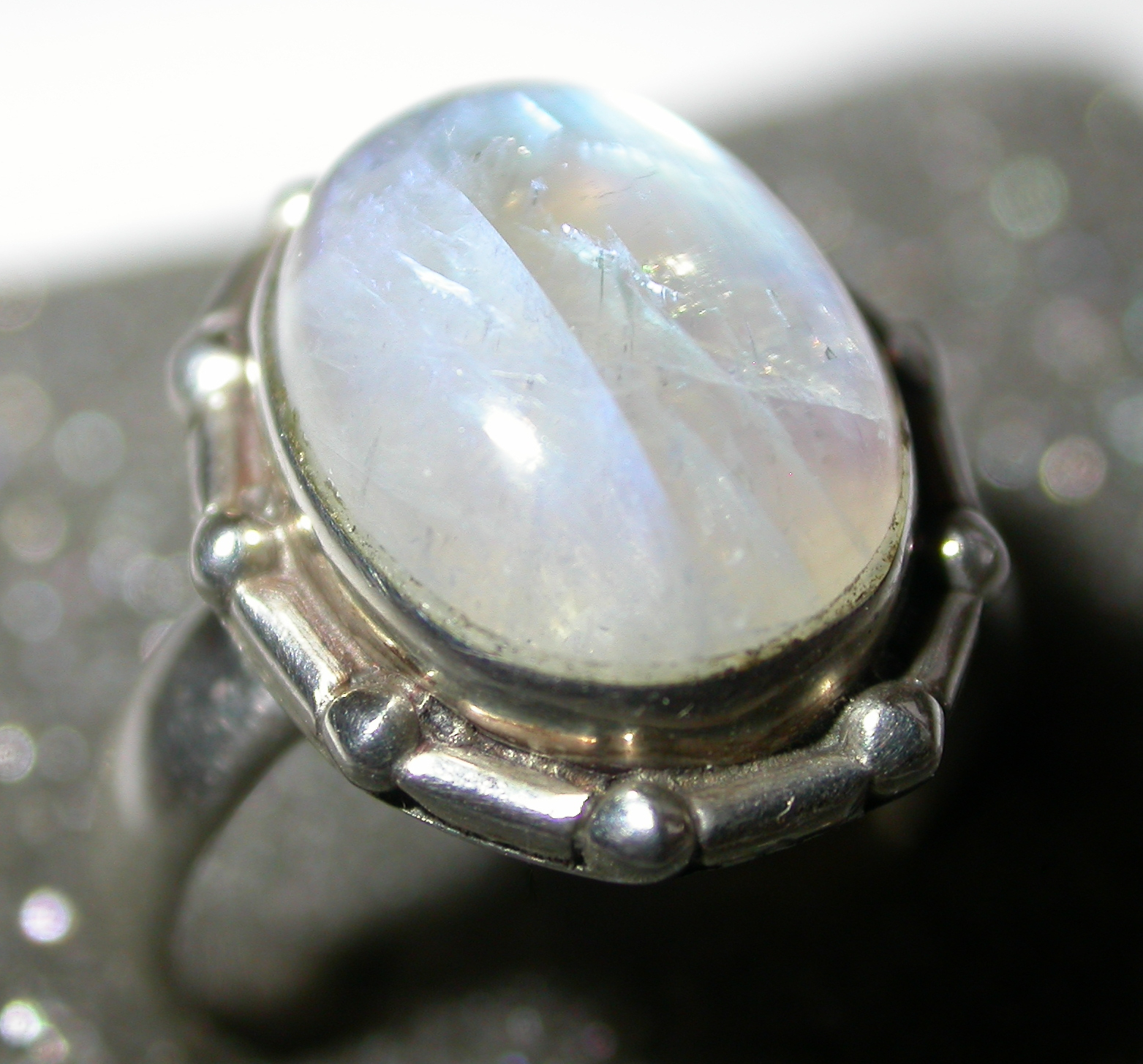
MOONSTONE

Moonstone is a kind of feldspar with a pearly white sheen that, according to popular belief, resembles moonlight. Pliny the Elder claimed that it changes its brilliance according to the phases of the moon (which is not true, but it sounds fun).

The serpent's moonstone
Spanish/Basque legend

Two churches in Navarre, the Santa María de Eunate and the San Miguel de Olcoz have almost identical Romanesque portals at their entrance, like mirror images - and an old legend to explain the similarity.
The legend says that when the Santa María was built in Eunate sometime in the 12th century as a convent for the Knights Templar (allegedly), the master tasked with the work had to take a leave. He was away longer than intended, doing reparations somewhere else and also due to illness.
In his absence, the monks hired a local stone cutter to make the portal for the entrance, and he did so, in an astonishing three days' time. (Some versions of the legend say he was a jentilak, a Basque giant). When the master returned, he was furious to see someone else had done part of his work. To pacify him, the abbot paid him to make an identical portal - provided he could do it in the same amount of time.
The master, desperate, turned to a witch (or lamiñak) for advice. She told him that every Noche de San Juan (midsummer night) a large serpent appears at the nearby river, and deposits a magic moonstone on the bank while it goes bathing.
The master managed to steal the moonstone, and use its power to create an identical portal before the deadline. He placed it in a golden bowl of clear spring water on San Juan's Eve. As the water reflected the portal in the moonlight, the master said magic words, and the mirror image of the portal appeared on the church wall (except it was a little bit off, for the master jostled the bowl by trembling with excitement).
However, when the local stone cutter / giant saw his work, he grew furious, and hit the entrance with such force that it flew over to the neighboring village of Olcoz. The locals did not look a gift portal in the mouth, and built a church around it. There it remains to this day.

Sources: Read the story here, here, here, here, here, here, or here.

If you had the magic moonstone, what would you use it to build?

Thursday, April 14, 2022

L is for Lapis Lazuli (Gemstone Folklore)

Welcome to the 2022 A to Z Blogging Challenge! My theme this year is Gemstone Folklore. Because I love stories about shiny things. Read the introduction to the project here.

LAPIS LAZULI

Lapis lazuli is a metamorphic rock of intense blue color that has been mined for millennia. It often contains pyrite with gives it gold-colored veins. In the middle ages, it was the source of ultramarine blue pigment.

Inanna's descent into the Underworld
Sumer

This old Sumerian myth from about 4000 years ago tells the story of the goddess Inanna's journey into "The Land of No Return." The goddess of beauty, sex, and war (among other things) dresses in her finest, and descends down into the underworld to visit her elder sister Ereskhigal, queen of the dead. Among her adornments whe wears a necklace of lapis lazuli beads, and carries a lapis lazuli measuring rod and measuring line. Ereshkigal herself lives in a palace made of lapis lazuli. Passing through seven gates, Inanna's adornments are taken away one by one - including the beads and the measuring instruments - until she enters the palace naked, and is turned into a corpse. Later on, she is brought back to life.

Lapis lazuli figures into the mythology of Inanna and Ereshkigal in other texts as well. In the Babylonian epic of Gilgamesh (which is claimed to be inscribed on tablets of lapis lazuli itself), Gilgamesh makes various offerings to the gods at his partner Enkidu's funeral. He offers a cup of lapis lazuli to Ereshkigal, and a chair and staff of lapis lazuli to Namtar, her underworld vizier. When Inanna tries to seduce the king, she promises him a chariot of gold and lapis lazuli.
Also, when Uta-napishti tells Gilgamesh the story of the epic deluge he'd survived, he mentions another mother goddess, Belet-ili. Belet-ili mourns for humanity swept away by the flood, and after it ends, she appears to the survivors. She makes an oath to remember the deluge, and swears on her necklace of flies carved for lapis lazuli. Apparently she received the precious necklace from her lover, Anu the sky god. It is the Bablyonian equivalent of the Bible's rainbow...

Sources: Read about the Sumerian texts here and here. Gilgamesh here or here.

What is your favorite kind of blue?

Wednesday, April 13, 2022

K is for Kordierite, a.k.a. Sunstone (Gemstone Folklore)

Welcome to the 2022 A to Z Blogging Challenge! My theme this year is Gemstone Folklore. Because I love stories about shiny things. Read the introduction to the project here.

CORDIERITE

(I know I know, I am cheating with the K, deal with it. It works in Hungarian.)
Cordierite is one of the minerals that has been theorized to be the legendary sunstone, or sólarsteinn, that Norse navigators used in the Viking Age to see the sun's direction on partially overcast days. While it is not the only possibility (Iceland spar is also a strong contender), technically it has been proven to work.

Kings and crystals
Scandinavia

Sunstones make an appearance in various old stories. One is a 13th century Icelandic manuscript that contains an allegorical tale (Rauðúlfs þáttr) of Saint Olaf visiting a wise man named Raudr. The man lives in a meticulously laid out house, in which the king has a vivid dream that Raudr interprets for him. The two sons of Raudr, Sigurd and Dag, are also wise and well educated. Sigurd can guess the sun's position correctly on an overcast day - a feat which makes King Olaf bring out a sunstone to verify.

Another 13th century collection of various Icelandic sagas, collectively known as the Sturlunga saga, also has mentions of sunstones. The stories of two different sagas, that of Icelandic bishop Gudmundur Arason, and doctor and priest Hrafn Sveinbarnarson, intersect in this case. The bishop once gifted Hrafn, world-traveling healer, two things: an exquisite dress for a woman, and a sunstone. Later on, when Hrafn's home was raided, and he himself killed by his old enemy Thorvald, son of Snorri, the raiders took the gifts with them. According to legend, however, the beautiful dress turned into ugly black rags in their hands, and the sunstone looked like a mere pebble to them, so they threw it away on the beach. Later, the precious stone was recovered, without the raiders ever finding out what exceptional treasure they had lost.

Sources
You can read the first story here, the story of Bishop Gudmundur here, and you can find the text of Hrafn's saga here. Find more info on sunstones here and here.

Have you ever read Icelandic sagas before? 
Do you have a favorite story?

Tuesday, April 12, 2022

J is for Jade Seeds (Gemstone Folklore)

Welcome to the 2022 A to Z Blogging Challenge! My theme this year is Gemstone Folklore. Because I love stories about shiny things. Read the introduction to the project here.


JADE

Jade is actually the name of the gem quality version of two silicate minerals: nephrite, or jadeite. It is usually light to dark green in color, and has played an important role in East Asian and South American cultures for centuries.

Squire Yang plants jade
China

A kind man named Yang moves up to a steep mountain where there is no water source. He hauls water up the mountain to establish a free drinking station for pilgrims crossing the pass. One day a traveler, in exchange for his kindness, gives Yang a handful of stone seeds, telling him to plant them in a rocky place. Yang does so, and lo and behold, a crop of jade sprouts from the ground.
Later on, when Yang wants to marry a wealthy girl, her parents ask for a bride price in jade. Yang fulfills the request from his secret jade garden, and earns himself a wife. Finding out about the miracle, the emperor makes Yang a minister, and marks the Jade Field with four columns.

Sources
You can find this story in here. It is a translation from the Soushen Ji, a 4th century Chinese collection of legends and tales.

If you could grow any mineral or gem, what would you plant?