Friday, May 1, 2015

10 Things You Get to Do at a Northlands Conference

Last weekend was the annual Northlands Storytelling Conference in Lake Geneva, WI (kind of poetic that storytellers accidentally found themselves flocking to the birthplace of D&D every year). The conference this year was titled Confabulation; it was my fourth time visiting, and definitely by far the best.
It was con-fabulous.
(Not my pun! Not my pun!)

For those of you who have never been to a storytelling conference before (why not?!), and those of you who have not yet been to the USA's friendliest storytelling conference (that's Northlands), here are 10 things I got to do this year and you didn't.
(But you can next time!)

1. Attend Amazing Workshops
The array of workshops offered this year was staggering, and I wished I would have one of those time-turner thingies from Harry Potter so I could be in more places at once. Alas, without one, I had to make hard choices.
I attended Andre Heuer's three-hour intensive on healing stories, and I learned a lot that made sense to me (there are many kinds of story healing and story therapy, and not all of them do). We got to try out some of the techniques in person, and I ended up with a personally designed sequel to Turtle Flies South to talk about my flight anxiety... Talking about animals, Kevin Strauss' workshop on how to tell biologically correct animal tales was also awesome. I learned about parachuting beavers (which really happened!) and I was an armadillo for a while. Still on the topic of making up stories, I took Loren Niemi's workshop titled "Is the Ghost Story Dead?" and 90 minutes later I left with half a vampire tale that I made up on the spot. We all did. It was great fun. (The ghost story is alive and well). The last workshop of the weekend (other than mine) was taught by Lyn Ford; she used several variations of the Tortoise and the Hare to talk about tailoring storytelling programs to the common core curriculum. I left the conference with a pile of handouts, two new story ideas, and a ton of practical advice.

2. Hear Inspiring Concerts
There is a concert every night! All three days of the conference. We got to hear amazing local, regional and national storytellers bring their very best. In the middle of all the intensive learning that happened in the workshops, it was great to sit back, relax, and let the stories wash over us...
(My favorites were probably Jeff Doyle's wild rendition of a Robin Hood tale, and Beth Horner's telling of how she realized her mother was an academic legend. I highly recommend the latter for Women's Centers, universities, and academic conferences.)

3. Have Breakfast with the Next Generation
Northlands has a scholarship for young storytellers under 35, and this year they gave out 9 of them! Next Gen winners get to meet for breakfast on the Saturday of the conference and talk about how they got into storytelling, where they are going with it, and why a sloth petting zoo is a good idea. (Among other things). This year's 8 ladies and 1 gentleman came from many backgrounds, for libraries to environmental education to performance storytelling.

4. Cash in Some Pocket Stories!
This was a new thing this year, and Jeff's idea. We got together for a story swap of 5-10 minute tales, and all tales told and heard were fair game to take and run with! Storytellers tend to be somewhat possessive of their favorite stories, so it was a fun and liberating idea to do a swap where you could go "what a neat tale!... I'm taking it home!" (We ended up with 13 stories told)

5. Hear Fabulous Fringe Performances
Fringes also happened all three days of the conference, but here I'll only highlight one of them: Janice Del Negro's Broken Molds and Alternative Images: Folktales Reimagined. It was a breathtaking one-hour performance of fairy tales re-told through musing about questions that need to be asked: Why would the girl in Rumpelstiltskin marry the king that threatened to kill her? What happened to the Twelve Dancing Princesses after they were found out? Is wishing for all women to fall in love with you really a good idea?... Janice tells her reimagined tales with captivating eloquence, deep empathy, and craft that stays true to tradition and re-creates it at the same time.
No, really, this show needs a fandom.

6. Go to a Ghost Story Swap
We had one! I am not usually one for ghost stories, but this one was fun, in a dark room with an (electric) fireplace, popcorn, and chilling stories. I even told a Hungarian folktale about a vampire princess - I'll post it here tomorrow for Story Saturday!

7. See a Flash Mob
More aptly titled: See some of the most illustrious national storytellers of the USA dance to "Fabulous" from High School Musical.
Yuup.

8. Make Up Stories for a Raffle
Again, Jeff's idea. The conference does a raffle every year to support the Next Gen scholarship. This year, we had an array of thrift store items, and we spent Friday morning making up stories to make them more appealing. Anne Harding and I created a great tale about a mysterious hat pin. You could hear it drop.
Boom.

9. Teach a Workshop
I did! I taught a workshop on Heroes (the theme of this year's Summer Reading Program) and it was mostly about diversity in the tales we tell. It is kind of my home turf now, I guess, since my folktale collection is also about superpowers and pop culture heroes in folklore... More about it later, I plan on posting some of the workshop materials online.

10. Drink Socialize with Famous Storytellers
There is no conference without networking. You know what happens when you put dozens of storytellers in the same space? Talking happens. Cheerful, enthusiastic, hands-flailing-all-over-the-place, I-didn't-have-a-voice-for-two-days-after, star-struck, ocean deep conversations on life, the universe, and everything. Stories, mostly.

Next year, same place. See you there!

Thursday, April 30, 2015

Z is for Zong Belegt Baatar (Epics from A to Z)

Zong Belegt Baatar is a Mongol short heroic epic. "Short" in this case means under 500 lines (in chanted or sung oral poetry), and can be told in under 20 minutes. For epics, that is definitely short - but not any less epic.
(I read the English translation in this book.)

The Hero
The epic is named after its hero: Baatar means "hero" in Mongolian, and Zong Belegt is the name. He has a body of iron, and for all intents and purposes he is a giant of a man, and the leader and protector of a prosperous land. We don't find out a lot about his personality, but we do learn from the epic that his silk gown has seventy-five buttons.
(That's a lot of buttons)
His wife is praised for her wisdom.

The Highlights
The epic itself tells the story of Zong Belegt Baatar's fight against a terrible giant. The description of the giant is definitely a noteworthy moment: He is described in great detail and with a lot of exaggeration - His toenails are iron hooks, his face has blue stripes and his tongue has brown, and he can cover an entire continent in the smoke from his pipe. I can imagine younger audiences getting a kick out of this description alone... The fight between the hero and the giant is similarly cosmic and landscape-altering.
I found the mention of the iron body intriguing. Those of you who have been following me know that I published a book on superpowers in traditional stories. In it I included a Hungarian folktale about a hero with a body of ice, and a villain with a body of iron. Sounds like it's a popular theme...

This concludes our epic adventure from A to Z! Thank you for sticking with me, I hope you enjoyed the ride. Come back for the Reflections post on Monday (May 4th) - I will tell you a little about some of the epics that didn't make the cut!

Also, check out my book, titled Tales of Superhuman Powers (available on Kindle, Nook and in print), for more epic stories ;)

Outside of A to Z, I write regularly on this blog about storytelling adventures, mythology and MythOffs, books related to folktales and fairy tales, and other story-related odds and ends :) Follow or visit back for updates!

Wednesday, April 29, 2015

Y is for the lost epic of Yi (Epics from A to Z)

Stories, much like people, have a life cycle. Epics are created, told, and when people cease telling them, they slowly break apart and disappear. Some cultures pick up the pieces (like it happened with the Kalevala or the Kalevipoeg). For today, I will write about an epic that might or might not have ever existed.

Origins
In 1995, Mori Masako published an article in Asian Folklore Studies, suggesting that the many accounts and tales of Hou Yi, the most famous archer-hero of Chinese mythology, are actually the scattered fragments of what once was a coherent epic, much like the epic of Gilgamesh. She drew a parallel between Gilgamesh and Hou Yi, trying to arrange the fragments into their original order, from the hero's birth to his death. It is an intriguing article. I was familiar with the tales of Hou Yi before, but never thought of them as an epic; Mori Masako, however, makes a compelling argument.
It is an epic I would love to hear.

The Hero
Hou Yi is an archer. In his part of the world, he is THE archer, really. Some people suggest that Yi is not actually his name at all - it is a title that refers to archers. Hou Yi is known for one very famous feat: He shot nine suns out of the sky, saving the world from being scorched to ashes.
Other feats of his include killing various demons and monsters, and traveling to Kunlun Mountain in search of immortality (much like Gilgamesh did). He never became immortal, though; his wife, Chang'e, drank both bottles of the elixir he brought home, and flew away to live alone in the Moon forever.
Hou Yi is ambiguous in many sources; sometimes he is a hero, sometimes he is a tyrant. Mori Masako claims that those features are reconcilable in an epic; most heroes, like Gilgamesh, have both good and bad sides as well.

The Highlights
Instead of highlights, here are some versions of the story of Yi that you can read:

There is a nice and detailed version in Virginia Schomp's book of Ancient Chinese mythology.

There is also a detailed analysis in Sarah Allan's book The Shape of the Turtle.

In Treasure Mountain: Folktales from Southern China there is a Yao minority tale called Shooting the Moon, in which a brave archer and his wife work together to save the world from a scorching fiery moon. In the end they rise into the moon together as well. It is one of my favorite versions.

Here is a short animated video from the website of the Smithsonian Folklife Festival.

There is also the Mongolian version of the tale type where the hero Erkhii Mergen shoots seven suns.

Tuesday, April 28, 2015

X is for Xi You Ji - also known as Journey to the West (Epics from A to Z)

Come on, guys. Everybody knows the Monkey King, right?... Right?...

Origins
Journey to the West is one of the three great Chinese epics. It has existed in the oral tradition for hundreds of years, and it was also published in book format at the end of the 16th century. It takes place during the Tang Dynasty. It is an epic, mythical journey built on top of the historical event of Buddhism being brought to China.

The Heroes
The main hero of the story is supposed to be Xuanzang, a holy monk that is tasked by the emperor to travel to India and bring back the holy scriptures of Buddhism. He is very holy, very polite, very pure, and not exactly the survivor type. Here is the thing: Any demon who eats him gains immortality. That makes traveling for years through demon-infested lands a tad bit difficult.
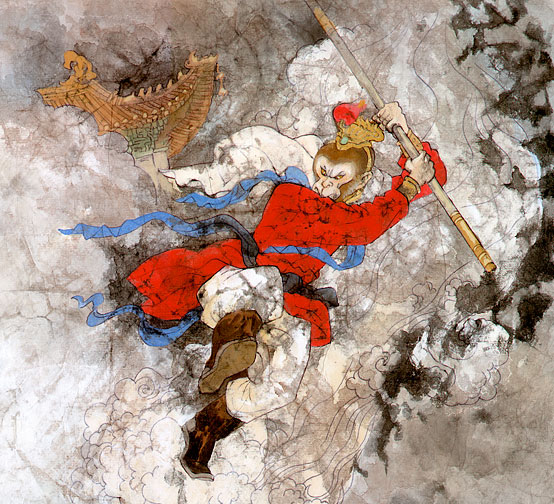
Here is where the real hero (by centuries of popular vote) comes in: In order to protect the holy monk, bodyguards are ordered to accompany him. First and foremost, there is Sun Wukong, the Monkey King, the archetypal Trickster, who once broke havoc in the Heavens, ate the peaches of immortality, crossed his name out of the Book of Life and Death, robbed the treasury of the Dragon Kings, and defeated the celestial armies... until they dropped a mountain on him. A couple of centures later he was freed to help Xuanzang on his quest. In order to keep him in line, Sun Wukong is crowned with an iron band that the monk can tighten with a special prayer - he is, for all intents and purposes, leashed to him until the end.
The other bodyguards are Zhu Baije, most commonly known as Pigsy or Monk Pig, and Sha Wujing, or Friar Sand. Both of them used to be heavenly generals before they were exiled to Earth for various sins, and became demons; they both join the monk's quest seeking redemption. Pigsy it not the brightest bulb on the Christmas tree, and gets in trouble almost as often as he argues with Sun Wukong. He fights with a rake. Friar Sand is more quiet and obedient, and also less powerful than his companions.
In addition to the three misfits, there is also a hidden fourth companion: Yulong, a dragon prince, who is sentenced to be Xuanzang's steed in the form of a white horse.

The Highlights
I know I say this a lot, but it is really impossible to list all the highlights. The entire story is exciting, colorful, and all-around epic.
My favorite chapter is probably the one where the team encounters a den of female Spider Demons who capture the monk with silk threads they shoot from their belly buttons. It is a delightful mix of awkwardness (Xuanzang is kind of scared of women to begin with), terrifying magic abilities, and insect-involved fight scenes.
Another great moment is when Xuanzang and Pigsy accidentally drink from a spring in Women's Country, and they both become instantly pregnant (best monk freakout ever). In order to dissolve the magic pregnancy, they have to drink from another spring, protected by a demon. Sun Wukong takes the matter into his hands... after laughing his ass off.
Another famous moment of the epic is the tale of Princess Iron Fan, whose fan Monkey needs to steal in order to make a path across a mountain of flame. She proves to be a worthy opponent in a fight, together with her close-knit family of demons.
I also love the end of the story, when Sun Wukong asks to be released from the headband... just to find it is already gone.
Really, honestly, I could go on forever and ever. At one point I even ran a blog about this epic together with another storyteller, writing about our favorite scenes.
Just... go read the books.

Adaptations
Journey to the West literally has thousands of adaptations in cinema, TV, theater, song, and games. Monkey keeps popping up everywhere. Remember Goku in Dragon Ball? How about Jet Li in the Forbidden Kingdom? Some of my favorite takes on the story are the Japanese manga/anime Saiyuki, the post-apocalyptic video game Enslaved (with the talent of Andy Serkis bringing Monkey to life), Stephen Chow's recent movie adaptation (in the vein of Kung Fu Hustle), and, more recently, Zen Cho's short story Monkey King, Faerie Queen. Once you know the story, you'll see it everywhere!

Monday, April 27, 2015

W is for Wagadu (Epics from A to Z)

“Four times Wagadu rose. A great city, gleaming in the light of day. Four times Wagadu fell. And disappeared from human sight. Once through vanity. Once through dishonesty. Once through greed. Once through discord.”

Origins The story of Wagadu is one of the most haunting, most enchanting pieces of oral literature I have ever encountered. It is a West African epic by the Soninke people, and tells about the early history of the place we know today as Ghana.
Sadly, no full English version of the epic exists today. Several different books present several different pieces of it, collected from the oral tradition. As suggested by the opening lines above, the full story would consist of four parts, each telling the rise and fall of one aspect of Wagadu (named Dierra, Agada, Ganna and Silla, respectively).
The most complete part of the story survived known as "Gassire's Lute" (collected by Leo Frobenius at the beginning of the 20th century). Other parts can be found in Oral Epics of Africa, and Courlander's A Treasury of African Folklore.

The Hero
The hero of Gassire's Lute is Gassire, the son of the king of the first Wagadu. Not being able to wait until his father dies to take the throne, he decides to become a griot instead - claiming that rather than being "second among the first" (the highest social class) he'll be "first among the second" (the keepers of the lore). In the end it is his blind vanity that brings down Dierra.

The Highlights
All of it, really. The rolling eloquence of the language, the haunting chorus, the mysterious opening lines (see above), and the gripping story of how Gassire slowly realizes he got way more than he bargained for when he decided to pursue the destiny of a storyteller. The blacksmith creates a lute for him, but the lute won't sing until it becomes part of Gassire's life and family - through drinking in their blood. Gassire starts taking the lute to battle with him every day, willing to endanger and sacrifice all of his sons to achieve his goal...

This story packs a punch. I wish I could have found a more complete version of the rest of the epic.

Saturday, April 25, 2015

V is for the Vetala Tales (Epics from A to Z)

(I was going to do the Völsunga saga, but we have had enough Vikings already)

Origins
All right, so the Vetala Tales (Vetālapañcaviṃśati) is not exactly an epic. It is a collection of short tales from the oral tradition of India, set inside a frame story, much like the Arabian Nights. It is more often known in English as the Twenty-five Tales of the Corpse Demon. It has four versions written in Sanskrit (both in prose and in verse), and other versions also exist in Hindi, Tamil, and other Indian languages. The English translation I used was based on the Sanskrit versions written down by Sivadasa and Jambhaladatta, sometime between the 11th and 14th centuries.

The Hero
The "hero" of the frame story is the legendary King Vikramaditya, the protagonist of countless Indian tales (I included one of them, involving paintings that come to life, in my book about superpowers). In exchange for valuable gifts, he volunteers to help a mysterious man perform a ritual that would give him supernatural powers. The King's task is to go to the burning grounds at night and bring a corpse that is hanging on a tree.
What the King doesn't know is that the corpse is inhabited by a vetala (an ancient deity, also sometimes translated as a genie, a goblin, a spirit, a vampire or a demon). If the King breaks his silence while carrying it, the corpse magically returns to the tree. As Vikramaditya carries his burden, the corpse starts telling him tales; each tale ends in a dilemma or a riddle. The King can't help answering them each time, and the moment he speaks, the corpse flies back to the tree, and he has to go fetch it again. This happens twenty-four times - hence the collection of stories.

The Highlights
While the book itself was a translation of Sivadasa's version, with some of Jambhaladatta's tales in the Appendix, I definitely liked the style of the latter more. It was more detailed, and all in prose. Also, a lot of the stories in the collection will read as strange or downright sexist for contemporary Western readers - don't forget that this is a historical text. Some of the King's answers to the riddles won't make sense to anyone else but the people of that time and place. But it is still an interesting read.
Some of the stories I enjoyed, mostly for their dilemma-endings which can start interesting debates:
1. Of Mandharavati and her Three Suitors (Tale 2) - a popular story among contemporary storytellers, and a riddle about the nature of love (and relationships)
2. Of the beautiful Mahadevi and her Three Suitors (Tale 5) - another popular folktale type about three companions that save a girl together, only to end up with a debate over whom she would choose as a husband
3. Of the young bride who switched heads (Tale 6) - while somehow reminiscent of season 3 of American Horror Story, this is an entertaining little tale with a moral dilemma in the end (once again over a girl)
4. Of three very delicate Queens (Tale 10) - an early variation on the idea of the Princess and the Pea
5. Of the merchant's daughter who loved a robber (Tale 13) - a refreshingly different love story among not very female-friendly tales, with a hint of Robin Hood
6. Of Jimutavahana and his supreme sacrifice (Tale 15) - An exiled prince offers his life to end a cosmic war between the serpent people and the Garuda bird
7. Who is Prince Haridatta's real father? (Tale 18) - an interesting legal-moral riddle of multiple fathers and a very non-traditional family model
8. Of three rather fastidious Brahmanas (Tale 23) - another take on Princess and the Pea, this time with three guys. A version of this story is also included in my book under Enhanced Senses.
9. Of strange and riddling relationships (Tale 24) - Another mind-bending riddle over family relations (this one actually took me drawing family trees to figure out)

All in all, most of these tales will spark lively conversations when told. That is kind of the entire point.

Friday, April 24, 2015

U is for the Ulster Cycle (Epics from A to Z)

The Ulster Cycle is one of the four cycles of Irish epics, centered around the heroes of Ulster (surprise). The most well known part of the cycle is the Táin Bó Cúailnge (in English, the Cattle Raid of Cooley), and the only reason this whole post was not under T yesterday is because I couldn't find another candidate for U. So, one day late, but here we are!

Origins
The Táin (as well as the rest of the cycle) takes place about two thousand years ago, in the 1st century AD. The earliest written versions are from the 12th century. This is an old, old, old story, you guys. And extremely important to Ireland's culture, history, and identity. It revolves around Ailill and Medb, king and queen of Connaught, going to war against Ulster over a bull, and re-arranging the Irish landscape while at it.

The Heroes
The uncontested protagonist of the Táin is Cú Chulainn. He is incredibly strong, kind of crazy in battle (okay, so, VERY crazy in battle), but all in all a great lad. He is the nephew of the king of Ulster, and was originally called Setanta until he accidentally killed a giant bloodhound with his bare hands, and then took its place. They named him the Hound of Culann. He was a little boy at the time.
While most of the story revolves around Cú Chulainn, both sides of the war have a great lineup of heroes. The great nemesis is Queen Medb, who is not only an incredibly (physically and mentally) strong woman, but also very entertaining in her many ways of trying to secure victory. She repeatedly offers her "friendly thighs" to heroes who might fight in her name, for example. Also on the Connaught side is Fergus mac Róich, an honorable and clever exile from Ulster who refuses to fight against his friend Cú Chulainn (and is not-so-secretly also bonking the queen). Both sides enumerate their many great heroes over the course of the epic, and honestly, I greatly enjoyed their individual descriptions.

The Highlights
One of the best parts of the epic is the story explaining why Cú Chulainn has to protect Ulster alone for half a year, while all the other heroes roll around in labor pains (yuup). The legend is called "The Pangs of Ulster" and it includes the hands down best curse in Irish mythology.
Another part close to my heart is Cú Chulainn's training in Scathach's school for warriors. Because of the coolness factor of a lady training Ireland's best heroes in her own (hard to approach) institution, and for all the things she teaches them, this part would merit an entire movie all on its own.
The pillow-talk that sets off the entire war is also quite great - Medb and her husband have a long discussion about which one of them is in fact running their kingdom. Medb calls her royal husband a "kept man."
Apart from Cú Chulainn being constantly badass, another Ulster hero kind of steals the spotlight for a while. Cethern returns from the fight against the enemy all wounded, and then proceeds to explain how he got each would. When the healer tells him he can rest and live, or fight and die, he chooses the latter, and they re-create his broken body with borrowed bone marrow and various chariot parts. He goes back to fight some more.

Other entertaining moments include:
Medb calling Cú Chulainn a "peppery overgrown elf."
Cú Chulainn threatening his opponent with "I will stand above you like a cat's tail erect."
Cú Chulainn encountering Medb alone while she is having her period in the woods, and deciding not to kill her.
The detailed description of Cú Chulainn going into his "war-spasm" and hulking out in a way that would make Bruce Banner cower in shame.
The women of Ulster flashing Cú Chulainn in order to cool down his war-spasm (and the order from the king "Bring the naked women!!!")

The Táin was also the chosen epic for this year's Epic Day. We told it in six hours! I blogged about the experience here.