Thursday, April 23, 2015

T is for Thidrek of Bern (Epics from A to Z)

If you like Norse sagas, King Arthur legends, and Alternate Universe fan fiction, then you will like this epic.

Origins
The group of legends centered on Thidrek (Dietrich) of Bern is German in origin. The particular collection discussed here, known as the Thidrekssaga, however, was probably written down somewhere in Scandinavia (although scholars can't agree if the writer was German or Norse). The English translation is almost 300 pages long (in extremely small print). The saga is usually dated around 1250, the high time of romances of chivalry... and boy does it deliver.

The Heroes
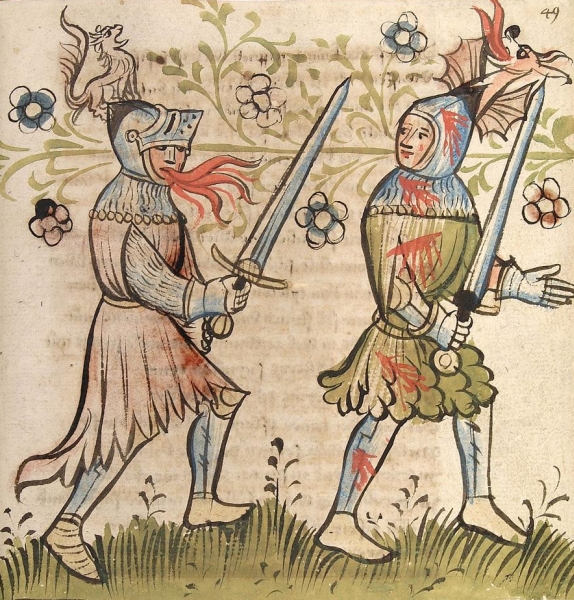
The story is essentially a mash-up of German legends such as the Niebelungenlied, some Norse sagas, stories of Attila the Hun, and a great dose of Arthurian pomp. It features several historical names, but in the end, it is a product of chivalric fiction.
In the center stands King Thidrek of Bern (Dietrich of Verona), who is often equated with the historical king Theoderic the Great. Around him gather the great names of German legends: his mentor Hildibrand (who can still kill ten young warriors in combat when he is over a hundred years old), Siegfried (the invulnerable dragon-killing hero of the Niebelungenlied), Heimir (who is not a nice person, but great with horses), Vidga (the white-haired half-mermaid son of Wayland the Smith - he is essentially the Lancelot of the bunch), Sistram of Fenidi (who joins the team after they fish him out of a dragon's mouth), Thetleif the Dane (who is not very smart, but very strong), Vildifer (who can and does pass for a live bear in combat), Herbrand the Far-Traveler (the diplomat of the team), Ekka and Fasold (the stereotypical red-haired identical twins, one a friend and one an enemy), Högni (the one-eyed, grumpy half-elf knight) (yeah, you read that right), Sifka (the traitor) and Earl Hornbogi (the handsome one).
Impressed yet?
Add Attila the Hun to the mix (he's best friends and allies with Thidrek), and you have a vague idea of the lineup you will meet in this story.
(There is an entire chapter devoted to what each of them look like, how they dress, and what their coat of arms is. They also all get their own backstories.)

Highlights
While a huge part of the saga is taken up by very detailed duels and epic battles, it also has a lot of other delightful bits going for it. For example:

1. The duel between Thidrek and Ekka (the evil twin). They meet in the woods at night, and neither can see the other. After Ekka taunts Thidrek with how superior his weapons are, they decide to fight. Thidrek strikes sparks on rocks with his sword to see where his opponent is, and they fight in the flashing light of sparks flying from their blades. Now there's a visual.
2. The scene where Thidrek and Fasold find a dragon on a clearing. The dragon is in the process of devouring Sistram, whose head and shoulders are still free. He yells instructions at the two knights on how to kill a dragon, one of which is "Don't cut its neck! My legs are way down its throat..."
3. The time young Thetleif defeats an older knight (who rides an elephant) and after the duel they become friends and go home together. When the daughter of the old knight sees her father wounded, she yanks Thetleif off his horse and throws him down with a force that would kill a normal man. Of course they fall in love later.
4. The time Vildifer dresses up as a bear and sneaks into the enemy's castle to rescue the imprisoned Vidga. The enemy king doesn't realize there is something wrong with the dancing-bear performance until the bear draws a sword... At which point the king comments "That's a well trained bear!" (Famous last words)
5. The time Vidga kills a giant in single combat, and then covers himself in the giant's blood and rides back to his friends, pretending to be mortally wounded. Everyone panics, and Vidga laughs his bloody ass off.
6. There is a version of Tristan and Iseult's legend in here - Herburt and Hild - and it has a happy ending. That in itself made me so happy...
7. There is a battle where one of the kings is helped by his wife, the sorceress Queen Ostasia. She summons an army of lions, bears and dragons. The entire chapter is just one big battle scene between knights and combat dragons. I was having some serious Maleficent flashbacks.
8. When King Thidrek gets angry, he literally breathes fire. He only uses it once in combat, though.
9. This line: "King Hertnid rode at the dragon more out of honor than out of wisdom." (He gets devoured)
10. The time Heimir becomes a monk, and then decides to return to being a knight when a giant threatens the monastery. The monks tell him they already broke down his sword and used it for door hinges (it's one of the three magic swords in the saga). Heimir almost gets a stroke.
11. The time Earl Iron gets so obsessed with hunting that his wife feels neglected. Finally she goes out into the fresh snow and rolls around naked, leaving boob-prints all around the castle. Then she goes back to her husband and says "I have seen the tracks on a very rare new prey around the castle. If you don't hunt it soon, some other man will."

(This saga was definitely one of my favorites I read for this challenge.)

Wednesday, April 22, 2015

S is for the Shahnameh (Epics from A to Z)

When it comes to epics, the Shahnameh (also known as the Persian Book of Kings) is definitely one of my favorites. I have loved it since I read some stories from it in an abridged "Epics of the World" collection back in middle school.

Origins
The Shahnameh is the national epic of Iran, the history of their kings from mythic origins all the way to the 7th century. It was written in verse at the turn of the 10th and 11th centuries by the poet Ferdowsi, who based his work on much older sources, tales and legends. The book contains some of his notes, comments, and musings about his own life during the thirty-something years he worked on it.
The Shahnameh exists in a number of English translations. I bought the 1967 Persian Heritage Series volume, translated by Reuben Levy - mostly because it is lavishly illustrated with miniatures. It turned out to be a very hard read, since Levy wanted to reflect the archaic language of the epic by putting it into Shakespearean (prose) English. Also, he annoyed me by cutting some of the best mythical parts out of the story, calling them "fanciful tales." I ended up re-reading the missing parts from the newer edition translated by Dick Davis.

The Heroes
The center of the epic is a long line of Iranian kings. Some of them, especially in the legendary eras, get more detail and attention than others. The greatest hero of Iran is undoubtedly Rostam, son of Zal, who lives for long centuries fighting for Iran under various Shahs (kings). Also worth mentioning are Esfandyar, the invulnerable prince, and Bahram Gur, with whom a whole lot of tales are associated (including Nizami's Seven Wise Princesses, which I introduced last year). The story also features some intriguing female characters, both slaves and royals, such as Gordiya the warrior maiden or Shirin, the poison-wielding matron of the royal harem.
And then there is Zal.

The Highlights
The undisputed best part of the entire epic (if you ask me) is the tale of Zal and Rudabeh. It is a love story for the ages, between a white-haired prince who is raised by the colorful mythical bird Simurgh, and Rudabeh, the daughter of a nobleman descended from Zahhak, one of Iran's first kings who was turned into a dragon by his evil ways. Both outcasts in some way - Zal for his unusual coloring and Rudabeh for her bloodline - the two fall in love. Some say they are the origin of the Rapunzel tale, since Rudabeh offers to let Zal climb her braids to her tower (which Zal refuses because he is awesome and he brought a rope). They end up getting married and becoming the parents of Rostam (who is delivered by the world's first C-section, assisted by the Simurgh, who is better than any fairy godmother ever). The entire story, from start to finish, is amazing, and everyone should read it in its full glory.
Another tale that I really like is that of Esfandyar (I included it in my book about superpowers in traditional stories, since it features an invulnerable hero). It is the story of a struggle between father and son for the throne, in which the prince chooses honor over inheritance. He also goes through an epic journey fighting demons and monsters to rescue his sisters, and ends up being forced to fight Rostam to the death, something that neither hero wanted and both of them regret. It is one of the most eloquent parts of  the epic.
There are two shorter stories that I like as well, one involving the invention of the game of chess and its arrival to Iran, and the other the story of how Kalila and Dimna was translated into Persian.
I also really love the miniatures and paintings that are used to traditionally illustrate manuscripts of the Shahnameh. They are full of bright colors, minute details, and life.

Tuesday, April 21, 2015

R is for the Ramakien (Epics from A to Z)

A lot of people have heard about the Ramayana, one of India's (and the world's) great epics. In the spirit of introducing readers to less well-known (at least in Western education) works, I picked another version of the same story: Thailand's national epic, the Ramakien.
I first came into contact with this epic when I told a short portion of it for a MythOff event. For this challenge, I went back and re-read the full English prose translation, and I found it even better that I remembered. The version I read was based on an 18th century document; earlier written versions of the epic were destroyed and lost in 1767.


Origins
The Ramakien (sometimes also spelled Ramakian) tells the story of an epic war between demons and humans - the latter side led by reincarnated deities and supported by a great monkey army. It is also a story of rescuing a damsel in distress (war breaks out when the king of the demons, Totsakan, kidnaps the hero's wife), and re-arranging the cosmic Thai landscape with the involvement of Heaven, earthly kingdoms, and several countries of the Underworld.

The Heroes
The power couple of the epic is Pra Ram (the human reincarnation of the god Pra Narai) and his wife and love Nang Sida (the reincarnation of the goddess Laksamee). They are surrounded by a stellar supporting cast including Hanuman the monkey-deity-trickster hero, Pra Ram's brother Pra Lak, Pipek the demon seer who betrays his evil brother and joins the human side, and a whole line of distinguished monkey generals and warriors.
Interestingly enough, the demon side is just as diverse and full of intriguing characters. The main villain for most of the epic is the ten-headed, twenty-armed Totsakan, surrounded by terrifying demon warriors and supported by his wife and love Nang Monto. While Totsakan is definitely the bad guy, he is also surprisingly gentle and loving with his family, and at the moment of his death he goes out with dignity and humility. The demon side involves a lot of good characters such as Benjakai, Pipek's shapeshifter daughter who falls in love with Hanuman while working to deceive the monkey army, and ends up marrying him after the war is over.

The Highlights - 12+1 times the Ramakien is truly epic
1. Monkey. Army.
2. Magic in this story works in amazingly logical ways. Shapeshifters have to see the person they want to copy. Magic weapons have to be charged with a certain amount of power before they are used. People have to go through a rite to become immortal. When incantations are interrupted, rituals fail. The heroes (and villains) of the epic take advantage of these rules in multiple ways.
3. The main form of combat in the Ramakien is archery, performed with powerful magic arrows that have various effects such as a rain of snakes (or birds of prey to eat the snakes), rings of fire, diamond nets, lightning and thunder, and even bringing dead soldiers back to life. Heroes and villains pick their arrows to counter the effects created by their opponent. Magical combat archery.
4. When Nang Sida is accused of adultery and exiled by her husband, she gives him an epic run for his money. Once Pra Ram realizes he was wrong, he tries to make amends (with the wife who just lived ten years in exile because he didn't believe her word). Nang Sida is having none of that, and after giving him a piece of her mind multiple times, she goes as far as divorcing him. In the end, and entire committee of gods is needed to convince her to give him a second chance, and even then all she says is "I'll try."
5. Queen Kaiyakeese holds the chariot of her husband together with sheer force while they fight a demon.
6. The sweet moment when Nang Sida gets married and leaves the house of her parents. As they are left alone in the quiet, the old parents "pledge their love to each other."
7. Sadayu the magic bird sacrifices his life to stop Totsakan from kidnapping Nang Sida. He fails, but manages to stay alive long enough to bring the news to the husband.
8. Hanuman sleeps with  mermaid, and the result is a tiny monkey with a fish tail. They keep him in a little lotus pond. At one point he tries to beat his father with a flower.
9. "Fighting a battle is like throwing water: Both sides get wet."
10. The time when Hanuman sneaks into the demon city and ties Totsakan and Nang Monto's hair together as they sleep. The magic knot can only be broken if Nang Monto punches her husband in the face three times.
11. The fact that even after Hanuman gets his own kingdom, he still spends his time climbing trees and scratching his head with his feet.
12. The time when Nang Sida gets a stern lesson in motherhood from a bunch of female monkeys for leaving her child alone in the forest with a meditating hermit for a babysitter.
+1. The time when Hanuman does the "I've got a jar of dirt!" routine with Totsakan's heart in a box.


Fun fact: According to an image published in Time Magazine, Barack Obama carries a small figurine of the Ramakien's Hanuman in his pocket for good luck. How cool is that.

Monday, April 20, 2015

Q is for the Queen of the Mountains (Epics from A to Z)

The lineup got slightly wonky here: I'll have to introduce you to Dietrich's first quest before I introduce you to the awesomeness that is the Dietrich Cycle (which you will see under T in three days). But I was really hard pressed since the only epic that starts with a Q is not available in English. Therefore, I had to go with the Queen of the Mountains, and Dietrich's first Quest. It's a great story anyway.

Origins
The poem generally known as "Virginal, Queen of the Mountains" was written sometime before the 14th century, and it is German (Swabian-Alemanic) in origin. It survives in three different versions, two of which are fairly long, and none of which are translated. I read it in two, freely available short prose translations here and here.

The Hero
You'll hear enough of Dietrich later, so I'll talk about Virginal instead. She is introduced as the Queen of the Mountains (of Tyrol), and also as the Queen of the Dwarves. This in itself sent me into a righteous gloating mood over the "female dwarves are not authentic!" whiny part of the Tolkien fandom. 
Sadly, none of the story actually calls Virginal herself a dwarf, although it would be interesting to look at the German text. In English they call her an elf, and describe her as a beautiful maiden dressed in white and crowned with a magic jewel (sounds like an elf doesn't it). She also marries the (human) hero in the end, which means she's probably not a dwarf - although it has to be noted that the same legend cycle does mention a (happy!) marriage between a Dwarven king and a human princess. (The legend is called King Laurin's Rose Garden. I love that story so much, I even included it in my book!) 
Anyhow, dwarf or elf, Virginal (whose name, while it seems self-explanatory, probably derives from a Gothic word that means 'mountain') rules over the glaciers and snow-covered peaks of the mountains. According to the story she has a magic jewel in her crown that allows her to command all the creatures - dwarves, elves, giants - of the mountains (although, concerning the main story, it probably doesn't work very well).
While the idea of an elf queen over a dwarf kingdom bugs me, she is still a fairly interesting character.

The Highlights
The story itself is much like many other medieval romances: Virginal's kingdom is threatened by evil giants (the traditional enemies of dwarves) led by two evil magicians, and she asks help from the great hero Dietrich and his knights. Several adventures commence, giants are slain, maidens are saved, dragons are defeated, until finally Dietrich kills the last evil magician, and the war is over. As I said earlier, he marries Virginal in the end, and she gives up her kingdom (meh).
Some of the fun parts:
1. While fighting re-spawning giants and dragons all night (courtesy of black magic) Dietrich and his mentor Hildebrand rescue a knight from a dragon's mouth. Literally. That's a whole new level of "Look what the dragon dragged in!"
2. Much in the  vein of Hansel and Gretel, the maidens offered to the evil giants as sacrifice are kept in a chamber, being fattened for consumption. For some reason, I found this amusing. Especially since the wording said: "In the castle they found three of the queen's maidens, cooped up for fattening."
3. Virginal has an "undefeated champion," a dwarf called Bibung, who during the story turns out to be a tremendous coward.
4. There is a cosmic battle in the end with human heroes, magicians, dragons, giants, evil hounds, and all kinds of natural disasters. Very epic.

Sunday, April 19, 2015

A Whirlwind of Stories

Sunday is Visiting Day! We take a break from writing A to Z, and catch up on visiting other blogs. If you are looking for A to Z posts, scroll on down!
In the meantime, I am going to write about an awesome storytelling gig I had earlier this week.

After a long semester of snow days and schoolwork, I finally had the time and the opportunity to return to the local school that I adopted for storytelling practice purposes. They invited me in for Right to Read Week. I was scheduled to visit 7 classrooms on Thursday, and 2 on Friday - it was going to be a whirlwind of stories!
I unleashed a full semester's worth of pent-up storytelling energy. The kids didn't know what hit 'em. I broke in three new stories:
The King's Daughter who Lost her Hair (an Akamba folktale, about a princess who is mean to a magic bird and in return she goes bald; a hero has to go out and find a magic hair tree for her)
The Red Lion (a Persian folktale, about a prince who is terrified of lions, but no matter ow far he runs, he keeps encountering them, until he learns to face his fear)
The Sisimiqui (a Costa Rican folktale that features a rabbit riding an armadillo into battle) (yeah you read that right) (5th grade actually tagged this one "Assassin's Creed: Bunnyrabbit")
All three worked great. I did the princess one multiple times, and it was not only tremendous fun to tell, but it also managed to hold the kindergartners' rapt attention for almost twenty minutes!

I told a bunch of other things as well, such as Greek myths in 4th grade (Dionysus and the Pirates, and the fable of Momus - because they asked for my favorite), Journey to the West and some Nart sagas in 6th grade (I was really not planning on the former, but they were still talking about our trickster stories from last year, and before I knew it, I was asking them "have you ever heard about the Monkey King?..."), the adventures of St. Vincent de Paul (it's a Catholic school), and the meeting of Oisín and St. Patrick (to explain how tales get written down).
One of the things I loved the most was the questions kids asked. After every story they got to ask me anything they wanted to know, and most of them had great questions (if you ask me, the education system needs to encourage all students to ask as much as they can...). The first and second graders, for example, after hearing the tale of Oisín and Niamh and St. Patrick, had a slew of fun questions, such as "Who was Oisín's mother?" and "What was the name of his friends?" and "How could the horse run on water?" and "Where did the fairies go?" and "Are the Fianna the same as knights?" and even "Why did Oisín not die when he aged 300 years?" I was happy that I have a solid background knowledge in Fianna legends - answering their questions promptly and with real information delighted both them and me.

I was completely spent by the end of the day, but it was totally worth it.

Saturday, April 18, 2015

P is for the Panther Skin Knight (Epics from A to Z)

Origins
The Knight in the Panther's Skin, written by poet Shota Rustaveli, is the national epic of Georgia. The epic poem was composed in the 12th century, under the reign of Queen Tamar, with whom sources suggest the poet was distantly and madly in love. I read the epic in its English prose translation.
The Knight in the Panther's Skin is a tale of love and adventure. It doesn't actually take place in Georgia - rather, it happens in a half-imaginary landscape between Arabia, India, and the Kingdom of the Seas. And while it aims to tell a double love story, it ends up being something more than that: A tale of friendship and loyalty.

The Heroes
The two main male heroes of the epic are Avtandil, commander-in-chief of the Arabian armies, and Tariel, a young king from India (the latter being the knight in the title). Both of them are great champions - honorable, brave, loyal, and blindingly handsome. They are also both madly in love with two young queens, Queen Tinatin of Arabia, and Nestan-Darejan of India, respectively. The story centers on Tariel's exile from India and his meeting with Avtandil. The two love-struck heroes soon become best friends, and Avtandil takes it on himself to reunite Tariel with Nestan, which he manages to do, after many adventures.
Next to the star-crossed power couples, there are also some notable female supporting characters in the epic, such as Tariel's loyal sister Asmat who follows him into exile, and Phatman, a rich woman from the City of Flowers, who saves Nestan-Darejan in her exile and makes sure the lovers end up united.

The Highlights
After reading so many epics centered on fighting, I enjoyed this tale of love, intrigue and adventure. It is essentially a friendship for the ages, between Avtandil and Tariel, as well as between the two queens, and their supporting cast. Some things that I especially liked:
1. The fair treatment of women. They not only become sovereigns in their own right (spoilers, even Asmat gets a kingdom), but they are also described with the respect and admiration due to sovereigns, and their legitimacy is never questioned.
2. The importance of friendship. "He who does not seek a friend is his own enemy," says Avtandil at some point. One of the great messages of the epic is that no one can be a hero alone. One of the most powerful scenes is when Avtandil talks Tariel out of suicide, with compassion and ingenuity.
3. Phatman's character. Not only is she crucial to saving Nestan who had been thrown out of her kingdom, but she also acts as a mother figure and some kind of early feminist icon to her. She clearly takes pleasure in sleeping with younger men and she admits it - and she never gets punished for it. She is a rich, clever, independent lady married to a not-too-bright husband, and she puts her means to good use, helping young love find its way.
4. The cathartic final fight. Avtandil, Tariel and their third king-friend, Nuradin-Phridon, launch an attack against an impregnable citadel to rescue Nestan. It is a fairly well done fight scene (with some serious planning), but the crowning moment of it all is the end: Once the fortress is secured Avtandil and Phridon go in search of Tariel (they got separated in the fight). They find a trail of dead guards and scattered weapons, and finally find Tariel himself inside the citadel, helmet cast away, sword dropped, kissing Nestan for dear life. Boom. Hollywood ending. I totally ship them.
5. Love is suffering. I like how much guys suffer from love in this story. They definitely don't hide their emotions or try to look tough. They sigh, they cry, they faint. One of my favorite moments early on is when Tariel tries to write a love letter to Nestan and fails; finally his sister Asmat dictates to him what to write. Because that's what big sisters are for, after all.

Friday, April 17, 2015

O is for Ogier the Dane (Epics from A to Z)

I remember reading the story of Holger Danske in a picture book when I was little: The story said that he was a great knight who now sleeps under the castle of Kronborg in Denmark, waiting to wake up and return when he is needed.

Origins
Ogier the Dane (French), or Holger Danske (Danish) is a hero from medieval romances of chivalry. While the stories claim he was a Danish prince, most of the romances in which he is featured are French and Italian. I read a prose version of his story based on a French romance (Chevalerie d'Ogier de Denamarche) written in the early 13th century.

The Hero
Ogier is the firstborn son of the king of Denmark. At his birth he is visited by "six ladies of ravishing beauty" who each grant him a gift (and, surprisingly, none of them curses the child). The last of the six is none other than Morgana le Fay, who takes her chance to call dibs on the little hero (after he has been gifted bravery, strength, and handsomeness).
Ogier grows up as a hostage in Charlemagne's court and becomes one of his greatest paladins (and makes friends with legendary characters such as Roland and Olivier). If you like the legends of King Arthur and the Knights of the Round Table, definitely read more about this court as well!
Ogier is strong, brave, and honorable - the very image of chivalry. What is even more important, though, is the gift given to him by the fourth fairy: “Lest all these gifts serve only to betray, I give you sensibility to return the love you inspire.” That's a very good quality for a hero.

The Highlights
The legend of Ogier the Dane has pretty much everything you would expect from a medieval romance of chivalry: Epic battles, daring duels, enchanted love, magical voyages, and even a trip to the Holy Land.
One of my favorite parts is the duel between Ogier (merely a day after he has been knighted) and the King of Mauritania, the Saracen Carahue. The son of Charlemagne, Charlot (who is very Mordred in a lot of ways) is also scheduled to duel with Carahue's cousin, but he decides to plan an ambush instead and get rid of the enemy, as well as Ogier (because he is jealous of his father's love for the young knight). Seeing the ambush Ogier and Carahue stop their duel and fight side by side - for chivalry, and against treason. They end up saving each other's lives and becoming best friends. Carahue keeps showing up over the course of the romance to save Ogier or help Charlemagne against other Moorish armies. It is a remarkable moment in the legend where honor and friendship trumps cultural and religious differences.
Another favorite character of mine is Turpin, who "occasionally recalled to mind that he was an archbishop." He is a priest, but also a knight and a warrior, and a very clever man - Charlemagne's most trusted adviser. He saves Ogier's life when he is imprisoned: The king plans to starve him to death by only allowing a quarter loaf of bread and a quarter cup of wine a day. Turpin, keeping to the word of the law, starts making loaves from two bushels of flour, and makes a cup the size of a barrel, keeping Ogier well fed. He is a fun, clever, likable character, and I have loved him since I read a folktale about him saving Charlemagne from enchantment (Aix-la-Chapelle: The Magic Ring).
Ogier has a wife, and a hundred-year enchanted love affair with Morgana, but the most touching love story happens at the end of his tale: After missing almost two hundred years of French history, he returns from Avalon to find Hugh Capet on the throne. He is introduced to the young queen, who is very curious about Ogier's stories and the history he lived; he tells her all of his life, and they fall in love through long conversations. When Hugh Capet dies, Ogier proposes to the queen... But sadly, the marriage never comes to pass.