Tuesday, April 10, 2012

I is for I'm going to talk about Hungarian Easter now

Really, I couldn't find anything that starts with I, but this is something that doesn't cease to amuse my American friends, so I'm going to write about this anyway.


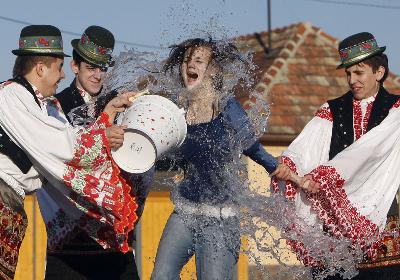
It's called Locsolás, and they usually translate it to Easter Sprinkling, even though the proper term would be Easter Dousing. Really.

In Hungarian tradition, on Easter Monday, guys go around knocking on doors, asking girls if they are allowed to water them like flowers, so they can stay fresh throughout the year (yeah, it's a fertility thing). They have clever or not so clever little rhymes and poems, asking for permission. When permission is granted, they take a bucket of water (if you are lucky) or a bottle of perfume (if you are not so lucky) and proceed to thoroughly drench you to an extent that no actual flower would survive.

Basically, it's the wet t-shirt contest of our ancestors. You can't argue with it if it's tradition!

Sounds fun, right?
Listen up, guys, it gets better.

To thank the men for keeping them fresh, girls are supposed to pay for this! Traditionally, they pay with painted eggs (and alcoholic beverages); nowadays, they pay with painted eggs, chocolate, candy, and cash (and more alcoholic beverages).
So, by the end of the day, if you are a guy, you are rich and drunk; if you are a girl, you are drenched and feel very popular. Halloween meets Valentine's Day meets Spring Break.
Sweet, huh?

(In some areas of Hungary girls could return the favor on Easter Tuesday. Sometimes, if the girl refuses to get sprinkled, guys pull a trick on her. Or at least that's what my grandpa's stories are about)

Sprinkling is still alive and well, but nowadays, at least in urban settings, perfume is more popular. By the end of the day, everyone stinks from different scents, and this is the one day of the year when all the girls' hairwashing schedules sync up. I usually push my little sister out the door first so she gets the bigger part of whatever's supposed to keep us fresh.

Still. I think it's a fun tradition to have :)

Sunday, April 8, 2012

H is for Holnemvolt

A little less than one week from now, Hungary will have it's second international storytelling festival!!!
That is one of the many reasons I have been so busy lately.

We organized the first Holnemvolt Festival last March; our goal was to introduce international storytelling to the Hungarian audiences. We had almost no funding, but we had a lot of volunteers; awesome people who helped us arrange everything in time! We had amazing storytellers from all over the world, and a lot of fun!

And this year, we are doing it again!
Unfortunately, I don't get to go home for the festival this year. But I will be following everything that happens next weekend!
In the meantime, here are some links:

My blog about last year's festival: Part 1, Part 2, Part 3

Our Facebook page (with pictures and the introductions of our performers in Hungarian and English)

Our YouTube channel (with videos in various languages)

By the way, Holnemvolt is Hungarian for 'Once upon a time'.
(Well, technically, our stories start with 'Egyszer volt, hol nem volt' - which means 'There was, and there wasn't')

Only one week to go!

Saturday, April 7, 2012

G is for Garabonciás

Because we have the original dragon riders, that's why!

Garabonciás are wizards in Hungarian folklore who learn their magic in a school (rings a bell yet?). 13 of them study together, and when their schoolyears are over, they all have to sit on the Wheel of Fortune, and the first one who falls down dies - the other twelve receive magic. Some say it is because they learn their magic from the Devil, and a life is the price they have to pay.
Garabonciás carry their magic in their books (they say this comes from the Middle Ages when any stranger who happened to walk into the village and was carrying books with strange signs in them - traveling students returning from abroad - was supposed to have great knowledge). They constantly travel from village to village; they can bring good or bad luck according to how people treat them. They usually drink milk. Just sayin'.
Garabonciás have powerful magic. They can fly, appear and disappear, bring luck, hunt witches, break curses, see buried treasure, make trees grow to the sky; but what they are most famous for is summoning storms and riding dragons. They can tame dragons that live in the lakes and rivers, saddle them, and fly on their back across the sky, hidden in stormclouds. There are hundreds of tales and legends about them; people used to believe in their existence until quite recently.

Nothing says badass like a tame dragon and a book full of magic.

Friday, April 6, 2012

F is for the Fianna. Obviously.

This is going to be super dorky, but whatever, I am writing these around midnight.

I first read Fianna stories when I was about 12 years old, and one of my many roots as a storyteller is miles deep in them still. I know I know, shame on me for being a 100% Hungarian storyteller and not coming up with something right off the back of a horse on the steppes, but then again, things you don't grow up with are always much more fascinating when you are a kid. I remember being absolutely enchanted by Gods and Fighting Men (usually skipped straight to the Fianna parts), to the extent that the first imaginary crush I ever had was Oisín (and the rest of the class could have Leonardo DiCaprio all to themselves). I also wanted to be a bard, on the side, and this was about 10 years before I found out I can actually be a professional storyteller. I filled notebooks with my retellings of the Fianna legends, even though I had no clue why I was writing them.

Gods and Fighting Men was not translated to Hungarian back then, and I could only read it painfully slow in English. But I did anyway. A few years later in high school I was digging around in the back of the library where all the foreign-language books were piled up without any semblance of order, and I found Rosemary Sutcliff's book, the High Deeds of Finn Mac Cool, and I was in love once again. I actually told a Fianna story for an English competition, but I didn't win anything (they told me the story was too serious for my age. Right after my music teacher told me my voice was too deep for singing Eric Clapton songs).

When I actually decided that I wanted to tell stories to people Fianna legends were among the first I have ever told - to kids in the sailing camps, to classmates, to anyone who would stay put long enough to listen. I still tell them, and they make me feel all warm and fuzzy every time. I have spent the last 14 years with these guys, I want to see anyone top that. Quoting Dolores Hydock: "They don't make men like that anymore..."

Also, yay to White Wolf for making the Fianna a werewolf tribe for Werewolf: the Apocalypse. They are tons of fun to play!

Thursday, April 5, 2012

E is for the Elements

All right, so this post will be brief (not PowerPoint brief, but kinda sorta crap-I-need-to-get-my-thesis-done brief). I have just watched Legend of Korra recently (WHEEE, by the way), and I thought talking about tales of the elements would be a fun thing to do. I don't particularly sign up to any ezoteric stuff, but as any good storyteller, I do believe in stories. So, here is a storyteller's perspective on the elements:

Fire
Once a few years ago I have designed a full hour storytelling show around the theme of Fire, for Physics Day in a local school. It was a lot of fun; I gathered dozens of folktales, legends and myths, and even made a video that was probably more fun to make than to watch, but it helped me realize how common fire-based superpowers are, both in tradition and in popular culture.
As for the stories: there is an endless treasury of fire tales. Coyote or Prometheus stealing fire; Princess Iron Fan dancing fire; the Phoenix being reborn from fire; Pietro Baillardo the Medieval fire-mage; fire spirits, fire gnomes, will-o-the-wisps, and of course, fire-breathing dragons. There is the epic fight between fire and water in Inca mythology; the folktale of Fire Boy and Snow Girl; fire fire fire everywhere. Great stories, all of them!
One thing I learned after I did the show repeatedly for a full day and then I zonked out for about 15 hours: fire stories come with a very strong burst of energy. It was a great storytelling high to be on for a few hours; I put all my energy into telling the tales, and doing them justice; and when it was over, and I just dropped from blazing to ohmygodIneedtosleeprightnowzzzzz. I still do most of those stories; but not in such a high concentration.
Unless someone happens to pay me for that program again.

Water
If I had to choose an element for myself, it would undoubtedly be water. Not just because of the whole symbolic thing, but also because it is an endless realm of many of my favorite tales. Sailors' tales, mermaids, sirens, water spirits; the Underwater Kingdoms of the Arabian Nights, endless sea voyages to the edge of the world, goddesses of the ocean with their long green-blue hair; storms, suprestitions, sunken treasures.
Stories with water in them are usually long-ish, and charged with deep emotions. They are also very beautiful, and sometimes dark at the same time. I have never done a full hour water-themed performance before, but I do a lot of river and lake stories from Hungarian folklore. My favorite is the legend of Lake Balaton, which takes about 30 minutes to tell if I do it right. It has a Medusa-like lake fairy in it, snakes and all.

Earth
Two words: underground kingdoms. I have always had a fascination with two earth-bound things: caves and gemstones. As an archaeologist, I love legends about hidden cities; as someone who would choose the magpie as her spirit animal, I love everything shiny. Once I constructed a full storytelling performance based on gemstones; I would have tiny pebbles of them in a puch, and each one had its own folktale, legend, or myth. If I had a small enough audience, people could pick pebbles from the pouch, and I would tell them that story. I also has tales for birth-stones, in case the audience was ezoterically inclined.
Earth stories feel ancient and mysterious. They feel like something other than life; other than trees, animals, humans. They are old, eternal, and unnaturally beautiful. The underground realm in many stories usually signifies hell, or some form of an underworld; but it can also mean elves, goblins, and most of all, dwarves chipping away on stone, working in their hidden caves, creating weapons and jewels fit for the gods...
(The cave in the picture, by the way, is the Skocjanske Jama, in Slovenia. Most amazing place on Earth I have ever been to, and I mean it.)

Air
I don't think I have ever done an air-themed storytelling performance before, but I can tell you what I did do: I keep thinking about flying, and things that fly. I tell tales from ancient times about winged horses, winged wolves, flying ships, flying carpets, chariots riding across the sky - and think about the times when people made up these stories, when flying like the birds seemed impossible. I have a Hungarian folktale called The Boy Who Wanted to Walk on the Clouds - and every time I travel on a plane, I think about what people a few hundred years ago would say if I told them about it. Flying is part of our most ancient desires, and some of our most fascinating stories. We take it for granted these days; but that does not mean the magic of it is completely gone...

Wednesday, April 4, 2012

D is for Deities

I worked really hard to find something mythology-related with D so I can post this...
So, blogging about another blog is lame, but I don't really have time to write right now (thesis, argh), so I decided to post it anyway, because it totally made my day, possibly my week.

Myths Retold

Storyteller's diagnosis: Advanced Trickster.

The language would probably give the Jonesborough storytelling scene a collective heart attack (and yet I'd pay to be there to see it happen); but do not be fooled, and while you are covering up your children's eyes and ears, stop and take a minute to admire the layers. The guy knows his mythology and folklore. And his English language. Making fun of things only works really well if you know the thing you are making fun of really well.
I have been working on the Lokasenna for a class assignment (rather, the assignment was my excuse to spend precious time working with that story and not feel bad about not typing my thesis), and as I was reading his version and laughing so hard the nerd table in the diner thought I have lost it, I could actually follow the original song line by line between his lines. The awkward moment when you realize you are too much of a good girl to give the Lokasenna justice. I'll let the pros do the yelling. Creatively.

"... and Loki’s like PUSSY


and thor’s like HAMMER

and Loki’s like PANSY


and Thor’s like HAMMER


and Loki’s like YOU GOT PRANKED BY A GIANT


and Thor’s like HAMMER HAMMER HAMMER


and Loki’s like you’re not even listening to me are you


and Thor’s like hammer?..."


I want that on a T-shirt.

Nothing has changed since the Middle Ages, it takes a lot of smarts to be a good fool.

Tuesday, April 3, 2012

C is for Crete (or, Theseus meets Hunger Games)

I am putting my money where my mouth is: after brainstorming about the Hunger Games-based storytelling performance, today I got a chance to put theory into practice. Twice.

First, the ETSU Tale Tellers were invited to an elementary school near Johnson City to tell Greek myths (and other fun things) for grades 6-8. We decided this is the age group that is probably reading the books day and night, and watching the movie as well - in other words, the perfect audience to test Theseus. I went last in the 45-minute show. Middle school is storytellers' least favorite age group; they are cooler than the high schoolers and more immature than the little ones; the most reaction one gets from them is an eye roll and the occasional yawn (even if then, when they are leaving the gym, you can hear them saying "that was AWESOME!", making sure the teacher does not hear).

Theseus needed a little bit of careful trimming around the edges: I only had 15 minutes left, so I had to cut right to the chase (for reference, I kind of liked working with this version). I told them how Theseus grew up not knowing who his father was, and then about the sword under the stone; I told them how he arrived to Athens (skipping the whole mess with the bandits - that is a whole spearate story) just in time to see the Cretan messenger arrive. This is where things really got Hunger Games-y; the messenger reminded everyone of the war that cost them so many lives, and that started because of Athens' fault; then he talked about the peace that was paid for with tributes. At this point my telling was a mix of original myth and Mary Renault's The King Must Die; names were pulled, and Theseus stepped forward to volunteer for tribute. This is the key sentence that first sends ripples through the crowd of kids. It was all rock and roll from there.
I spent precious minutes on describing Crete (that was the archaeologist in me) - all its colors, its strange dresses and hairstyles, and the crowd gathering to see the tributes. For the setting, I merged the palace of Knossos with the Labyrinth, with the open courtyard and the balconies in the middle. Archaeologists and historians argue that the myth of Theseus is based on the Cretan ceremony of bull-leaping, which probably had spectators, so I merged that idea with the Labyrinth, and had Theseus fight the Minotaur in the open courtyard, after wandering around in the maze of the palace's lower levels.

I was surprised at this, but the tale seemed absolutely new to most of the students. As for the fight, I went with the version where the Minotaur cannot be killed by weapons, so Theseus ends up strangling him. I cut the story short once he got away and sailed for Naxos; there was no more time to explain the rest, and I thought it better to end the tale with a victory, rather then... well, the rest.
I really enjoyed this telling! And the kids paid attention, which in this case equals fangirls screaming.

Since I was still on a post-storytelling high, I took the tale with me to 5th grade for my usual afternoon storytelling session in the University School library. In their case, I knew for a fact that they all loved the books. The second time around, the story felt... just as awesome as the first. There were much more reactions from 5th grade (perfect age for storytelling) - their jaws literally dropped when they started recognizing motifs from the books. They were excited, murmuring among themselves about the story (I usually let them comment on it, I know they are paying attention and making sense of what they are hearing). The moment of awesomeness came when Theseus killed the Minotaur - a loud gasp, and then silence, and then some of the kids started raising their hands in the Hunger Games sign of respect... and I felt like a rock star.

This story is a keeper, Hunger Games or no Hunger Games. Greek mythology still has it.