Showing posts with label festivals. Show all posts

Monday, May 15, 2023

Myths, Vikings, nostalgia: International Storytelling Festival in Budapest

The 10th International Theater Olympics is currently happening in Budapest, and as part of the event series, Karinthy Theater decided to put on a storytelling festival! I attended as part of the audience, and immediately felt at home: I got to hear some of my favorite storytellers, and after 11 years, we had a mini-reunion with tellers from the second Holnemvolt Festival, Berecz András and the Paramythokores trio. For three days, the theater created a friendly community of tellers, listeners, and a dedicated organizing staff.

On Friday, I was reunited with my three lovely Greek friends the Talemaidens (Paramythokores), whom I had last seen in Athens for the MythOff we did together. We took a boat trip on the Danube, ate some Hungarian street food, and caught up, enjoying each other's company despite the pouring rain. In the afternoon, I returned to the theater to attend Tom Muir's show of folktales from Orkney. I have met Tom at the Scottish International Storytelling Festival in Edinburgh last year, and it was great to hear him tell old stories about sea serpents, fairy hills, Viking battles and hidden islands. The performance had a Hungarian interpreter (all of them did) who did a great job of translating the tales' language into eloquent and expressive Hungarian. (You can buy Tom's book of Orkney tales here!)

On Saturday, the Greek ladies of Paramythokores told the Greek myths of Europa, Semele, and Athene, with their usual humor and brilliance, and a lot of music. Their interpreter, Edit, was an especially good choice; she found herself in the stories, and made an entertaining addition to the trio. After Greek mythology, Berecz András did his linguistically elaborate, hilariously funny performance of Hungarian folk humor, wisdom, and eloquence that had us in tears of laughter for ninety minutes straight. He is the greatest master of Hungarian storytelling; he is near impossible to translate, but you can trust me on this. I especially loved that he opened his show with the myth of Momus. Very fitting. The last performer of the day was Piret Päär from Estonia. She is a graceful, soft-spoken teller, who can bring out the magic in old folktales with a single smiling look. She connected the tales with stories from her own life, stringing them one after the other, and especially enjoyed showing us the wisdom of tradition. After the story of The happy man's shirt, she asked the audience to come up with new endings to the tale, and had a lovely conversation with us.

On Sunday the featured tellers had a roundtable meeting with the audience where they spoke about their work and experiences. They talked about difficult situations where stories won the day; turning points in their lives, memorable audience feedback, and strange places where they had performed. It was a fun, fascinating conversation that inspired a lot of questions from the listeners. After the roundtable, I went out for lunch with the Greek group, and then ran back to the theater to catch Berecz András' second show. I was drenched in the rain and arrived like a drowned rat, but it was worth it.

The last show of the festival was The golden tree by the Paramythokores. It is an hour-long enchanting Greek fairy tale with singing, music, and a lot of deep emotions. I have been looking forward to hearing it because we worked on the same folktale type parallel to each other (Paramythokores for this show, and me for my book last year), and Vasileia and I talked a lot about it at the time. It was absolutely brilliant: it took us on a journey were time ceased to exist, and words came alive. Even the interpreter was swept along, adding her own voice to the story. It was a perfect closing event for the festival. We applauded so much that we even got an encore story at the end!
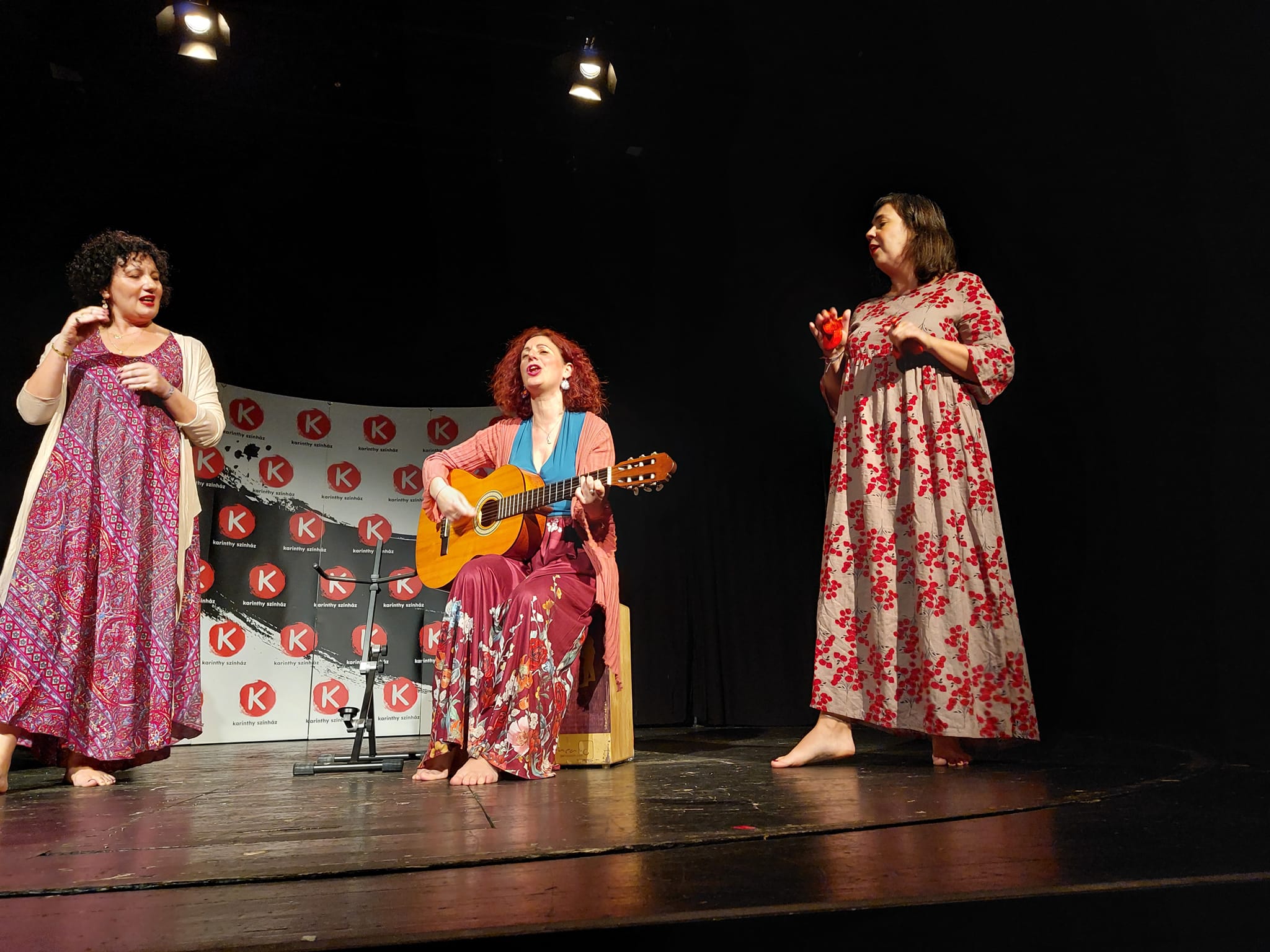
Image from here

It was great to see international storytellers on a Budapest stage again. The organization of the festival was smooth, the staff was welcoming and friendly, and the program was just enough to fill our ears and hearts for three days. I really hope they will do it again next year!

Tuesday, July 26, 2022

Storytelling Cities: Return to the Story Marathon


After two weeks of rehearsals we said goodbye to Sigüenza, and on a Thursday we drove over to Guadalajara. We arrived around five in the afternoon, and didn't waste much time lazing around: we left our stuff at the hotel, and immediately headed to the theater for one last rehearsal. The Teatro Moderno is the venue for the featured stage performances during the Marathon; for these, people have to purchase separate tickets, and due to the popularity of the shows, and the 30 year history of the festival, they are almost always sold out.

While in Sigüenza we had a nice 27-28 degree weather the whole time, Guadalajara greeted us with scorching summer heat. The theater was a bit cooler. After rehearsal we headed to the city hall to meet the (very kind and friendly) Mayor, for the signing of the official founding document of the European Network of Storytelling Sites and Towns. It was an exciting, delightful moment.


After the formalities were done, we gathered on the terrace of a restaurant, having a drink before dinner. From there, we could see the open-air exhibit of all the posters of the past 30 Marathons (see the pictures above). This is where I finally felt like I have arrived: after ten years, I was in Guadalajara once again. It made me giddy.

Friday morning we had another rehearsal. Pepito wanted us to rehearse in the afternoon as well, but we gave him the puppy dog eyes until he gave us the rest of the day. At five, we went to the palace courtyard to witness the opening ceremonies. The Marathon was opened by the Mayor himself, who delivered a short speech, and then told a Ukrainian fairy tale. Entirely by heart, like a real storyteller (with the Ukrainian name of the hero written on his palm, just in case, which I think was adorable). It was the perfect opening. He was followed by various school groups on stage, equally lovely.

After a while, with the Marathon up and running, we walked out of the palace to browse books at the marketplace (yes, I bought quite a few). From there, we headed out to have a drink of lemonade, and then moved on to the courtyard of a local school for the evening "Unheard Storytellers" show, where new performers are introduced every year. It was Susana's idea, and it was a good one. Not only because we heard amazing storytellers (among them my personal favorite was Sandra Rossi), but also because most of the Marathon's tellers were in the audience, checking out the newcomers. The mood was friendly and familiar.


(Spanish organizations have left FEST a few years ago, and I have missed them sorely ever since. I loved meeting Spanish tellers at conferences, and I finally got the chance to hang out with them again. Guadalajara, during the Marathon, is home to us all: storytellers are walking the streets, sitting in the cafes, lingering in the doorways, always steeped in excited conversation. I love it.)

Saturday morning we had one very last rehearsal at the theater. After that, I had time to run to the bookstore and buy more books, and then we decided to sit in on the theater shows before our own. They were all full house, and they were totally worth it. My favorite was Eugenia Manzanera's performance, who was witty, funny, and entirely enchanting.


While the last (musical) show was happening on stage, we all moved backstage to get ready. We were excited and a bit nervous - but our performance went really well. The audience was lovely. No one can wish for a better audience than a full house in Guadalajara: they applaud, they cheer, they laugh, they sing along with us, they answer every question. While we were on stage, I kept thinking we should have put more interaction into our show. This would have been the perfect audience to play with.

Our show started at nine in the evening, and we left the theater around eleven, in a very good mood: laughing, singing, accepting many warm congratulations. And this was not the end of the day yet: after a lovely dinner at the library, we headed over to the palace once again, for nighttime storytelling on the Marathon's main stage. For me, this was the hardest part of the festival: I usually go to bed around 10pm. This time, I was on stage, telling in Spanish, at 2am. Now I know I can tell in Spanish even when I am half asleep... But it was worth it. The Guadalajara audience, even after midnight, was cheerful, friendly, and surprisingly alert. I loved playing with them.

After passing out late at night, we only had one last day to go. In the morning we gathered in a conference room in the palace for a round table discussion. The audience was made up of some very sleepy storytellers, but we have a lovely conversation about our experiences, the project, and storytelling in general. This was what closed the festival for us. Those of us who were not heading straight to the airport went back to bed in the afternoon. In the evening, we gathered one last time for dinner, drinks, and conversation.

It was incredible to be in Guadalajara once again, after ten years. It's one of my favorite storytelling festivals in the world. I immersed myself in stories, in the company of fellow storytellers, and the beauty of the Spanish language. I was absolutely privileged to participate in the performance project, and work with a great group of tellers under Pepito's direction. I was proud of the show we got to bring to the stage in Guadalajara. I hope I won't wait another ten years before returning...

Thursday, September 6, 2018

An island on a sea of stories: Cape Clear Island International Storytelling Festival

It was almost exactly 10 years ago that I sat in a cafe in Jonesborough with Dovie Thomason, and she told me about Cape Clear for the first time. It sounded like a magical place, the kind storytellers would wish to find their way to, and I have been dreaming about going there ever since.
Well, dreams do come true sometimes.


This year I had the absolute privilege to be a featured teller of the Cape Clear Island International Storytelling Festival. I flew from Budapest to Dublin (a special thanks to the Hungarian Embassy in Dublin!), then took a road trip down to Cork, with my gracious host and friend Jack Lynch, and Lyn Ford, a lovely storyteller friend I already knew from Ohio. At the end of the road trip we just caught the 5 o'clock ferry from Baltimore to Cape Clear (we might or might not have stopped to hit some book shops on the way). By the time we were aboard, I could already catch my first glimpse of what awaited me for the weekend. Most passengers on the ferry were either storytellers, or audience, or both; the island only has about 100 inhabitants, but that number swells by the hundreds when the festival comes around. I quickly made friends with one of the other featured tellers, Daniel Morden from Wales, who braved the icy rain on top of the ferry with me, and helped me spot dolphins, seals, and birds (while we also discussed folktales and myths of all kinds). On the island we were greeted by our hosts and organizers, and set up in a cozy B&B, with delicious food cooked for us and tea ready. It was easy to tell that we were going to get horribly spoiled by the end of the week, but no one seemed to worry about that.
(Special thanks go out to Daphne Babington, Liz Weir, Maura Monagle, and Karen Edwards for making us all feel like we just arrived home)


The great thing about Cape Clear (apart from the warm hospitality) is that everyone who is there made a great effort to be there. We had audience members from as far as Canada and New Zealand, but even if they just came over from the mainland, or down the road, audience members were set, eager, and ready to come with us into every story we told. You could not wish for better listeners even if you tried. On top of all that, we also had a team of young volunteers that kept everything moving smoothly, and were there whenever we needed something - whether it was a lift to the top of the hill, or a song.


Each evening of the festival had a concert in a school building on a scenic spot of the island, and each day sported many other storytelling events at various locations. We opened the program with Hear All Tellers, where everyone had ten minutes to show off their stories and their style. Next to the four featured storytellers, we also had with us John Spillane, an amazing musician from Cork, who framed all the performances with beautiful songs in Irish and English. I brought Hungarian folktales and legends, and Lyn Ford brought Affrilachian stories; Joe Brennan, from Wexford via Donegal, told some wonderful Irish tales, while Daniel Morden told stories from all around the world with great humor and eloquence. On the first evening concert, he even ventured to tell a Hungarian folktale... I might have encouraged him to do so, because it is such a rare treat to hear a great storyteller from abroad tell a Hungarian tale. Daniel did it justice, and we had fun with him calling on me every time he had to pronounce "vasorrú bába" (iron-nosed witch) in the story. On my part, I told a legend about Attila the Hun; he came up earlier in a conversation, and I asked the audience if they have heard about him. Most people raised their hands; but when I asked how many of them heard good things, they all laughed and no hands went up. Therefore I told the tale of Attila and the comedians, and introduced them to another side of the Huns; the next evening, I went on to telling the legend of Attila's son, Prince Csaba, and the creation of the Milky Way (which we call the Road of the Warriors). For the rest of the weekend, I was mostly telling Hungarian folktales (among them many of my favorites from my new book), as well as the one Nart saga that I included in a moment of inspiration, since I only know it from two places, Ireland and Ossetia. Among the stories, I had the chance to tell my "feminist" re-telling of a Hungarian folktale called The Gossipy Women, a funny story that originally was told to prove that all women gossip - but in my version, it is told to prove that women share information and help each other in many secret ways.

The evening concerts were always a treat. They were framed by John's wonderful music (among them a song that I immediately fell in love with), and always closed with us singing popular Irish songs together with the audience. Con Ó Drisceoil also joined us for one day, and made us laugh with his songs until we were in tears. I'm not going to say that we exceeded seating limits on the Saturday night concert... I'm just going to point out that some people were standing on chairs, leaning in through the windows to hear us. It would take too long to list all the magical tales I heard over the course of the weekend, but there are many that I will remember fondly. I especially loved Lyn Ford's Cherokee story about Rabbit's heart song (funny and wise, as most trickster tales are), Joe Brennan's Irish version of the Hiding-from-the-Princess story (one of my favorite tale types), and Daniel Morden's telling of an Aesop's fable about love after loss.

I also had the chance to go on a walk across the island, led by Diarmuid Ó Drisceoil and Geoff Oliver. The sun came out for those two hours, and we listened to all kinds of tales about island life, folklore, and wildlife as we walked from North Harbor to the south. For the rest of the weekend, Cape Clear was wrapped in romantic Celtic fog, showing all kinds of picturesque faces of itself; one could walk around, admire the wildflowers, eat the blackberries, and watch the tide come in and go out in complete peace. It really is a magical place.

Sunday evening, after the last concert, we all walked down to the harbor, to say goodbye to the people who were leaving on the six o'clock ferry. In the tradition of the festival, we did so by waving long stripes of toilet paper in the air, singing "Go home, ya bums!" at the top of our lungs as the ferry moved away, carrying people who returned out heartfelt goodbyes with heartfelt gestures. In the evening, we had dinner in the pub with the organizers and the volunteers, told stories and jokes, sang songs, and laughed a lot. The next morning, we got on the ferry to return to the mainland, and, in a way, reality.

All those stories about magical islands in the sea seem a lot more realistic now. I know for sure I have been to one of them.


Thursday, October 5, 2017

Red-haired girl goes traveling - Storytelling festival in Transylvania!

This fall I was invited to be a featured teller at a Hungarian language storytelling festival in Transylvania (which is a region within Romania with a large Hungarian and Hungarian-speaking Székely minority). I could not have been more excited about the invitation. The last time I visited Transylvania I was 9 years old, and the place stuck in my memory as a land of endless beauty and magic. In addition, the program they requested also holds special meaning to me: My new storytelling show, titled The Cheerful Prince and the Girl with Red-gold Hair, contains folktales from my upcoming collection, Dancing on Blades (available January 2018). These stories, collected from uniquely talented folk teller Pályuk Anna at the turn of the last century, have been with me since the beginning of my storytelling career, and I am just as much in love with them now as I was 10 years ago. I finished the last round of editing on the book the day before I left for the festival.

The festival, attached to the Day of the Hungarian Folktale (September 30), lasted a whole week. I visited three cities, and had eight performances. The first two days were spent at the Székely National Museum, where schools brought in groups of children to listen to stories. To the little ones I told world folktales (Utgard-Loki and the Pumpkin Girl won best of show), while for the 6th graders I brought dragon legends (including Dietrich and Sistram), and medieval stories such as Dame Ragnell.

I also had the chance to tell in an almost 500 year old fortress church in Sepsiszentgyörgy (Sfântu Gheorghe). The audience consisted of the local Calvinist community, parents and children together, and there was a special magic to telling tales with values (kindness, love, hard work) inside the medieval walls.

In Csíkszereda (Miercurea Ciuc) I told tales on the main square on a chilly yet sunny day, surrounded by children, curious adults, and various TV reporters (watch the video here). It was a dubious choice to make the kids stand in the cold wind, but they cheerfully followed me into the stories, and listened while they wiggled. The best moment of the whole day was when I told Pályuk Anna's tale about the Boy who walked on the clouds, and we all looked up at the fluffy clouds above us while I was telling. It was a bright, unforgettable experience.

In Marosvásárhely (Târgu Mureș) I told at the Spectrum Theater, to an audience of almost 100 people (and therefore a lovely full house). There were children in the audience, but a lot less than adults, so I could bring out the tale of the Cheerful Prince (Anna's lovely, mother-in-law-positive variant of Rumpelstiltskin), which speaks to adults through emotion and imagery. It was my first time telling it in Hungary (English-speaking audiences always love it), and it worked great.

Returning to Sepsiszentgyörgy for the actual Day of the Hungarian Folktale, we closed the festival with a two-hour storytelling event. In the first hour I told tales from Dancing on Blades (once again, we had a fairly full house of about 100 people), and then handed the stage over to two Csángó tradition-bearers, elder ladies who still carry the oral tradition of folktales, and speak in an archaic Hungarian dialect. Their presentation was lively and lovely (and occasionally hilarious, since they were telling Jesus and St. Peter legends), but I had to work hard to follow what they were saying. It was definitely a unique cultural experience. And fun.

St. Anne's Lake in a volcanic
crater
In the midst of all the telling, I also had time to play tourist a little bit. I visited the former home of Hungary's famous storyteller and story collector Benedek Elek (I would not be a storyteller without him!), the Lake of Saint Anne (according to legend, fairies used to live in it, until they were chased away by the sound of church bell - there's an amazing story about it), Bran Castle (which is a nice historic site, with absolutely nothing to do with Dracula), the Castle of Déva (subject of our most famous folk ballad in which a woman is killed so that the castle can be built), and other famous sites of history and culture. Many of the Hungarian and Székely folktales I read and love were collected in these towns and all over this landscape, which made every river, every mountain, and every castle special, and every forest filled with fairies. Transylvania is still a land full of history, beauty, and tradition. 
(After this, if one more person asks me if I have met Dracula over there, I'm going to beat them with a folktale collection.)

In addition to the travels, I was also grateful for the chance to bring Pályuk Anna's tales to audiences in Transylvania (she was Transcarpathian). The stories took a new life, worked their magic, and, hopefully, will travel on to new places in people's memory. 

I hope to return again soon. 

Wednesday, May 17, 2017

Speak Story Series, Shepherdstown, WV

I could not have asked for a more perfect goodbye performance for my American experience.

Four days before leaving the USA, and after six years spent studying, traveling, and performing in this vast and fascinating country, I was invited to tell stories in the Speak Story Series of Shepherdstown, WV, courtesy of Adam Booth. I said yes, and I am glad I did. As far as gigs go, this one was pretty close to ideal.

I flew to West Virginia from Ohio; Adam drove me from the Baltimore airport to Shepherdstown. It was a beautiful drive, and I happily immersed myself one last time in Appalachia. Shepherdstown itself is an enchanting place, with a pretty, historic main street, a university, good food, and lots of extremely friendly people. They are used to storytellers visiting, and that makes them great hosts - and an even better audience.

Both of my performances happened on the same day. In the morning I visited the Morgan Academy, a small local school where seventy children, from the ages of five to fourteen, piled into the building's main room to hear my stories. It was an interesting system for a performance: After the first story, the little ones left, and after the second, the next youngest group left too, until I was left with the older kids, whose attention span was longer. I told Hungarian folktales - Princess Hide-and-Seek, Kingdoms of Ice and Fire, Bird with the beautiful voice - because they are fit for wider age groups (for the last one, I asked if a scary story was okay, to which they all yelled YEEES!). The kids had a lot of great questions, and seemed to enjoy the stories; the biggest compliment, however, was that they asked for an encore. One little girl wanted to know what the most popular folktale was in Hungary, and after I tried to shorthand-explain Son of the White Horse, I eventually just asked if they wanted to hear it. The answer was a resounding YES, so I told a fourth story, and had great fun with it. Bonus point: This folktale type also exists as an Appalachian Jack tale. I was told by the teachers that the kids have never asked for an extra story before. This is the best kind of compliment.
(I also loved that the school had its own ducklings and chickens, hatched and raised by the students right there in the hallway.)

The evening concert took place on a theater stage downtown, and was attended by more than a hundred people. I was happy to discover that there were several people in the audience who were Hungarian, or of Hungarian descent. It is a treat to be far away from home, and yet telling to people who have a personal connection to the culture I come from. My set consisted of all Hungarian folktales - stories from my upcoming book, Dancing on Blades, told a hundred years ago by Transcarpathian storyteller Pályuk Anna. I selected my favorites. I told Three princesses and a ring, which is a funny and lovely tale about a king who is too willing to give his daughters away for treasure; then I told the Cheerful Prince, which was Anica's kinder, more feminist telling of Rumpelstiltskin (with a good mother-in-law). Next, I decided to tell Mistress Tuberose, because my hosts told me they had an upcoming Garden Tour event, and I assumed I had a audience of gardeners. I did. The story worked like a charm, and at the moment where the cruel father tears up the flowers his daughter has planted, the entire audience gasped in horror as one.
I ended my set with Pályuk's version of The twelve dancing princesses. It is my favorite telling of that tale, and one that is kinder to the princesses than all others I have read. When I have time to tell it fully and comfortably, it is a fantastic experience.
This audience also had a lot of questions. I spend almost another half an hour on stage, answering them one by one; once they ran out, and I was presented a gift basket by the organizers, I still stayed for a long time, signing books and talking to friendly, curious people.

The trip only took three days, but I'll treasure the memory for a long time. I hope I will be back one day, and visit Shepherdstown again. Every storyteller dreams of performances like this.

Monday, October 31, 2016

Scary Story Festival at a haunted opera house, and other Halloween fun

This year I really managed to cherry-pick the best Halloween gigs.

It all started on Friday, when I participated in the Friday Folklore Tour at the Wood County Historical Museum in Bowling Green. The tour had several stops, all centered on creepy and eerie things, such as a Day of the Dead educational display, a haunted trail, the former asylum, a magician... and yours truly, who set up shop in the cemetery behind the museum. And by "set up shop" I mean I camped out all alone in a dark cemetery in the company of a lantern, some blankets, and a box of Halloween chocolates (because someone trusted me to be a responsible adult and not fish all the Reese's out) (I did not fish all the Reese's out).
Over the course of three hours, we had 9 tour groups passing through. I told one story to each of them; because I would have bored myself by repeating one of them over and over again, I ended up randomly rotating 5 different stories, depending on what I felt like telling, and who was in the audience. I told a Hungarian folktale about a brave princess and a haunted castle (our version of Mr. Fox) mostly when kids were around; one girl still stood with her hands over her ears until I promised her that there would be no jump scares in the story (I hate jump scares). One little boy told me that princesses were booooooring - but took it back at the end of the story. My favorite part was when I asked a group what happens to fairy tale princesses when they grow up - and one little girl immediately answered "They become queen!" Girl power.
Next to the magic castle, I also told Princess in the Coffin, and all-time favorite of mine, as well as the Burning of Tara (it's almost Samhain, after all), and the legend of Erzsébet Báthory. I also handed out candy (or rather, held the box out and let people take a handful, because I'm Hungarian and I don't know how to trick-or-treat). All in all, it was great fun, the cemetery setting was perfect, and the groups were all very appreciative. Someone even asked me about how they can become a storyteller...

The Halloween roll continued on Saturday, when I took a trip to Howell, MI to their tenth (!) annual Scary Story Festival. The event takes place in Howell's very own haunted opera house, which is a perfect setting for scary stories. They have a children's scary story show at 7, and then an adult one at 9. I only caught the end of the kids' show, but it looked like it was great fun.
The adult performance took place in the actual opera house (which was built in the 1880s, shut down in the 1920s, and functioned as the attic of the building for several decades). It was an amazing setting, all gloomy and mysterious, decorated with spiderwebs and candles. The floors creaked, the shadows stretched, and there was coffee, hot cider, and pastries available to make everything perfect.
And, of course, there was the lineup.
The show was opened by Robin Nott, who sung us the ballad of Resurrection Mary (a version of the Vanishing Hitchhiker), and then told a story about the ghost of a mother who returned from the grave to feed her child. Both were sufficiently eerie, and touching at the same time. Next, Leif Larsen told us his version of Grimm's Bearskin, set after the American Civil War (I really loved this twist on the tale). Yvonne Healy brought us a terrifying Irish tale of dark magic and revenge, and Jeff Doyle told a Kentucky ghost tale that sent shivers down our spine.
After a short break, Barbara Schutzgruber graced us with singing Childe's ballad of the dead lover (fittingly, the oldest known version of the Vanishing Hitchhiker), and then telling her amazing, rhyming and eloquent version of an English lullaby about a vain lady who turned into the first mole. I am always amazed by Barbara's elegant performances... it was a tough act to follow. I told next; I chose the Princess in the Coffin, since it is a fairly creepy story but also has some humor in it, and it is tons of fun to tell, especially in an eerie setting. The concert concluded with Steve Daut's twist on Rapunzel, with some very graphic and gory images about what could go wrong when one gets tangled in so much hair...

The festival was a superb experience, and a perfect place for some Halloween storytelling. I am happy that I got to be a part of it this year. We did not encounter Meredith, the opera house's resident ghost, but I am sure she was listening...

Monday, July 27, 2015

13th Kea Folktale Festival, 2015

This year was not only my first time in Greece - it was also my first time at a Greek storytelling festival! I have been hearing about the magical island of Kea for years, and I was excited that I finally got to participate in their festival. It was a treat.
Our participation started on Wednesday evening, when we all gathered in the garden of the Mylopotamos museum of folklore and cultural heritage, in a nice small open-air theater. Storytelling started at 7pm; there were 21 storytellers in the lineup, with 10 minutes each. Together with the breaks where we drank wine and ate dinner, the program lasted until midnight, and in true Mediterranean fashion, we still had quite a big audience at the end. Apart from the international FEST participants, there were also Greek families, and tourists who happened to pass by. The acoustics of the theater left some things to be desired, especially because of the mixed background noise of cicadas, playing children, and a road. It was sometimes hard to hear the storytellers if they did not project at full capacity. Still, we experienced quite a few amazing performances.
Antonietta Pizzorno (above) told the tale of "A prince made by woman's hands" and while she mostly told in Italian, she conveyed the story really well, and left us in tears of laughter. Nuala Hayes told an Irish folktale in which the son of the King of Greece fell in love with the daughter of the King of Ireland - it was a great story, and very appropriate for the occasion. Susana Tornero told Stone Soup entirely in Sabir, the pidgin language of the medieval Mediterranean. We could all follow it, although it sounded like she was speaking Italian, Spanish and French at the same time (which, technically, she was). Regina Sommer told my favorite legend of Charlemagne, about the founding of Aachen. Senem Donatan, one of the Turkish ladies, told the myth of Inanna in the Underworld, with powerful singing. Seung Ah Kim, the Korean visitor, wore a traditional dress, and told the tale of the Snake Bridegroom with graceful gestures, eloquent words, and a haunting song.
As for me, I told a folktale collected from one of my favorite storytellers, Anna Pályuk, more than a hundred years ago. It is about three princesses who are half-siblings - one of them had a mother who was a fairy, one was a witch, and the third was a mortal. Their father, the king, tries to make them marry the Devil out of a mistake, and the three princesses work together to change his mind and fix the situation. It is a fun story to tell, the audience loved it, and it fit air-tight into the 10 minutes.
On Thursday, the festival moved to another location: We drove up to the town of Ioulida on the mountain, and prepared for a second story walk. The first stop was a fountain surrounded by fig trees and bushes; we sat on a flight of stairs, and listened to four stories. Three of them had to do with the sea; my favorite was Janneke Tanja (right), who told a haunting legend about a fisherman who ferries the souls of the dead across the sea. I had goosebumps all over. It was excellently crafted from a small bit of a local legend in the Netherlands.
The second site was a small alley, surrounded by the white walls and winding steps of the town. Once again we sat on stairs. We heard three storytellers, Jennifer, Marina, and Dafydd Davies Hughes (left), who told us a Welsh version of the myth of King Midas. Once again, bonus points for the choice of story. It is always interesting to see how far certain motifs have traveled over the centuries.
The third and final stop on the walk was an open air theater in a grove, under the stars and below the old stone walls of the town. The performance was a treat: Abbi Patrix (France) presented a full show of smart animal tales, spiced with African proverbs and percussion music by Linda Edsjö.
The festival continues on over the weekend, and I am a little sad that I didn't stay longer (although the performances seem to be in Greek from this point on). Kea is a lovely place, very calm and beautiful, and the festival was an amazing blend of mythical landscape and good storytelling. I am glad I made the trip, and I hope I will get to return in the future!

Thursday, December 11, 2014

Cuentos Los Silos - Stories for Everyone

Los Silos is an incredibly diverse festival, with the participation of pretty much the entire town, as well as people from all over the island, and (in my case) all over the world. I was impressed by how well it all fit together, and how seamlessly it incorporated events for all ages and all tastes. 2014 was the 19th year of the festival, and the practice definitely bore fruit.
Instead of a chronological account of the events, I decided I would like to mention some of my favorite parts of the weekend, to give you all a glimpse of what it felt like to be in the middle of such a colorful, busy, inspiring whirlwind of stories. So, if you ever decide to visit Los Silos early in December, here are some of the things you can encounter:
(All pictures come from the Cuentos Los Silos Facebook site. Go and like it.)

Storytelling concerts
We all had to bring several 50 minute shows to the festival. As for me, I had 3, scheduled for Saturday and Sunday. It took me almost a year to piece them together, translate them, and practice telling them in Spanish, but the end result was absolutely worth the work.
Some shows took place late in the morning (11am) and were advertised for a family audience. For that, I presented my Strange Princesses program, filled with Hungarian folktales about brave, clever, and exceptional girls. The show took place in the theater room of the local Health Center (yep), and it was filled with families. After the show, little girls lined up to thank me for the stories and give me a kiss on the cheek. A few times I stumbled over words in the stories; I was delighted to find out that the audience was more than willing to help me find the right one, and smile in approval as the story continued on.
My two adult shows took place in the local high school on the two nights of the weekend. The first one was a new program of legends about Attila the Hun; the second a series of Hungarian folktales that had connections to Spain (and even, in a symbolic way, to the Canary Islands). The house was completely full both times (about 100 people), and to my great surprise I found out later that there was even a Hungarian lady in the audience!
Sadly, I didn't get to go to the big shows of anyone else over the weekend. I would have loved to see all of them, but we either told at the same time, or other things came up on the schedule. Pretty much all of our shows played to a full house, though, and we were overwhelmed by the love and support of the audiences.

Stories from the Balcony
I was so happy I got to do this one! In the evenings, under the light of the full moon and the lampions, storytellers told one story each from various balconies around the main square. People gathered below, sitting on stairs, benches, fences and chairs, and gazed up at the pretty wooden balconies where the storytellers were. It was tons of fun to walk up the creaking wooden stairs of the town hall (more than 200 years old) and walk out onto the balcony to impart some folklore upon the masses below. Made you feel like the Pope.
I got to hear two rounds of Balconies, and I was glad I did. A lot of the local tellers did them too. In my round I shared time with Luís and Fabio (who actually did the balcony thing twice; also, he is really good at picking the right story for the right audience); walking around in the evenings I got to hear Mar González and Laura Escuela as well. Since the weather was so warm, it was great fun to sit around on the square, waiting for storytellers to appear in a strange Romeo and Juliet fashion.

Stories on Couches
This one was truly unique and fun. At 5 in the afternoon people gathered in front of the town hall, holding their tickets to a show by one of the five storytellers listed on the program. When we all gathered, volunteers led us in different directions along winding alleys and around corners until we arrived to... someone's home. In the spacious living room, hidden from the noise of the main square and the spotlight of the stages, the chosen storyteller sat in an armchair, waiting of us, accompanied by drinks and cookies. I went to Luís' session; there were ten of us there, including the couple who owned the apartment, and that was really all the living room could fit. What resulted was a very nice, quiet, relaxed hour of stories, where the storyteller talked to us instead of at us, and we all got to sit back and enjoy a quiet hour of storytelling the way it most naturally works. Luís was graceful and funny and eloquent, and even played us a lullaby on his accordion in the end.
I am suddenly a big fan of small-scale storytelling festival events.

Stories in Patios
These kind of worked the same way the Couches did, except this time we took our seats in the small hidden patios of old apartment buildings. The audience consisted of about twenty adults and children. This time I got into Fabio's session, who did not only switch quickly between Inuit myths and colorful children's books, but even told a Fionn Mac Cool story, with which he totally won the festival, at least in my eyes.
(I noticed that Spanish tellers like to tell with picture books, which pretty much defeats everything I have learned about the art of oral storytelling. They do an amazing job bringing the stories to life with their own words, and the books they use I gorgeous. I spent a lot of money on picture books in the festival's bookstore. A lot.)

Lightning round!
The end of the festival was marked by a final show in front of about 300 people in the inner court of the old convent building. On this stage all of us featured tellers told one more 5 minute story each, to say a fitting farewell to our beloved audiences. I told second, and after I did I took my place in the back of the stage on a brightly painted bench, to watch the others. In the case of some of them it was the first time I heard them tell, and instantly regretted not getting around to go to more of their concerts. The Tapetes duo was lovely, and so was Arturo, who told his own funny story about saints running a race to decide who gets to stay in the canon (a very Spanish story for a very Spanish audience). As a former Catholic school student, I was very close to peeing myself from laughter on the stage. The lineup came to a closing with a tale told by the festival's main organizer, Ernesto Rodríguez Abad, who brought all of our tales into perspective. The full moon and the stars peered in from the night sky above. At the end of the show a marching band appeared out of nowhere, and we all filed out of the building and onto the square where everything erupted into a spontaneous dance party that lasted long into the night.

Poems and Umbrellas
 In addition to all the shows, circles, book signings and children's workshops, there were also many volunteers walking around the square, adding more color to the weekend. Some of them carried long cardboard tubes, and if you asked them, they put it to your ear and then whispered a poem into it for you, in a vibrating, mysterious voice. Others carried umbrellas decorated with colorful cards, and if you stopped them, they stood under the umbrella with you, reading you a story from one of the cards (and then pointed you to the bookstore where you could find the corresponding book). It was all good fun, and literally brought poetry, art, and storytelling to all the people on the streets.

All in all, the festival was packed with things to do, things to hear, and things to learn. It was extremely busy, and at the same time a whole enchanted weekend full of colors and words. It was one of the best storytelling events I have ever been to, and I am deeply honored to have been asked to be a part of it, and bring my stories from Hungary all the way to Tenerife. I will be re-living and re-telling this experience for a very long time.

Cuentos Los Silos - Storytelling Festival on Tenerife

This one might have been my most adventurous storytelling job yet.
Definitely one of the best.

I was invited to the Festival Internacional del cuento de Los Silos (Los Silos International Storytelling Festival) almost a year ago. My first reaction was to look it up on the Internet; I have been to festival in Spain before, but this one I was not familiar with. Turns out it takes place in a town on Tenerife, Canary Islands. I thought about it for about a whole ten seconds before I agreed to go.

Los Silos is a small town in the northwestern corner of the island. It is far away from most tourist-frequented places (they tell me tourists congregate on the southern beaches of the island where there is sand and less rain). The town is surrounded by banana groves and breathtakingly beautiful volcanic mountains on one side, and the black rocks of the Atlantic shore on the other. From the airport we were taken by car along the long winding road that balances between ocean and mountains, through small cities and towns made of colorful houses, until late in the morning of the day after I left the US (thank you, time difference) we arrived to the main square of Los Silos, and the house that was going to be our home for the weekend.
Before I passed out for 17 hours, I took a small walk around: Around the main square stood the town hall, the building of the old convent that was transformed into the festival headquarters, and the restaurant that was going to be our regular place for breakfast, lunch, dinner, and wifi. I was also introduced to the organizing team of the festival, all extremely friendly, insanely busy, and very patient to repeat sentences when my sleep-deprived brain failed to switch over to Spanish fast enough (it always takes a day or so before I make the switch between two foreign languages).
By the time I rolled out of bed the next morning, the festival was already on full swing. In fact, it had been in full swing for more than a week at that point: The local storytellers of Tenerife, as well as some guest performers, had been making the rounds in the schools of the island, telling to kids. The festival itself is a several week long series of events, crowned by the last weekend full of storytelling all over the city, from early morning late into the night. This last three-day long extravaganza was the part that I (and a series of other storytellers from all around the world) got invited for.
Our personal headquarters for the weekend was the little café in the middle of the square. People sat out there at any given point during the day or the night. Although it was the middle of December, the weather was lovely. The locals frequently apologized to us for the cold, shivering in their coats - it was about 20 degrees Celsius (in the 60's Fahrenheit) the entire weekend. I, flying in from Freezingcold, OH, was thoroughly amused, and took all possible chances to sit outside and soak up the warm.
It was in the café on Friday that I was introduced to most of the guest storytellers of the festival. I already knew Ana Griott (her storytelling name; her real name is Ana Cristina Herreros), a lovely and elegant lady that in her spare time writes wonderful folktale collections in Spanish. I also knew Luís Correia Carmelo from Portugal from one of the FEST conferences, and I was happy to get to hear him again. I was introduced to Kamel Zouaoui, an Algerian-French storyteller who speaks a zillion languages and is very passionate about the art of storytelling; we were instantly best friends. I also met Arturo Abad, a young Canarian storyteller who lives in Granada and writes and tells wonderful tales of his own. Turns out he lived in Hungary for a month, and has a puli dog! Small world. I also got to know André Neves, a children's author and illustrator from Brazil, whose colorful and enchanting work was on display the whole weekend in the bookstore. Our little team was complete with a duo from Brazil named Tapetes contadores de historias together, and Warley Goulart and Rosana Reátegui respectively. We were joined by local storytellers such as the lovely Mar González Novell, Andrés Novoa, and Fabio González. There were many more storytellers around all weekend, but since we were scattered and very busy, I sadly didn't get to make friends with all of them. The ones I met and heard were all delightful.
The theme of the festival was the Ogre, which was represented by a large statue on the square (drawn by Fabio, who was an illustrator before he also started telling stories). It was supposed to symbolize the power of stories to present dark and scary things and help us learn to deal with them. The orge in question was not only delightfully ugly, but also very useful: One could climb in through its butt and emerge from its open maws onto the festival stage; alternately, they could also hold storytelling sessions by mysterious flashlight inside the ogre's belly. Of course kids could not get enough of it. The additional theme was recycling; in order to promote it, the square and all the venues were decorated with strings of lampions created by the kids and adults of the town from recycled materials and made to look like ghosts, little monsters, and other amusing shapes.
A lot happened during the three days of the festival weekend; parallel events took place from morning to evening. I'll describe some of them in the next post, with more pictures.

Tuesday, April 17, 2012

O is for It's Over

And done! The second Holnemvolt Festival happened this weekend, and from what I can tell from photos, articles, Skype conversations and the occasional peek through a webcam, it was awesome!

There shall be videos up soon(ish). In the meantime, for those of you who don't speak English, there are beautiful pictures!
You can see some of them on our Facebook page.

Some others can be seen here.

I am way too tired right now to write; I was up at 6am all weekend, checking in on the festival in-between storytelling sessions. It was exciting, and amazing, and exhausting, and I find myself already planning for the next one...

I'll be back tomorrow with a real post!

Sunday, April 8, 2012

H is for Holnemvolt

A little less than one week from now, Hungary will have it's second international storytelling festival!!!
That is one of the many reasons I have been so busy lately.

We organized the first Holnemvolt Festival last March; our goal was to introduce international storytelling to the Hungarian audiences. We had almost no funding, but we had a lot of volunteers; awesome people who helped us arrange everything in time! We had amazing storytellers from all over the world, and a lot of fun!

And this year, we are doing it again!
Unfortunately, I don't get to go home for the festival this year. But I will be following everything that happens next weekend!
In the meantime, here are some links:

My blog about last year's festival: Part 1, Part 2, Part 3

Our Facebook page (with pictures and the introductions of our performers in Hungarian and English)

Our YouTube channel (with videos in various languages)

By the way, Holnemvolt is Hungarian for 'Once upon a time'.
(Well, technically, our stories start with 'Egyszer volt, hol nem volt' - which means 'There was, and there wasn't')

Only one week to go!