Showing posts with label Wales. Show all posts

Monday, April 3, 2023

B is for Beards and some Buttocks (Body Folktales)

This year, my A to Z Challenge theme is Body Folktales. Enjoy!

There are actually quite a few body parts that start with B, so I had a great time picking through some of the most interesting stories. I decided to delve into tales about two things: Beards, and Buttocks. Because I couldn't resist. Here we go.

How the White Man got his beard (Cheyenne)

A white man travels without food and, seeing rich green grass, wishes he was a buffalo so he could eat. He finds some buffalo and begs to be turned into one of them. They take pity on him, and, by running at him five times and tipping him over, they turn him into a buffalo. White-Man-Buffalo grazes to his heart's delight - but then another white man shows up and wants to do the same. White-Man-Buffalo doesn't like the idea of sharing, so he starts chasing the other man. Eventually, he tips him over... but instead of turning him into a buffalo, he himself turns back into his human form. Only the buffalo's beard remains on his face, and since that day, white men have beards.

The Cloak of Beards (UK)

Among the legends of King Arthur we find not one, but two instances of beards being symbolically important. In a fashionable sense.
Early in Arthur's reign, he is challenged by a Welsh king (giant) named Ryence who keeps defeating other rulers and sewing their beards to his cloak - a total of eleven. He demands Arthur's beard as well, suggesting he should save himself the trouble and tear it off, and promising it would have a place of prominence on the cloak. Sir Balin ends up fighting and killing Ryence and saving Arthur's honor. In some versions of the legend, Arthur himself defeats the giant, and takes the cloak - adding the giant's own beard - as his trophy.
Later on, Arthur also runs into the giant of Mont-Saint-Michel in Brittany, who has defeated 15 kings, and in homage the humiliated rulers gave him a Christmas present: a cloak embroidered with their beards and decorated with gemstones. Arthur, once again, wins the fight and beheads the giant.

The count's beard (Italy)

A village is terrorized by a witch that keep stealing cattle. The count that rules the village does nothing to stop her. The villagers turn to a small but very clever man who does some stellar investigating, Sherlock Holmes style, and figures out that the witch is actually the count himself, with his luscious beard pined up into a hairdo.

Anansi and the pharaoh's beard (Suriname)

Same story as the ears of King Midas, except in this case a pharaoh has a very long and strange beard that he tries to hide, killing everyone who finds out about it. Anansi, the spider trickster is the one who whispers the secret into a hole in the ground - and in time, a tree grows from the hole, whispering the truth.

Beware the red beard (Bosnia and Herzegovina)

A young man is warned by his dying father to beware red-bearded men. As he sets out to seek his fortune, he is soon cheated out of all his money  by a red-bearded innkeeper, and a red-bearded judge refuses to rule justly. Finally the young man encounters a red-bearded hodja; and although he doesn't trust the man at first the hodja manages to help him, and set everything right. Proving that not all red-bearded people are the same.
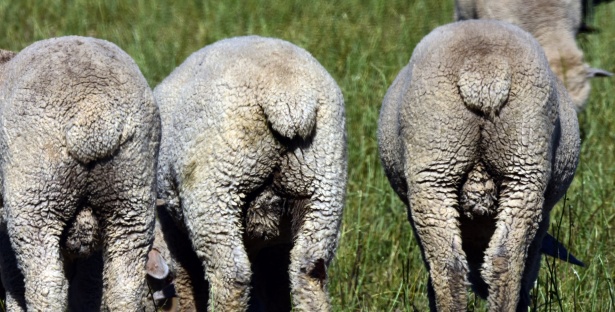
The spatula that makes buttocks sing (Japan)

A young man, by some luck, comes into possession of a magic spatula. If he rubs his buttocks with it, they begin to sing, and if he rubs them again with the handle, they stop. He finds a way to touch the butt of a rich man's daughter with this curious item, and her buttocks begin to sing day and night. The father pays him handsomely for curing his daughter's strange affliction.

The buttocks of Conan Mac Morna (Ireland)

One of my favorite episodes in the Fianna legend cycle is "The house of the quicken trees" (Bruighean Caorthuinn). In this story, some of the heroes of the Fianna are captured by an enemy prince. He invites them for a feast under false pretenses, and casts a spell that makes them all stick to their seats, unable to move. Some of the remaining heroes, outside the hostel, fight a fierce battle to protect their friends from an invading army, and procure the royal blood that can break the enchantment. Finally, they succeed.
However, by the time they sprinkle the blood on everyone, it runs out. Conan Mac Morna, the team's resident grump, is last in line, and there is no way to disenchant him, which makes him even more churlish (he tells Diarmuid, the rescuing hero and famous ladies' man "you wouldn't have left me for last if I was a pretty woman"). With no other course of action, Diarmuid pulls Conan from his seat by force, tearing off the skin of his buttocks. In some versions of the legend, the Fians mend Conan's injury with sheep skin - and after that, they have to shear him every year, procuring some fine wool in the process. (Sources here, here, and here.)
There is also another Fianna adventure that ends with Conan getting sheep skin on his butt, in a slightly more heroic fashion; you can read it here. 

From previous A to Z years, see my post about the Hungarian tale of Flowerbeard.

Which story is your favorite? 

Which one would make for the best movie adaptation? And in what genre?

Friday, April 23, 2021

Tarot Tales: T is for the Tower

Welcome to the 2021 A to Z Blogging Challenge! My theme this year is Tarot Tales. I am making a selection of folktales, legends, and other traditional stories that correspond to tarot cards. Storytelling and tarot go well together. Do other stories come to mind? Let me know in the comments!


The card: The Tower

Meanings: The Tower is about sudden, devastating change. Something that comes out of nowhere and wipes the board; "lightning from the clear sky" that breaks everything down in a moment. It symbolizes the feeling when life pulls the rug from under you, when everything you knew turns out to be wrong. Things come crashing down because they were not built well in the first place. The Tower symbolizes the imploding of lies, false beliefs and pretenses - but also, the possibility of rebuilding after the destruction, on more solid foundations. 

Selection process: At first, I was thinking of flood myths, for obvious reasons. There are thousands of them. And then I somehow ended up reading legends about sunken cities, which seemed much closer to the kind of story I wanted to choose.

The story: The Drowning of the Bottom Hundred

Origin: Wales

Summary:
The Bottom Hundred was a fertile lowland in Wales, protected from the sea by a great stone wall and watchtowers. Each tower had a captain responsible for its upkeep, and the whole embankment was under the supervision of Prince Seithenyn - one of the "Three Immortal Drunkards of Wales". The prince, who loved parties more than work, let the wall fall into disrepair. There was only one decent captain, Teithrin, who kept his tower at the end of the wall in good shape. One day he took a walk along the embankment and he was shocked to discover how dilapidated the whole thing was becoming.
Knowing the Bottom Hundred was in danger, Teithrin tried to warn Prince Seithenyn but he didn't listen. So Teithrin went to the great King Gwyddno Garanhir - but he was having a feast and not taking any visitors. So Teithrin moved on to Elphin, the king's son, who was a more attentive man, and listened to the warning. Prince and captain returned to the embankment to talk to Seithenyn, but they found him busy getting wasted. In the meantime, a storm was starting up at high tide, and the embankment began to shake and crumble.  
With the help of Angharad, Seithenyn's daughter, they lit the warning beacons of the wall, so the people of the lowland would know to evacuate and run to high ground. Then, as the embankment was breaking down all around them, Teithrin, Elphin and Angharad managed to get out to safety with some of the people that followed them. Seithenyn on his part tried to fight the tide with a sword, and drowned. Many people and villages were lost as the sea swept over the lowland. 
The legend of the Bottom Hundred is sometimes called the Welsh Atlantis. In one night, the fertile lands transformed into Cardigan Bay. 

Sources & notes: Read one version of the story here, and some background information here.

Runner-ups: I was also thinking about using the famous Dutch legend about the sunken city of Stavoren.

What other myths, legends or tales would you associate with sudden disaster? Which one speaks to you the most?


Monday, November 5, 2018

Arthur, Merlin, and the Fair Family (Following folktales around the world 90. - Wales)

Today I continue the blog series titled Following folktales around the world! If you would like to know what the series is all about, you can find the introduction post here. You can find all posts here, or you can follow the series on Facebook!

The Welsh Fairy Book
W. Jenkyn Thomas
F. A. Stokes, 1908.

This old volume contains a treasure trove of eighty-four Welsh fairy tales. They were collected by a teacher who wanted to make sure that his Welsh students could read stories from their own culture. The language of the tales is eloquent and entertaining, and many tale types repeat based on different places where they are said to have taken place. They are connected to the Welsh landscape - lakes, mountains, towns. Many of the names are difficult for the non-Welsh reader, but Thomas provides a handy pronounciation guide at the beginning of the book. I was delighted to discover that the original volume had been illustrated by Willy Pogány, an artist of Hungarian descent.

Highlights

The drowning of the Bottom Hundred is an eerie legend about a kingdom protected by levees and devoured by a flood after the people whose job it was to keep everything in good shape neglected their duties. It is a very exciting, elaborate story with appealing characters such as a brave princess and a clever minstrel. Floods happened fairly often in these stories; another captivating yet dark legend was that of the Swallowed Court, where a king swapped his elderly wife for a fair young maiden, just to find out too late that the maiden was his old wife who had made a dark deal to regain her youth.
The curse of Pantannas was a story of truma passed down through the generations. A farmer plowed a fairy ring, but when the Fair Folk threatened him hi begged for the punishment to be passed down to his descendants instead. Generations later his descendant Madoc was stolen away on his wedding day, and only appeared again decades later, when all his loved ones were dead. Another tale, titled The ancients of the world, spanned a similarly long time: An ancient eagle wanted to marry someone who matched him in age, so he visited the other ancient creatures of the world until he found an Owl who was older than all of them.
Most of the book is taken up by various fairy legends. One of the most interesting was Elidyr's sojourn to Fairyland, from which we find out that fairies eat saffron milk, never lie, and their language is related to ancient Greek. Next to the fairies we also encounter the Pwca, a mischievous and dangerous trickster creature, and also some witches, in some cases a whole town of them (Goronwy Tudor and the witches of Llanddona).
The book also features some of the most famous Welsh legends, such as the origin of the Red Dragon as a symbol of Wales (along with Merlin's origin story), the tale of Gelert the faithful hound, and the Mantle of Beards, in which King Arthur kills Rhitta Gawr, who collects beards from defeated kings. I was also familiar with the story of Hu Gadarn, who, with the help of a maiden, saves his people from the water monster called Afanc.


Connections

If there is a country that can claim to be them home of the most Sleeping Knights, Wales is probably it. The knights of King Arthur are said to be asleep under various mountains, waiting to be called back to help their people. Of course the fairy legends followed familiar types: There were several fairy midwives with ointment in their eyes (e.g. Lowri Dafydd), changelings that had to be tricked (e.g. the Changeling of Llanfabon), and people who got lost in Fairyland and only returned years later. Even the Open, Sesame tale type featured fairies instead of thieves, whose secret world opened with a Fairy Password.
Some other familiar tale types were also featured in the book, such as Rumpelstiltskin (here the name was Sili go Dwt), or Cricket the false seer (here named Black Robin). Among the classic Welsh tales there was the King with horse's ears (just like the Greek King Midas), and also a surprise appearance from the White Woman whom I have not seen since South America. But the story that made me the happiest was that of Why the robin's breast is red, which echoes one of my favorite American folktales, about birds bringing water to Hell to ease the suffering.

Where to next?
Scotland!