Showing posts with label mothers. Show all posts

Wednesday, April 7, 2021

Tarot Tales: F is for Fortitude (Strength)

Welcome to the 2021 A to Z Blogging Challenge! My theme this year is Tarot Tales. I am making a selection of folktales, legends, and other traditional stories that correspond to tarot cards. Storytelling and tarot go well together. Do other stories come to mind? Let me know in the comments!


The card: Strength

Meanings: This card is not about brute force or physical strength. It is about endurance, fortitude, and perseverance; holding on, putting your foot down, and weathering the storm. It is about an inner power that you are in control of, a kind of confidence that says "I can do this." Courage, coping, and composure. 

Selection process: The original Strength card shows a young woman taming a lion, holding it firmly but gently. I wanted to find a tale about a girl or a woman taming a lion, to keep the symbolism of the card, but I also wanted the story to deal with perseverance and fortitude rather than physical strength or trickery.

The story: The lion's whiskers

Origin: Ethiopia

Summary:
A woman marries a widower who has a young son, and becomes the child's stepmother. No matter how she tries to befriend her new stepson, he does not open up to her. The woman, desperate to find a way to connect with him, goes to a wise man and asks him for a magic potion to make the boy like her. The wise man tells her that the main ingredient for such a potion is the whisker of a ferocious lion that lives in the desert - and she has to acquire the whisker herself. 
The woman, determined to gain the love of her stepson, sets out into the desert to face the lion. She comes up with a plan: she brings food, and every day she tosses it to the lion, coming a little closer each time. Slowly, day by day, the lion grows used to her presence, until she gets so close that she can take a whisker. 
When she returns to the wise man, he reveals that there is no magic potion. Instead he tells her: "All you have to do for your stepson to like you is the same you did with the lion." It takes time, patience, and perseverance for the boy to accept his stepmother - but eventually, he does. 

Sources & notes: You can find the story in this book. There are also many variants that involve a wife and a husband instead of mother and child. You can read one, also from Ethiopia, here.

Runner-ups: I was also considering the tale of Diirawic from Sudan, where a young man wants to marry his sister, so she runs away into the wilderness with a bunch of other girls, and they tame and adopt a lion as their brother.

I think getting ahead day by day, little by little, is probably a good message for trying times like these. How are you all doing? What's the whisker you are reaching for? 

Saturday, February 27, 2021

StorySpotting: What did King Solomon actually decide? (New Amsterdam)

StorySpotting is a weekly or kinda-weekly series about folktales, tropes, references, and story motifs that pop up in popular media, from TV shows to video games. Topics are random, depending on what I have watched/played/read recently. Also, THERE WILL BE SPOILERS. Be warned!


New Amsterdam just dropped on Netflix, and since I can't resist a ridiculous, over-the-top-feel-good, I can fall-asleep-and-miss-nothing medical drama, of course I have been binging it. 

Where was the story spotted?

New Amsterdam, season 1, episode 18 (Five Miles West)

What happens?

A young pregnant woman is brought to the hospital, where she has an emergency C-section and delivers a healthy baby boy. However, due to complications she falls into a coma. Turns out she was a surrogate mother, and the baby's biological father is there, ready to take the baby. So are her parents, who also have a claim, because the surrogacy contract is not legal in the state of New York. They go to court, and the judge decides the baby has to go into the foster system. Heartbroken, the father gives up the baby to the grandparents, rather than give him to Social Services. The grandparents, of course, are so touched by his sacrifice that they give the baby back to him. 

What's the story?
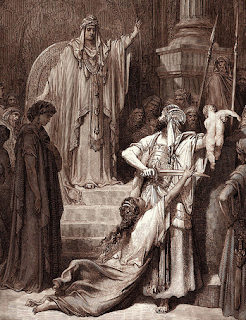
By the way, no one in these paintings
is handling babies correctly
Did someone say King Solomon? Ding, ding, ding! The story of the Judgment of King Solomon from the Bible deals with the custody of a baby with a very similar result (First Book of Kings, 3:16-3:28). Two women fight over a baby, and the king suggests they should cut him in half, dividing him equally. The false mother (kidnapper) agrees, but the real mother is ready to give up her child just to save his life. Solomon, wisely, sees who the true parent is. 

(I have a bone to pick here, by the way: a lot of people think "Solomon's judgment" means cutting a baby in half. To be clear: Solomon never wanted to cut the baby in half. He wanted to see which woman loved the baby enough to let him go rather than let him die. So next time you use this story as a metaphor, make sure you leave the baby-cutting out.)

Unsurprisingly, this story is not unique to the Bible. It belongs to a folktale type numbered ATU 926 (aptly named Judgment of Solomon). A very similar story exists in the Jataka tales from India that chronicle the Buddha's previous lives; it is he who makes a similar decision to tell a demoness (yakshini) from a human mother. The same story also appears in the Ummagga Jataka from Sri Lanka. A woman goes to take a bath, and a demoness takes on her form, claiming the baby is her own. The Buddha suggests they should grab the baby and pull - but the real mother is not willing to cause pain to her child. In a Telugu story from India, two widowed mothers have a custody battle over their son, and the one that actually loves him refuses to have him cut in half.

The story exists in many variants all around Europe and Asia, all the way to Japan, and in West and South Africa. It even migrated across the Atlantic, where we can find it among the tales of the Dominican Republic. Here the frantic mother even tries to point out a birthmark, but in the end it is the sword (machete) trick that reveals the truth. 

The story can be found as far as China, where it takes a very Chinese twist. Two women have babies, but one of the infants die, and the bereaved mother kidnaps the other (the story hints at the fact that she wants to get rid of the baby to make the other woman equally miserable). They take their case to a magistrate, who decides that the baby should be taken into his own household and raised to be an official. The real mother agrees to this, hoping for a good life for her child, while the kidnapper wants to keep the baby at all costs. The clever magistrate figures out the truth. 
(This is actually very similar to what happens in New Amsterdam)

(The same source also notes a tale where a woman finds herself facing two identical husbands, one of whom is a shapeshifter. She solves the problem by setting a tiger loose on them, because apparently tigers like to eat shapeshifters.)

A less dramatic judgment is rendered in a Swahili tale where two women give birth in the same bed, and later they can't decide which one of them had a girl and which one a boy (they both want the boy, obviously). A wise man tells them that the one whose breasts are heavier with milk is the mother of the girl. I am thinking something got lost in translation here. Here is yet another version from Africa (in Gothic letters, good luck).

This tale type also shows up in an Early English version of the Gesta Romanorum, in a slightly different way. The wise Roman emperor Polemius' wife reveals to him that out of his three sons only one is his biological child (oops), but refuses to tell which one, the dying emperor leaves a ring to his sons, and the mission to figure out which one is his true heir. The three princes go to the King of Jerusalem (Solomon, is that you?), and the wise king tells them to dig up the corpse of their father. Whoever shoots an arrow into the middle of his heart will be the heir. However, the youngest son refuses to hurt his father, even in death. He is declared the true heir. (There is also a love story version of this, from the Philippines!)
Find out more about this tale here.


Conclusion

Real love does not hurt.
Also, it was a nice twist from New Amsterdam to have a father make the loving decision rather than a mother.
Also, when in doubt, set a tiger loose. 

Thursday, June 4, 2020

The three little eggs (Feminist Folktales 19.)

Another Thursday, another post for Feminist Folktales! It's a series of traditional stories from around the world that display motifs that reflect feminist values. I am not changing any of the stories, merely researching and compiling them, and posting them here as food for thought. You can find the list of posts here.

Origin: Eswatini (Swaziland)

The story

A woman is beaten and abused by her husband regularly until she decides to run away. She takes her two small children and escapes into the wilderness. By a river they find a nest with three little eggs in it, and they carry it safely with them. For the rest of the journey the little eggs whisper advice to the woman about which road to take, where to find shelter. She has to face and defeat various monsters, keeping her children safe in the wild. In the end she breaks a curse on a kingdom, she is elected their queen, finds true love (in a prince who had been transformed into an egg), and lives happily ever after.


What makes it a feminist story?

I loudly support any folktale where the abusive partner is not "saved" or "fixed" but rather escaped and left behind (there are not many of these). This story highlights the fact that the abusive, violent husband is bad for the wife, and the best solution for her is to leave him.
However, the story also clearly shows that such an escape is very hard and full of danger. Sometimes the travelers find shelter that turns out to be a den of monsters; sometimes they get lost in the woods and the only way through is forward. The mother cares for her children, feeds them, sings to them, helps them climb trees to be safe. She is not a "selfish woman" who "destroyed her family" (women fleeing abuse are often told by people that they should have "tried harder, for the sake of the children", which is, frankly, bullshit). We see a brave and caring mother who literally faces man-eating monsters to make the life of her children (and herself) better and safer.
It is also important to note that the mother needs help and encouragement on this road, which she gets from the eggs. This symbolism can be explained in many ways, as internal or external help. At the end of the story we find out that the eggs were princes under an enchantment. But whether the help comes from without or within, it is important to see that the brave hero needed encouragement, advice, help - as in real life survivors of abuse also need a lot of these things to escape a bad situation, especially with children. At the end of the story the hero becomes queen, a queen who has the power to help others. Getting help from others does not diminish her heroism. Quite the opposite.

Things to consider

This story can be triggering to some audiences (esp. survivors of abuse). The storyteller should consider carefully the context of the telling, and make sure there will be time and space to deal with the feelings that might surface.

Sources

E. J. Bourhill & J. B. Drake: Fairy tales from South Africa (MacMillan, 1908.)

Notes

I included this story in my upcoming book (in Hungarian), about "non-traditional" families.