Showing posts with label Scottish. Show all posts

Sunday, June 18, 2023

Folktales about adoptive fathers (International Father's Day)

It's father's day, and I felt like making another post, so here it is. 

(Everybody calm down, this is a stock photo)

We are celebrating fathers - and father figures - all around the world today. I already posted about the importance of caring fathers in folklore a few years ago. Today I decided that I want to highlight stories about adoptive fathers - because adoption is a topic near and dear to my heart, and because it is often represented in a negative way in folklore.

So, let's hear it for great adoptive fathers, both in folklore and in the real world!

(Links in the titles, as usual.)

The Flying Horse of Earthdom (Scottish Traveller tale)

One of Duncan Williamson's tales. A king's son is born with a hump on his back, and the king orders the baby to be abandoned in the woods. He is adopted by an old hunchbacked man who takes him to a secret place called Earthdom, populated by people shunned by society. The boy is raised there, and since his adoptive father teachers him archery, his back straightens by the time he grows up. He returns to court to win a series of contests. When the king finds out the young man is his son, he wants to take him back - but the boy refuses him, and returns to Earthom to the kind people who raised him.

The Wild Man's Daughter (Greece)

A king's daughter sees a dream that foretells her father bowing before her. The king grows so angry that he orders her to be abandoned in the wilderness. She ends up in the house of a Wild Man, who adopts her and cares for her, and helps her grow in confidence and find a worthy husband. Even after his death, he leaves her some magic to ensure her happiness.

Heimer and Aslaug (Iceland)

This is a sequel to the epic story of Sigurd and Brynhildr. The tragic couple has a daughter, Aslaug. After the death of her parents she is saved and spirited away by Heimer, who becomes her foster-father. He hides the baby girl inside a harp and travels with her to faraway places, disguised as a wandering musician. Eventually he is killed, but he manages to save Aslaug's life.

N'oun Doaré (Brittany)

The hero of this story (whose name means "I don't know") is found as a small child by the Marquis of Coat-Squiriou. The kind marquis adopts him and raises him. When N'oun Doaré grows up, he goes through a series of adventures, supported by his parents. Eventually he even finds out about his own origins - however, when asked, he still names the marquis and his wife as his true parents.

Boris Son o' Three (Ukraine)

A boy is kidnapped by an eagle and lost in the woods. He is found by three brothers who decide to raise the baby together; they christen him Boris Son o' Three. When he grows up, the fathers gift him a magic foal, and he goes on to amazing adventures.

The Wild Cat of the Forest (Austria)

A charcoal burner encounters a large man in the forest and invites him to baptize his newborn child. The godfather names the boy Wild Cat. Growing up, the boy keeps getting into trouble and his parents abuse him, so one night he runs away and goes to live with his godfather. The wild man teaches him a useful trade and cares for him, until Wild Cat runs away again to other adventures.

There are more stories, but this is all I had time for today. I hope I managed to demonstrate that kind adoptive fathers do exist in folklore :) 

Happy father's day!

Saturday, April 9, 2022

H is for Heliotrope and Northern Lights (Gemstone Folklore)

Welcome to the 2022 A to Z Blogging Challenge! My theme this year is Gemstone Folklore. Because I love stories about shiny things. Read the introduction to the project here.

HELIOTROPE (BLOODSTONE)

Heliotrope is a form of jasper, usually dark green in color with bright red hematite spots, which is why it is more commonly known as bloodstone.

The Nimble Men
Scotland

Legend says that when the rebel angels fell from Heaven, they became three types of beings: those who fell to the land became Fairies, those who fell into the sea became Blue Men (Na Fir Ghorma), and those who stayed in the air became the Nimble Men (Na Fir Chlis, sometimes also translated as Merry Dancers or Streamers). According to another legend, the Nimble Men, the Blue Men, and the Green Ladies are all descendants of Queen Beira, the winter goddess. The Nimble Men are the Northern Lights, creating a flurry of colors with their dancing. Or, occasionally, fighting.

"The Nimble Men are divided into two clans. The heroes of one clan are clad in garments white as hoar-frost, and the heroes of the other clan in garments of pale yellow. Brighter and more varied colours are worn by the ladies of the clans. Some are gowned in green, some in red, and some in silvery white, and a few wear royal purple."

According to the story, a prince of the White Clan called Lightfoot, and the chief of the Yellow Clan, Green Eyes, competed for the love of a maiden called Princess Comely. She favored Lightfoot, who was the best dancer. One night, at the dance, Lightfoot proposed to her and she accepted. However, Green Eyes grew so angry that he and his men attacked the rival clan, and the party turned into a battle. So much blood was spilled that it dripped to the earth, and left red spots on the stones. When the battle was over, the princess went looking for Lightfoot, and found him cold and dead. Embracing him, she died of heartbreak.
The stones still bear the red spots of blood. They are called bloodstones, or fuil siochaire, "elf blood."

Sources
You can find this story in here. You can read more information here.

Have you ever seen the northern lights in real life? 
Did they look like a dance, or a battle?

Thursday, April 29, 2021

Tarot Tales: Y is for Youth (the Pages)

Welcome to the 2021 A to Z Blogging Challenge! My theme this year is Tarot Tales. I am making a selection of folktales, legends, and other traditional stories that correspond to tarot cards. Storytelling and tarot go well together. Do other stories come to mind? Let me know in the comments!

For the last time this month, I am doing court cards, four instead of one. We have already met the Kings, Queens, and Knights - it is time to meet the Pages! They are all about youthfulness, new beginnings, and potential. 


Page of Cups
This Page is full on unbridled creativity. They are open to new possibilities, follow their intuition and their feelings, they are curious about everything, and they love surprise discoveries. This card is about new creative endeavors, and seeing the beauty in new things around you. 

From a very old book, but it's a beautiful story. Thashira, daughter of the Queen of Fountains, is in love with colors. She collects flowers, berries, different kinds of dyes, and paints her own skin as well as the rocks around her home. She admires anything colorful. The Sun falls in love with her and creates colorful sunsets. The Wind also falls in love and brings rain to make colorful flowers. Thashira chooses the Sun, and as she rises into the sky to meet him, she becomes the rainbow.


Page of Swords
This Page is looking for knowledge. They want to learn new things, come up with new ideas, explore new theories, and find new ways to express all these. Since Swords are related to intellect and communication, this Page also has an affinity for wording or explaining things in innovative ways.

This story features two very clever brothers who understand the language of birds and are "clever at drawing deductions from the smallest signs" (hmm, where have I heard this before?). They set out to see the world and exercise their skills. They solve a mystery about a lost cow, get framed for murder, and then dazzle a magistrate with all kinds of clever observations and deductions - including the one when they tell him who his biological father is.


Page of Wands
This Page is about restless energy. They are ready to go, starting out on a journey, full of inspiration and creativity. They want to discover the world, find new things, and go places.

The Ocean-Jumping Shoes (Hungarian folktale)
One of my favorite Hungarian tales. It's about a girl who wishes for ocean-jumping shoes so she can travel the world and see all there is to see. When her father finds her the shoes, she sets out on all kinds of adventures, including a visit to the Glass Mountains and an encounter with an evil witch. The brave and clever girl rescues a prince and his sisters, and goes on to many other adventures in her magic shoes.


Page of Pentacles
This page is about material, practical things: learning new skills, starting new business opportunities, finding a new profession, a source of income or wealth. They are actively beginning to turn ideas into tangible things, practicing, learning, exploring.

Archie's besom (Scottish Traveller tale)
One of my favorite tales from legendary Traveller storyteller Duncan Williamson. Archie is a poor boy who makes a living from doing odd jobs with his brother. One day they meet an old Traveller who makes brooms from heather, and Archie decides he wants to learn his craft. He gets to work with great determination and enthusiasm, asking questions and experimenting with making his first broom. The end result is a bit strange: Archie's besom is huge, much bigger than any broom should be. But Archie doesn't despair, rather he cheerfully sets out to sell it. As luck would have it, he meets a very strong-boned witch who has been looking for a broom big enough to carry her. She happily buys the broom, and pays Archie with a magic coin.

Which Page do you feel closest to? Have you started any new things lately?

Monday, November 12, 2018

Fairies, heroes, wizards (Following folktales around the world 91. - Scotland)

Today I continue the blog series titled Following folktales around the world! If you would like to know what the series is all about, you can find the introduction post here. You can find all posts here, or you can follow the series on Facebook!


The Penguin Book of Scottish Folktales
Neil Philip
Penguin Books, 1995.

Yet another folklore classic, with notes, sources, tale types, and a world of information. It represents various aspects of Scottish oral tradition; the 112 tales are grouped into chapters by region (Highlands and Lowlands), as well as story types (historical stories, anecdotes, fairy legends, etc.). The long introduction talks about tale type indexes, the features of oral storytelling, Scottish tradition, and even the roles of male and female tellers. Each story comes with sources, type numbers, and the teller's name. Many texts were written out phonetically, which made it harder for me to follow, and often I had to read them out loud to understand the words, but it was worth it. I found quite a few great stories in this book.

Highlights


Kate Crackernuts
Some of my favorite Scottish folktales are featured in the book - for example Kate Crackernuts, with a heroine who saves a prince and also helps her stepsister (in a sort of reverse "dancing princesses" story); or Mally Whuppie, who repeatedly outwits a giant to save herself and her sisters. The latter also had a Highland variant, called Maol a Chliobain.
I really liked Maraiche Mairneal, the Weatherwise Mariner, who was not even the protagonist in his own story; the hero was a prince who had a snake twisted around his body, and in order to find the women who could help him get rid of it, he had to enlist the help of an old, blind mariner. All was well in the end. The story of The widow's son and the king's daughter took an unexpected turn when the hero, in order to defeat a fire-breathing dragon, got a camel, filled it up with water, and made it spew water at the flames of the dragon. Similarly unexpected was the story of The man in the boat, a version of "the man who had no story", in which said man was spirited away by a boat, turned into a woman, married, had children, and then got back on the same night - and now he had quite the story to tell. Teenagers love this story.
I was delighted to find quite a few Fianna legends in the book. Finn in the land of Big Men was familiar; I even have a version of it in my own book. Finn and the Grey Dog is also an old favorite of mine; I knew it from Rosemary Sutcliff's collection, but it was great to find the folk text as well. There was a variant of the Hostel of the Quicken Trees (here the Yellow Field), where the Fianna warriors get stuck to their chairs in an enchanted house, and the younger generation has to rescue them. And of course there was a story about Oisín (Ossian), after the Fianna.

Michael Scott's tomb
There were some fascinating historical legends as well. One was about the last of the Picts, and how father and son took the secret of the heather ale with them to the grave. I encountered Sir James Ramsay of Bamff, a legendary doctor with magical abilities, and Michael Scott, one of the most famous wizards in European lore (both were features in my book on superpowers).
Among the fairy legends, I really liked Black Lad MacCrimmon and the Banshee, where the fairy asked the piper lad if he wanted success without talent, or talent without success. He chose the latter.

Connections


A Fekete Bika képregény- változata (Image Comics)
There were quite a few classic tale types in the book, such as Mother killed me, father ate me; Cinderella; Beauty and the Beast (here the Black Bull of Norroway); Magic Flights (Green Sleeves); Frog Bride; The hunchback and the fairies; Clever Maiden; Water of Life (here with a friendly bear); Firebird (here with a friendly fox); and even Raven brothers (here with shirts made from bog cotton). There was a Scottish Frog Prince who had to be beheaded with an axe, rather than kissed. Rumpelstiltskin here was a woman named Whoppity Stoorie, and Frau Holle's tale was called The well at the end of the world (one of my storyteller friends recently released a CD with the Appalachian version of this).
I was reminded of other European wizards by Donald Duibheal Mackay who had not shadow, and other European tales by the Humble-bee that flew from the mouth of a sleeping person, and had dream-like adventures.
There were familiar Münchhausen tales among the anecdotes, such as the servant who ate one leg of the goose (known from the Decameron, and also my own grandfather), or the Mare's egg.
Of course I found sleeping knights, waiting for their king to appear; and there was also a Polyphemus story, but instead of blinded cyclops here it featured a blinded fairy (Tam M'Kechan).
The fairy legends were full of familiar motifs: Dance in the fairy hill, fairy midwife, changelings, wife kidnapped by fairies (who then had to choose between two husbands), and mortal traveling with fairies (Hurrah for Kintail!). There was also a selkie and an evil mermaid.
As for tricksters, we had George Buchanan, the king's clever fool.

Where to next?
Northern Ireland!

Thursday, June 25, 2015

Folklore Thursday: A mosaic of stories

Today is Folklore Thursday on social media! If you want to find out more, follow this link, or click on the #FolkloreThursday hashtag on Twitter! Hosted by @FolkloreThursday.

One of my favorite things to do as a storyteller? Looking up several versions of the same tale, and building my own from them. It is kind of like a make-your-own ice cream thing.

One of the stories I am working with recently is most commonly known as The Black Thief and the Knight of the Glen. It belongs to Aarne-Thompson folktale type 953 ("Old robber tells three stories"), and I have managed to find about a dozen different versions of it, most of them from Scotland and Ireland. Interestingly enough the story also shows up in the Grimm Fairy Tales, but it was edited out after the 6th edition (it was No. 191 until then).

The story in a nutshell: Three young men and an old thief are caught trying to steal a king's horse. They are about to be burned alive for their crime. In order to save the lads, the old thief tells the king that he has been in a worse situation before. The king promises that if it's true, one of the lads can go free. The old thief tells outrageous stories about his close brushes with death; each story gets more hair-raising and exciting, and after each, one of the lads is let go. After the last story, which involves saving a baby from a giant, the king realizes that the child the old thief saved was no other than himself, and lets everyone go free with gifts and good wishes.

There are many things to love about this story, and it is a lot of fun to tell. In order to show some of my build-a-story process, here are some details:

1. The protagonist is known as the Black Thief, Red Conall, Conal Yellowclaw, or the Byzantine Brigand in different sources. In my version, I call him Red Conall, the Byzantine Brigand, because his red hair is an important plot point in the story, and "Byzantine Brigand" just sounds too awesome not to include.

2. In some versions the three lads are Conall's own sons whom he tries to keep away from becoming robbers themselves (Conall himself reformed in his old age). In other versions they are three princes sent on a quest by an evil queen. While both versions carry a lot of emotional weight and possibilities, I tell the second one, because an old, wandering former master-thief taking three exiled princes under his wings is just too interesting to pass up. He definitely becomes a father figure that is willing to sacrifice his own life to save the lads.

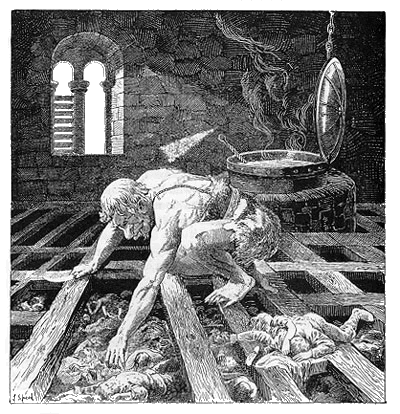
3. The three stories told by Conall are varied across the board. One of them is often a version of the "Blinding the Cyclops" episode from the Odyssey. I left that one in since it is exciting, and also intriguing that it shows up in an Irish folktale. I especially like that according to Conall, he and his companions went into the Cyclops' cave because they wanted to rob it. Conall talks about his former exploits of thieving and robbery with pride, even if they went horribly wrong in the end. He used to be the best of the best, after all.

4. You can never quite tell how much of Conall's stories are true, and how much he is making up on the spot. The last story usually includes a physical sign - he saves the baby's life by cutting off a little finger, and that's how the king knows it was himself, since he is missing a finger too. I like to imagine that Conall just looked at the king, saw the missing finger, and took a chance on it. It is never said in the story when I tell it, but kind of implied, that Conall is just pulling a Scheherazade, making up tales on the fly in desperation to save the princes' lives. You have to be an awesome storyteller to get away with that three times in a row.
(Scheherazade at least always had a day to think ahead...)

Anyhow, fun story, many possibilities. I really enjoyed assembling my favorite version.

Here is a short list of some of my sources:

Johannes Bolte & Georg Polívka: Anmerkungen zu den Kinder- u. Hausmärchen der Brüder
Grimm, 1913. (Der Rauber und seine Söhne)
Italo Calvino: Italian folktales, 1992. (Three Tales by Three Sons of Three Merchants)
J.F. Campbell: Popular Tales of the West Highlands Vol. 1, 1890. (Conall Cra Bhuidhe)
J.L. Campbell: Stories from South Uist, 1961. (The Byzantine Brigand)
Wilson M. Hudson: Tire Shrinker to Dragster, 1968. (An Gadaí Dubh: The Black Thief)
Joseph Jacobs: Celtic Fairy Tales, 1892. (Conal Yellowclaw)
Andrew Lang: The Red Fairy Book, 1890. (The Black Thief and the Knight of the Glen)

William Thackeray: The Irish Sketch Book, 1843. (The Black Thief of Sloan)