This year was not only my first time in Greece - it was also my first time at a Greek storytelling festival! I have been hearing about the magical island of Kea for years, and I was excited that I finally got to participate in their festival. It was a treat.
Our participation started on Wednesday evening, when we all gathered in the garden of the Mylopotamos museum of folklore and cultural heritage, in a nice small open-air theater. Storytelling started at 7pm; there were 21 storytellers in the lineup, with 10 minutes each. Together with the breaks where we drank wine and ate dinner, the program lasted until midnight, and in true Mediterranean fashion, we still had quite a big audience at the end. Apart from the international FEST participants, there were also Greek families, and tourists who happened to pass by. The acoustics of the theater left some things to be desired, especially because of the mixed background noise of cicadas, playing children, and a road. It was sometimes hard to hear the storytellers if they did not project at full capacity. Still, we experienced quite a few amazing performances.
Antonietta Pizzorno (above) told the tale of "A prince made by woman's hands" and while she mostly told in Italian, she conveyed the story really well, and left us in tears of laughter. Nuala Hayes told an Irish folktale in which the son of the King of Greece fell in love with the daughter of the King of Ireland - it was a great story, and very appropriate for the occasion. Susana Tornero told Stone Soup entirely in Sabir, the pidgin language of the medieval Mediterranean. We could all follow it, although it sounded like she was speaking Italian, Spanish and French at the same time (which, technically, she was). Regina Sommer told my favorite legend of Charlemagne, about the founding of Aachen. Senem Donatan, one of the Turkish ladies, told the myth of Inanna in the Underworld, with powerful singing. Seung Ah Kim, the Korean visitor, wore a traditional dress, and told the tale of the Snake Bridegroom with graceful gestures, eloquent words, and a haunting song.
As for me, I told a folktale collected from one of my favorite storytellers, Anna Pályuk, more than a hundred years ago. It is about three princesses who are half-siblings - one of them had a mother who was a fairy, one was a witch, and the third was a mortal. Their father, the king, tries to make them marry the Devil out of a mistake, and the three princesses work together to change his mind and fix the situation. It is a fun story to tell, the audience loved it, and it fit air-tight into the 10 minutes.
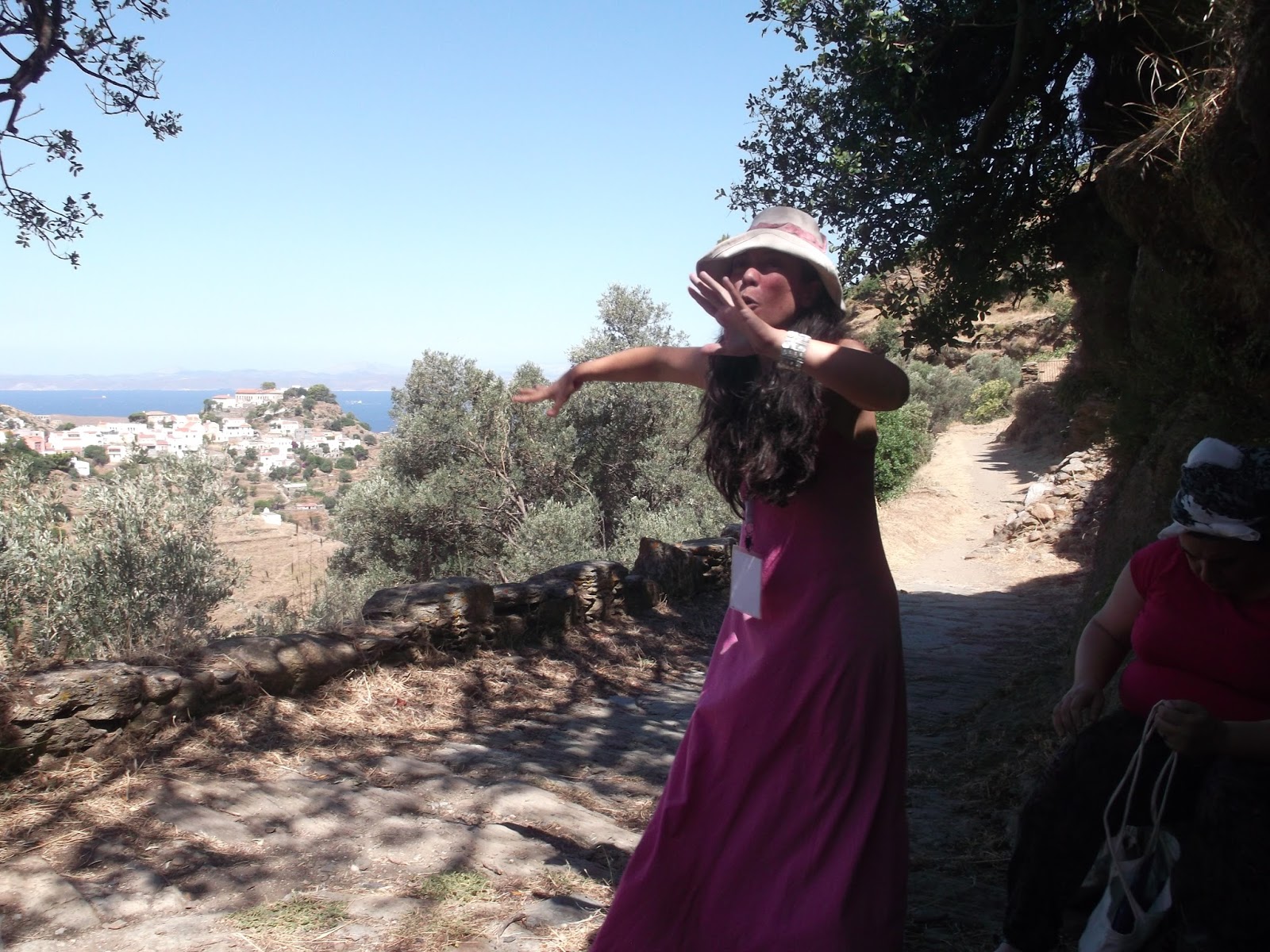
On Thursday, the festival moved to another location: We drove up to the town of Ioulida on the mountain, and prepared for a second story walk. The first stop was a fountain surrounded by fig trees and bushes; we sat on a flight of stairs, and listened to four stories. Three of them had to do with the sea; my favorite was Janneke Tanja (right), who told a haunting legend about a fisherman who ferries the souls of the dead across the sea. I had goosebumps all over. It was excellently crafted from a small bit of a local legend in the Netherlands.
The second site was a small alley, surrounded by the white walls and winding steps of the town. Once again we sat on stairs. We heard three storytellers, Jennifer, Marina, and Dafydd Davies Hughes (left), who told us a Welsh version of the myth of King Midas. Once again, bonus points for the choice of story. It is always interesting to see how far certain motifs have traveled over the centuries.
The third and final stop on the walk was an open air theater in a grove, under the stars and below the old stone walls of the town. The performance was a treat: Abbi Patrix (France) presented a full show of smart animal tales, spiced with African proverbs and percussion music by Linda Edsjö.
The festival continues on over the weekend, and I am a little sad that I didn't stay longer (although the performances seem to be in Greek from this point on). Kea is a lovely place, very calm and beautiful, and the festival was an amazing blend of mythical landscape and good storytelling. I am glad I made the trip, and I hope I will get to return in the future!
Showing posts with label Kea Island. Show all posts
Monday, July 27, 2015
FEST Conference 2015, Kea Island, Greece
This is me reporting in from the Federation for European Storytelling conference in Greece. This is an unofficial, personal account of the conference.
The 8th FEST storytelling conference took place between July 19th and 22nd this summer, on the lovely island of Kea in Greece. According to my count (based on the list of participants we received in our conference packet) it was attended by 75 storytellers, representing 21 countries and 44 storytelling organizations, 32 of which were members of FEST. It was the first time I was representing an official member: We registered the Holnemvolt Storytelling Foundation last September! Apart from several European countries, we had people visiting from Canada and South Korea; also for the first time in FEST history, 9 lovely ladies showed up from Turkey! It was a dynamic, exciting, culturally colorful conference.
We started off on Sunday evening with an international picnic where every country offered up some traditional food. Sadly, I couldn't find any Hungarian delicacies that would have traveled well, so I gave up the Hungarian table to the Turkish delegation, who promptly filled it with overflowing delicious sweets (talk about history going the right way). Our gracious Greek hosts treated us to dinner with music and spontaneous dancing. The walk around the harbor in the sunset was a very romantic opening scene for the three days of storytelling work.
Monday morning opened at the Cultural Center in Korissia, with a ceremony involving Greek mythology and music. Next we heard a presentation from Mr. Stavros Benos from an organization called Diazoma that works to revitalize ancient Greek theaters, and bring new cultural events to the ancient stages. They talked about research and restoration work, tourist programs, and ideas for future projects.
Three other presentations followed: Marina Granlund (Sweden) introduced us to Project Hermes through a ritual invoking the Greek gods and a beautiful telling of the myth of Demeter and Persephone. Maria Vrachionidou (Greece) gave a presentation about motifs of mythology surviving in folktales (or maybe the other way around?) and brought some great examples too. My favorite was a version of the Prometheus myth that features a smart old woman. The third presentation was by Stella Kassimati from Friends of Amari in Crete, who talked about how mythology and personal or family stories can be intertwined, and brought the story of Europa and Kadmos as an example.
Monday evening we could choose from two workshops: One was on performance skills, and one on the use of storytelling in education. I attended the latter, presented by Guy Tilkin (Belgium), Regina Sommer (Germany), Heidi Dahlsveen (Norway), and Jennifer Ramsay (Spain). We herd about several school storytelling projects; Regina presented academic research on the effects of regular storytelling on the students' skills; we discussed how we can prove and present that storytelling (and narrative thinking) is useful to a school. Jennifer talked about language education and activities that go with storytelling. We also discussed the use of storytelling with students who are disadvantaged in some way. All in all, it was a great workshop, and much needed in the field of applied storytelling.
Tuesday morning we started with a long story walk up on the mountain in Iulida. We were split into three groups; my group was led by two lovely Greek storytellers, Georgia Lazarou and Katia Kantouri (left). We walked around town and along the mountainside, and occasionally stopped to hear local legends and folktales. It was both gorgeous and fascinating.
My favorite stop was the Lion of Kea, an old, old statue lying in the mountainside, smiling its enigmatic smile. It reminded me of the stone lion from the Neverending Story, one of the books that made me a storyteller. I touched its back - although it was lying in the burning sun, it was cool to the touch.
The walk ended under a great old plane tree, where we all gathered to take pictures, drink from the fountain, and have a picnic together. Before the food we had an open forum discussion about how landscape affects the stories that are born from it. We heard very interesting opinions, examples, and even stories (obviously). The common ground seemed to be that yes, stories are affected and shaped by landscapes, but that in itself is not enough to make them interesting to a foreign listener. Speaking for myself, I was glad I got to hear the tales of Kea in the place where they were born. It added a lot to the experience.
After a great lunch, we returned to Korissia for siesta before we began the afternoon sessions. Everyone could choose two from four round table discussions (Festivals, Performance, Healing, and Inclusion). First I attended the discussion on festivals (moderated by David Ambrose from Beyond the Border), in which we talked about practices and ideas about translation, commissioning new work, residencies for storytellers, and outreach for new audiences. Some people in the group were veteran festival organizers, while some of us were fairly new, and drinking in information like a sponge.
In the second round I joined the group titled "Storytelling and Inclusion - Social, political, economic immigrants." This was a very timely topic for me as a Hungarian person, for all the wrong reasons, and I was eager to hear about projects and ideas that help storytellers contribute to building bridges and counteracting hate and prejudice. The discussion was moderated by Guy Tilkin (Alden Biesen, Belgium), and we heard about things like the Human Library Project, integration of immigrant children into German-speaking schools through storytelling, and other great things. It made me feel hopeful to hear that storytellers had an important part to play in this cultural shift.
Tuesday evening the Greek hosts passed the torch of FEST on to the French representatives - next year's conference will be in France! We celebrated with drinks, singing, and dancing, and conversations late into the night.
The conference's last day contained all the actual organizational work. We had to vote on several things. One of them was the location of the conference in 2017; both the Irish and the Dutch delegation brought excellent presentations to pitch their own sites. It was a tough choice; we had to break a tie, and in the end, Ireland was chosen by the representatives of FEST members for the 2017 conference. I am personally very excited about it! I also hope the Dutch apply again. Their plans sounded amazing as well.
We also voted on FEST 2018; 4 countries proposed, and in the end, after another elaborate voting process, Slovenia gathered the most votes. In my personal opinion, this is great for several seasons: One, Slovenia is a gorgeous place; two, Ana, the Slovenian representative, made a very good point about the need to bring FEST to Eastern European and Slavic speaking storytellers, in order to bring them into the FEST community (she was the only Slavic speaking person at the conference). I am looking forward to the next three years!
Finally, we also voted on new members of the FEST Executive Committee. I was among the nominees, which surprised me, but also made me think seriously about what I could contribute to the work of FEST. While I spend the school years in the USA, I could offer my experience with digital and social media, and networking. In the end, I was among the three new members elected for the Executive Committee, along with Ana Dusa (Slovenia) and Sonia Carmoma Tapia (Spain). The next three years are looking to be an adventure! I am deeply honored and excited for having been chosen for this position, and looking forward to all the work.
All in all, it was a great conference: Friendly, well organized, educational, and not too hurried. I will be processing all I heard and learned for a very long time.
With all the voting done, we were free to relax and enjoy the 13th Kea Folktale Festival. But I'll leave that for the next post.
The 8th FEST storytelling conference took place between July 19th and 22nd this summer, on the lovely island of Kea in Greece. According to my count (based on the list of participants we received in our conference packet) it was attended by 75 storytellers, representing 21 countries and 44 storytelling organizations, 32 of which were members of FEST. It was the first time I was representing an official member: We registered the Holnemvolt Storytelling Foundation last September! Apart from several European countries, we had people visiting from Canada and South Korea; also for the first time in FEST history, 9 lovely ladies showed up from Turkey! It was a dynamic, exciting, culturally colorful conference.
We started off on Sunday evening with an international picnic where every country offered up some traditional food. Sadly, I couldn't find any Hungarian delicacies that would have traveled well, so I gave up the Hungarian table to the Turkish delegation, who promptly filled it with overflowing delicious sweets (talk about history going the right way). Our gracious Greek hosts treated us to dinner with music and spontaneous dancing. The walk around the harbor in the sunset was a very romantic opening scene for the three days of storytelling work.
Monday morning opened at the Cultural Center in Korissia, with a ceremony involving Greek mythology and music. Next we heard a presentation from Mr. Stavros Benos from an organization called Diazoma that works to revitalize ancient Greek theaters, and bring new cultural events to the ancient stages. They talked about research and restoration work, tourist programs, and ideas for future projects.
Three other presentations followed: Marina Granlund (Sweden) introduced us to Project Hermes through a ritual invoking the Greek gods and a beautiful telling of the myth of Demeter and Persephone. Maria Vrachionidou (Greece) gave a presentation about motifs of mythology surviving in folktales (or maybe the other way around?) and brought some great examples too. My favorite was a version of the Prometheus myth that features a smart old woman. The third presentation was by Stella Kassimati from Friends of Amari in Crete, who talked about how mythology and personal or family stories can be intertwined, and brought the story of Europa and Kadmos as an example.
Monday evening we could choose from two workshops: One was on performance skills, and one on the use of storytelling in education. I attended the latter, presented by Guy Tilkin (Belgium), Regina Sommer (Germany), Heidi Dahlsveen (Norway), and Jennifer Ramsay (Spain). We herd about several school storytelling projects; Regina presented academic research on the effects of regular storytelling on the students' skills; we discussed how we can prove and present that storytelling (and narrative thinking) is useful to a school. Jennifer talked about language education and activities that go with storytelling. We also discussed the use of storytelling with students who are disadvantaged in some way. All in all, it was a great workshop, and much needed in the field of applied storytelling.
Tuesday morning we started with a long story walk up on the mountain in Iulida. We were split into three groups; my group was led by two lovely Greek storytellers, Georgia Lazarou and Katia Kantouri (left). We walked around town and along the mountainside, and occasionally stopped to hear local legends and folktales. It was both gorgeous and fascinating.
My favorite stop was the Lion of Kea, an old, old statue lying in the mountainside, smiling its enigmatic smile. It reminded me of the stone lion from the Neverending Story, one of the books that made me a storyteller. I touched its back - although it was lying in the burning sun, it was cool to the touch.
The walk ended under a great old plane tree, where we all gathered to take pictures, drink from the fountain, and have a picnic together. Before the food we had an open forum discussion about how landscape affects the stories that are born from it. We heard very interesting opinions, examples, and even stories (obviously). The common ground seemed to be that yes, stories are affected and shaped by landscapes, but that in itself is not enough to make them interesting to a foreign listener. Speaking for myself, I was glad I got to hear the tales of Kea in the place where they were born. It added a lot to the experience.
After a great lunch, we returned to Korissia for siesta before we began the afternoon sessions. Everyone could choose two from four round table discussions (Festivals, Performance, Healing, and Inclusion). First I attended the discussion on festivals (moderated by David Ambrose from Beyond the Border), in which we talked about practices and ideas about translation, commissioning new work, residencies for storytellers, and outreach for new audiences. Some people in the group were veteran festival organizers, while some of us were fairly new, and drinking in information like a sponge.
In the second round I joined the group titled "Storytelling and Inclusion - Social, political, economic immigrants." This was a very timely topic for me as a Hungarian person, for all the wrong reasons, and I was eager to hear about projects and ideas that help storytellers contribute to building bridges and counteracting hate and prejudice. The discussion was moderated by Guy Tilkin (Alden Biesen, Belgium), and we heard about things like the Human Library Project, integration of immigrant children into German-speaking schools through storytelling, and other great things. It made me feel hopeful to hear that storytellers had an important part to play in this cultural shift.
Tuesday evening the Greek hosts passed the torch of FEST on to the French representatives - next year's conference will be in France! We celebrated with drinks, singing, and dancing, and conversations late into the night.
The conference's last day contained all the actual organizational work. We had to vote on several things. One of them was the location of the conference in 2017; both the Irish and the Dutch delegation brought excellent presentations to pitch their own sites. It was a tough choice; we had to break a tie, and in the end, Ireland was chosen by the representatives of FEST members for the 2017 conference. I am personally very excited about it! I also hope the Dutch apply again. Their plans sounded amazing as well.
We also voted on FEST 2018; 4 countries proposed, and in the end, after another elaborate voting process, Slovenia gathered the most votes. In my personal opinion, this is great for several seasons: One, Slovenia is a gorgeous place; two, Ana, the Slovenian representative, made a very good point about the need to bring FEST to Eastern European and Slavic speaking storytellers, in order to bring them into the FEST community (she was the only Slavic speaking person at the conference). I am looking forward to the next three years!
Finally, we also voted on new members of the FEST Executive Committee. I was among the nominees, which surprised me, but also made me think seriously about what I could contribute to the work of FEST. While I spend the school years in the USA, I could offer my experience with digital and social media, and networking. In the end, I was among the three new members elected for the Executive Committee, along with Ana Dusa (Slovenia) and Sonia Carmoma Tapia (Spain). The next three years are looking to be an adventure! I am deeply honored and excited for having been chosen for this position, and looking forward to all the work.
All in all, it was a great conference: Friendly, well organized, educational, and not too hurried. I will be processing all I heard and learned for a very long time.
With all the voting done, we were free to relax and enjoy the 13th Kea Folktale Festival. But I'll leave that for the next post.
Labels:
conferences,
FEST,
folklore,
Greece,
Kea Island,
storytelling,
travel
Subscribe to:
Posts (Atom)