Showing posts with label Solomon Islands. Show all posts

Thursday, May 7, 2020

Riina and her Amazons (Feminist Folktales 17.)

Another Thursday, another post for Feminist Folktales! It's a series of traditional stories from around the world that display motifs that reflect feminist values. I am not changing any of the stories, merely researching and compiling them, and posting them here as food for thought. You can find the list of posts here.

Origin: Solomon Islands (Malaita)

The story

Image from Rejected Princesses
Two women are walking on the beach when two gosile swoop down and kidnap them. The gosile are ghosts who can fly, have supernatural powers, and eat human meat and brains. They take the women to their house on a rock in the middle of the sea and want to eat them, but the women cry so miserably that the gosile decide to keep them prisoners instead.
Meanwhile, the husbands of the kidnapped women gather a large amount of bounty for anyone who can rescue their wives. Men set out with a hundred canoes for the rescue, but when the gosile swoop down and eat two of them, they hastily retreat. Soon after, another volunteer appears: Riina, the blonde warrior woman with her group of Amazons from the island of Lumalao. Initially no one thinks they could possibly succeed where men failed, but Riina states that she can easily break the jaw of any gosile, even if it's a male one.
The Amazons set out in their canoe to the ghosts' island. The two gosile attack them on the way, but Riina wrestles one of them into submission, ties him up, and interrogates him about where his powers are hidden. When she finds the magic objects, she steps over the, desecrating them with her "female presence", rendering the gosile powerless. She then befriends him and tricks him into helping her get to the house on the rock. Entering the house she sits in places where a woman is not allowed to sit, angering the two gosile who attack her. Riina kills both of them with her boomerang, and rescues the women. They all return home, and the Amazons get all the bounty.

What makes it a feminist story?

Not only do we have strong, independent woman warriors in this story (who work as a team), but also, they actually win in this story. On a global scale it is hard to find Amazon legends that don't end with the Amazons being defeated, disappearing, or marrying and settling down. Riina and her Amazons succeed where men have failed, and they get appreciation and a reward for it. The latter they take as a team, although Riina asks for an extra gift for herself, and receives a household spirit.
I find it especially interesting that Riina overcomes her enemies by breaking taboos. She takes the first gosile's power by stepping over the magic items that contain it (it is a taboo for women to step over things in various cultures), and she angers the second one by sitting in places where women are not allowed to sit. Riina knows the rules limiting her femininity, and breaks them on purpose to gain an advantage. (This reminds me of the time in first grade when I found out that the boys who bullied me were afraid of cooties. Soon my parents were called in because I was "throwing kisses at the boys" to keep them away. Dunno, I think it was a pretty solid defense mechanism.)
From another story we find out more about the warrior women of Lumalao. We encounter Moaanawalo, Riina's sister and the leader of the tribe. We find out that the "light skinned" warrior women live in a type of house that is usually reserved for men. They form a real society: they hunt, they fish, and they take their wares to market. They make alliances and launch revenge campaigns if they are attacked. At one point Moaanawalo dresses up as a married woman (taboo for unmarried women) to make a plan succeed.

Things to consider

The texts collected by Kay Bauman carry a lot of symbolism and cultural references. The book contains a short introduction for both stories, highlighting some of the exciting elements, but European readers might see these as simpler stories than they really are. It's worth digging deeper into the traditions of Malaita, to understand Riina's legends better.

Sources

Kay Bauman: Solomon Island folktales from Malaita (Rutledge, 1998.)
Bo Flood, Beret E. Strong, William Flood: Pacific Island Legends (Bess Press, 1999.)

Riina appeared in the Rejected Princesses series.

Notes

It actually happens on the Solomon Islands that dark-skinned Melanesian people are born with natural blonde hair.

Image from here

Sunday, November 17, 2019

MythOff Budapest: Bestiary

Fall is here, and it was time to have another MythOff in Budapest! We met at our usual place, the Premier Kultcafé, to tell myths to adults (although this time we also had three very attentive children, under parental supervision). The evening was themed Bestiary, and we all brought stories that involved legendary animals and mythical creatures. It seemed to be a popular idea: we had more than seventy people in the audience!
The emcee of the evening was Nagy Enikő, who made sure everything went smoothly and well. Here is the rundown:

Round one: Beasts in the family
This round featured myths where the creatures formed a part of the family. Varga-Fogarasi Szilvia told the story of Greek creation, from Chaos to the rise of the Olympians. Hajós Erika told a melancholy Japanese story about a kitsune and her love for a moral man. 
Voting question: Which myth would you name your music band after?
Winner: Japanese mythology, and a theoretical punk band named Fox Fur Smell

Round two: Female beasts
This round had two myths were women turned into mythical creatures - and both of them from Greek mythology. Klitsie-Szabad Boglárka brought us the story of Medusa with wit and humor, while Bumberák Maja told the lyrical, touching story of Arachne. They made a great pair.
Voting question: Which would you rather take on, fighting Medusa or competing with Athena?
Winner: Everyone would rather fight Medusa (go figure)

Round three: Beasts in the wild
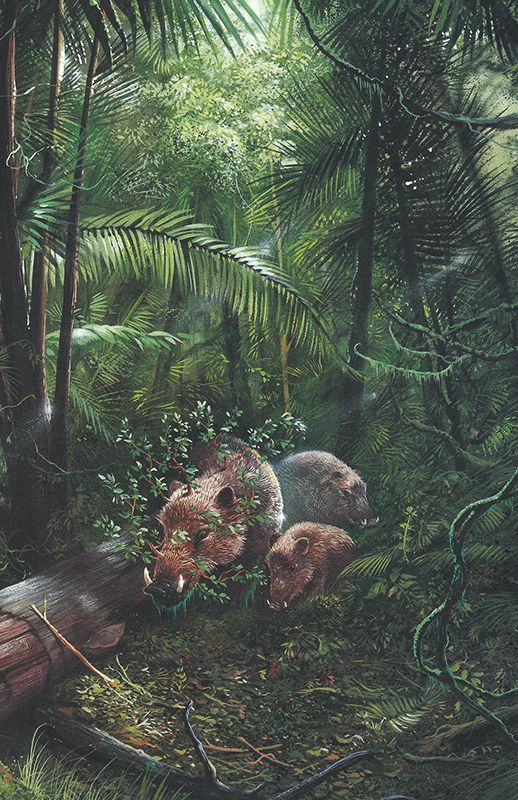
This last round had myths where people crossed over into the wilderness. First I told the myth of the Boongurunguru, Umaroa's mythical boar, from the Solomon Islands (one of my favorite mythical creatures!). Next, Stenszky Cecília told a Khanty story about a woman who died in the woods and was reborn as a bear, raised by a bear family.
Voting question: What would you rather plant in your garden, Knathy pines of ferns growing on the back of the Boongurunguru?
Winner: Solomon Islands

The tellers of the winning myths received coffee cups painted with mythical creatures (courtesy of Enikő) - the fourth mug was raffled off to the audience. The evening went great, and we are already preparing for the next one: telling love myths for Valentine's Day!

Monday, January 9, 2017

Female warriors, and the roots of life (Following folktales around the world 7. - Solomon Islands)

Today I continue new blog series titled Following folktales around the world! If you would like to know what the series is all about, you can find the introduction post here. You can find all posts under the Following Folktales label, or you can follow the series on its Facebook page.

For those people that like to think of the "Pacific" as a cultural monolith, I'm going to say up front that all the tales in this book have been collected from the Baegu people, who live in the northeast part of the island of Malaita. The more than 1600 square mile island is home to more than a dozen different peoples, all with their own customs and languages. The Solomon Islands are a country that includes 6 major and more than 900 minor islands. Think about this next time you design a sci-fi world where every planet is one homogeneous culture...

Solomon island folktales from Malaita
Kay Bauman
Rutlege Books, 1998.

Kay Bauman moved to Malaita in the 1960s with her two small children and her anthropologist husband; they lived among the natives for a year. Kay learned the local language and began collecting traditional stories (even though she had no formal training in ethnography). Most tales were told to her in a shortened form, since local legends are often chanted for long hours into the night (and some were not told at all, if the elders decided she was not allowed to hear them). The book itself is a pretty well done volume - it has maps, a decent introduction, and includes bios for all the storytellers. I had some minor problems with it, such as the fact that she listed Thompson folktale motifs, but not their numbers... The most annoying feature of the book was that comments always came before the tales - apart from spoilers, they also did not make a lot of sense until one read the actual story, so I kept flipping back and forth.
All storytellers were male (apparently, women were not allowed to tell stories). One of them still remembered eating human meat from his younger days...

Highlights


I have to say that women rarely fared well in these folktales. At best, they were seduced with the help of love potions, but abuse and suicide were also fairly common. The great exception was two legends about Warrior Women, a tribe of amazons who lived on a neighboring island, and turned out to be pretty badass in the stories. In one legend, they rescued two wives stolen by evil spirits; in the other, they went to war to avenge the death of one of their relatives. Their leader was called Riina, she was as smart as she was strong, and she has actually been featured on the Rejected Princesses blog.
There was also an interesting tale about the origin of bananas and sugarcane. In this, a wife refused to sleep with her husband, and was abused for it; she fled to the world of spirits, and spent time happily dancing with them. Eventually she returned with the gift of bananas and sugarcane; but when her husband abused her again, she sunk into the ground, and returned to live with the spirits. Another beautiful image was the burial of a girl who'd killed herself out of shame. The roots of a life-giving tree grew around her in her grave, and the life-water seeping from them brought her back to life; following fissures in the ground, she came to an underground river, and followed it back to the light.
Many stories involved mentions of a bride-price. Women were bought as wives, usually for shell money and porpoise teeth (e.g. "ten strings of red shell money and a thousand porpoise teeth"). The image on the left shows a Solomon Island chief with such a necklace. I didn't do the math, but I kinda felt sorry for the porpoise population...

It wasn't in the book, but here I have to note that one of my favorite mythical creatures, the Boongurunguru, is also from the Solomon Islands. You can read about it here (wonderful blog, check it out).

Connections
Obviously, I once again found a legend about the origin of coconuts, and once again it involved a man being buried. This time, coconuts, betel nuts, and sago palms all grew from the same body. Another story that reminded me of multiple European myths and legends was that of a giant pig that ran away from the people who raised it, wreaked havoc on the island, and was chased by a large group of warriors, naming places wherever they went.

Where to next?
Vanuatu.