Showing posts with label Norse. Show all posts

Saturday, April 22, 2023

S is for Saliva (Body Folktales)

 This year, my A to Z Challenge theme is Body Folktales. Enjoy! 

NOTE: I am sorry I have not been visiting back. I really miss seeing all your posts! I was traveling, my phone died, and then the Internet went down at home. I will catch up as soon as I can!

I could not find a single image that was not gross,
so here's a puppy.

CW: These stories will get gross.

Spitting and saliva have long featured into all kinds of customs and folklore. This book has a long list of them. I also blogged about a Japanese legend earlier about a samurai killing a giant centipede with arrows he'd spat on. Here are some other interesting tales I found:


In this 5th century legend a saint slays a dragon by spitting into its mouth. The trick works, says the notes, because there was a long-standing belief that human saliva is scalding to serpents. In another 13th century text, people trap and kill a dragon by fasting and then spitting a circle around it.
(This is a whole D&D adventure waiting to happen...)

Juan and the Princess (Philippines)

A poor boy is challenged by a king to find his hidden daughter. He succeeds, but the king still doesn't want to keep his promise and marry him to the princess. Juan receives help from some birds, who give him a pen-point but no ink, telling him to use his saliva. Whatever the king makes him write turns to gold, proving that the boy is special.

Kvasir (Norse mythology)

In Norse mythology there is a wise being named Kvasir, who was born from a bowl of spit. The Aesir and Vanir gods once had a fight, and decided to make peace by spitting into a bowl together (try this next time you have a family fight). Thus, Kvasir was born, blessed with all kinds of knowledge. Later, two Dwarves killed him, and from his blood they made the Mead of Poetry.


Chasing a monster that has been stealing apples from the garden, the hero of this story ends up in the depths of the underworld. There, he meets a woman who is making dough with her own saliva instead of water, for her six children. She tells the hero that there is no water in their realm because a monster is guarding the well. Of course the hero manages to defeat the monster, and bring water back.

Glaucus (Greece)

Glaucus, son of King Minos of Crete, dies, and the seer Polydius brings him back to life. Against his will, Minos forces the seer to teach Glaucus the art of divination. However, when Polydius is finally allowed to leave, he asks Glaucus to spit into his mouth, and the boy forgets everything he'd learned.

The fairy midwife (Guernsey)

This is a common tale type I have blogged about before, where a woman acts as midwife to the fairies, and accidentally gets something in her eye that allows her to see through enchantments later on. In a version from Guernsey, that something is the saliva of the newborn fairy baby.

Talking spit

This is a folktale motif, rather than an individual tale. There are many stories around the world where someone escapes captivity of witches / ogres / devils / abusive parents / etc., and spits on the floor on the way out. Later on, the spit answers in their name, delaying the discovery that they'd escaped. (D1611: Magic spittle impersonates fugitives)
In the tale of Dhon Cholecha from Nepal, a girl escapes from demons by leaving spittle behind and putting charcoal in it. The motif is especially common in Blancaflor tales from Spain and Latin America (see here, here and here).

Would you tell any of these stories to your audiences? 

Wednesday, April 13, 2022

K is for Kordierite, a.k.a. Sunstone (Gemstone Folklore)

Welcome to the 2022 A to Z Blogging Challenge! My theme this year is Gemstone Folklore. Because I love stories about shiny things. Read the introduction to the project here.

CORDIERITE

(I know I know, I am cheating with the K, deal with it. It works in Hungarian.)
Cordierite is one of the minerals that has been theorized to be the legendary sunstone, or sólarsteinn, that Norse navigators used in the Viking Age to see the sun's direction on partially overcast days. While it is not the only possibility (Iceland spar is also a strong contender), technically it has been proven to work.

Kings and crystals
Scandinavia

Sunstones make an appearance in various old stories. One is a 13th century Icelandic manuscript that contains an allegorical tale (Rauðúlfs þáttr) of Saint Olaf visiting a wise man named Raudr. The man lives in a meticulously laid out house, in which the king has a vivid dream that Raudr interprets for him. The two sons of Raudr, Sigurd and Dag, are also wise and well educated. Sigurd can guess the sun's position correctly on an overcast day - a feat which makes King Olaf bring out a sunstone to verify.

Another 13th century collection of various Icelandic sagas, collectively known as the Sturlunga saga, also has mentions of sunstones. The stories of two different sagas, that of Icelandic bishop Gudmundur Arason, and doctor and priest Hrafn Sveinbarnarson, intersect in this case. The bishop once gifted Hrafn, world-traveling healer, two things: an exquisite dress for a woman, and a sunstone. Later on, when Hrafn's home was raided, and he himself killed by his old enemy Thorvald, son of Snorri, the raiders took the gifts with them. According to legend, however, the beautiful dress turned into ugly black rags in their hands, and the sunstone looked like a mere pebble to them, so they threw it away on the beach. Later, the precious stone was recovered, without the raiders ever finding out what exceptional treasure they had lost.

Sources: 
You can read the first story here, the story of Bishop Gudmundur here, and you can find the text of Hrafn's saga here. Find more info on sunstones here and here.

Have you ever read Icelandic sagas before? 
Do you have a favorite story?

Saturday, May 11, 2019

StorySpotting: A whisper at a funeral (Game of Thrones)

After some consideration, I decided to revive an old, old blog series of mine, called StorySpotting. In this weekly or kinda-weekly series of posts, I will write about folktales, tropes, references, and story motifs that pop up (heh) in popular media, from TV shows to video games. Topics will be random, depending on what I have watched/played/read recently. Also, THERE WILL BE SPOILERS. Be warned!


Where was the story spotted?

Game of Thrones, season 8, episode 4 (The Last of the Starks)

What happens?

The episode opens with a funeral scene, where all the fallen from the Battle of Winterfell are being burnt on funeral pyres. The task of lighting Ser Jorah's pyre falls on Queen Danaerys. Before setting it aflame, she leans down, and whispers something in Ser Jorah's ear. What does she say?
No one knows.
It has since been revealed that neither the audience nor the crew were supposed to know what she said. Emilia Clarke wrote her own lines for the scene, so the only people who know are she and her co-star, Iain Glen. Glen has been asked multiple times since the episode aired to reveal what Clarke said in the scene, but he is adamant about not telling.
(We'll see how long that lasts)

What's the story?

This scene, and the secrecy around it, reminded me of something: the death of Baldr in Norse mythology. Baldr, god of light, son of Odin, dies by being shot with an arrow made of holly, thanks to Loki's trickery. The entire world mourns for him (except, obviously, for Loki). He gets what people now call a "Viking funeral" - they place him on a pyre on his magnificent ship named Hringhorni, launch the ship onto the sea (it is so large that they can only do so with the help of a giantess), and set fire to it as he floats away. Baldr shares the pyre with his wife Nanna who died of grief, his horse, an unfortunate Dwarf that Thor punted into the fire (yup), and Odin's magic ring Draupnir.
However, before Baldr is placed on the pyre, Odin leans to his dead son's ear and whispers something to him. Something that no one knows. It is the great secret of Norse mythology. In one of the songs of the Poetic Edda, Vafþrúðnismál, Odin gets into a contest of widsom with a giant. They trade riddles and questions, and the giant finally loses the contest, and his life, when his opponent asks him what it was that Odin whispered in Baldr's ear at the funeral. The giant admits, "you alone know that."
Odin apparently really likes this riddle, because he also uses it in the Saga of Hervör and Heidrek, in a riddling contest against Heidrek. The fact that he knows the answer reveals his true identity as Odin.
The whisper remains Norse mythology's best kept secret.

Conclusion

Some people suggest that Odin whispered to Baldr that he will return after Ragnarök, as foretold. I doubt that's in the cards for Ser Jorah.

Thursday, April 12, 2018

High School Mythical

We were asked by a friend if we could take MythOff to a high school, as a gift to a mythologically inclined seventh grade class. We said yes.

MythOff is a series of live storytelling events that was invented bring mythology, told live, back to modern audiences. It is generally an adult event; we do it in pubs, and coffee houses, and other similar venues. We have never had one in a school setting before - but when we were asked, some of us could not say no.

I love telling to teenagers. They make an amazing audience. In addition, when I was their age, I was a complete mythology dork: I made lists of gods, and read Graves and Kerényi, and collected magazine articles in a binder. And that was pre-Percy Jackson. I tried to imagine how I would have reacted if real storytellers came to my school to do real mythology.


So, we went.

Round One: Tricksters and creation

All three of us picked a mythology. For round one, all three of us brought stories that involved creation, or birth, or origins... and also, completely by accident, tricksters. Varga-Fogarasi Szilvia brought the birth of Maui; Nagy Enikő the story of Sif's golden hair and Loki's bet for the forging of Mjölnir; and I brought Momus, and his critique of Greek creation. I especially had fun with the Greeks when I asked the kids how many gods live on Mount Olympus (they knew). Then I asked if someone could list them... and a girl, very proudly and confidently, listed all twelve, with some enthusiastic support from her classmates. Be still, my heart.


The voting question: We never really had a MythOff with an odd number of tellers before - but we came up with a genius solution.
First, I asked the class if they knew how the Trojan War started. A guy said that someone kidnapped someone's wife; a girl added that the wife had been given to Paris by Aphrodite. Someone else added that it was in exchange for the golden apple; and yet another person pointed out that the apple had been thrown by Eris into a wedding. After the class assembled the entire story, I produced a golden apple (I painted it gold the night before, along with half the kitchen), and the voting question: If you had to pick a roommate when you go to college, which one of the three tricksters would you want as your roommate?
Szilvi brought three cups and a box of glass pebbles. Each cup represented a mythology. Each student got one pebble, which they places in the cup of their choice, under the supervision of the two guys in the front row, who enthusiastically commented on the proceedings, and monitored the fairness of the vote. Loki won by considerable majority (with Momus second and Maui last). If they wake up one day in college with their hair cut off, I take no responsibility.


Round Two: The wrath of the gods

This round involved myths where someone pissed off a deity in some way. Szilvi brought Maui back, and told about how he stole fire from the volcano goddess Mahuika (you're welcome). Enikő brought Thor, and told the story of how he was dressed up as a bride to take Mjölnir back from the giants (and then killed them all). On my part, I told the myth of King Erysichthon, and how Demeter punished him with deadly hunger when he chopped her sacred grove down.
The voting question: If you had to give the golden apple (I made two) to a god, knowing that the other two will be angry at you, which god would you want to piss of the least?
This time, the vote was overwhelming: Demeter won it by a landslide. To be fair, we were just before lunch break, so the kids were probably really feeling the hunger...

Once again it has been proven that mythology works like a charm in high school. And that high schoolers make an awesome audience. They were attentive, appreciative, creative, they made comments and asked questions, and took the vote very, very seriously (I loved hearing them discuss their decisions in line).

Bring more storytelling to high schools!

Saturday, September 26, 2015

Story Saturday: 5 Masculine Heroes Who Dressed Up As Women

Today we interrupt our regularly scheduled program of the Dietrich Cycle, to bring you the latest season of Mythology Drag Race.


Thor
One of the most fun stories to tell to any age group, the Þrymskviða tells the story of Thor's hammer Mjöllnir being stolen by the giant Thrym. He asks for the goddess Freya in exchange for the weapon, and she (dis)respectfully declines. Thor decides to take her place and dress up as a bride, with Loki as his maid, and they manage to fool the giant through the entire wedding, until the hammer is returned. Thor almost manages to give himself away by eating too much, and glaring at the giants, but Loki seems to be enjoying himself. 
(Of course it was Loki's idea.)

Hercules
At some point in his career, Herc also got a taste of women's clothing, although not exactly by his own free will. Serving as a slave to Queen (or, according to some other sources, Goddess) Omphale, he spent a year switching roles with the lady - Omphale wore Hercules' lion skin, and the hero wore a woman's dress, doing women's chores around the house. While not voluntary, apparently the change did not leave a scar on his pride - once freed from the one-year contract, he ended up marrying Omphale, and fathering some legendary children.

Achilles
(Because who wouldn't want to see Brad Pitt in drag?)
In a famous prequel to the whole Troy shebang, Achilles lived disguised as a girl for a while. Since the prophecy said he would die young, his mother tried to keep him away from fighting by dressing him as a girl, and sending him to live with the daughters of the king of Skyros, a tiny island. Achilles lived under the name of Pyrrha (Redhead), until Odysseus found out where he was hiding, and came to recruit him for the war effort. He brought jewelry and gifts for all the girls, and some weapons; then he pretended the island was under attack, and at the sound of the horns Achilles grabbed up a sword and thus gave himself away.
Story also says that while there, he fathered two sons with one of the actual daughters of the king. I am sure the girls didn't mind the dress.

Hugdieterich
I already wrote about this in my post on love stories from the Dietrich Cycle. Hugdieterich, emperor of Constantinople, not only dressed himself as a princess to get close to the love of his life, but even learned womanly arts like embroidery, in order to impress her father. She spent some time at court teaching the girls womanly arts, before giving away who he was (and fathering some heroic sons). Story doesn't tell if he kept his hobby of embroidery later on.

Arjuna
The leader of the legendary Pandava brothers of Indian mythology, the great and mighty hero Arjuna also spent a year in women's clothing (cursed into an eunuch by a woman whose advances he turned down). He took on the name Brihannala, and taught dancing and singing to a princess. He was later (after changing back) offered the hand of the princess, but declined, saying that he saw her as a student and a daughter. Princess ended up marrying his son instead.

Case in point: Wearing feminine clothing does not tarnish your chances at manly immortality.

One question remains: Who wore it best?

Wednesday, June 17, 2015

Fear and Trembling in Ancient Rome

One of my favorite summer gigs is camp at my former grade school. They invite me over every year for campfire storytelling (which is how storytelling really should be done).
This year, their theme for the week was time travel, and Tuesday evening fell on Ancient Greece and Rome. This is, for all intents and purposes, my home turf, so I was super excited; on top of that, they wanted me to tell scary stories, to create the whole traditional campfire experience.
I don't think they knew what they were asking when they told me "the scarier, the better."

I selected stories from my repertoire, including Greek, Roman, Egyptian, and the odd barbarian or two. I included Petronius' werewolf, Pliny the Younger's haunted house, the Nart skeleton story, and some darker pieces of Greek mythology. Since the organizers specifically asked for a mummy story to prepare the kids for the nighttime "bravery game," I also brushed up on Lord Hamon's case with the Mummy's Hand.
I arrived to the camp around 9 pm, dressed in full Roman garb (I love dressing up for storytelling; it's not really a character thing, but it does get me in the right mindset). The kids, almost 70 of them between the ages of roughly 8 and 14, eyed me from a safe distance; some of the boys demanded to know what I was. When I told them I was the storyteller, they frowned, and informed me that they thought storytelling was boring. I told them I was sorry, since according to camp rules they would have to sit through the horror tales anyway. The word "horror" worked like magic. It's the Achilles heel of middle school apathy.
For the next half hour or so I was surrounded by a swarm of kids, all talking at the same time. They wanted to know what stories I was going to tell, and whether they were going to be really, truly, really seriously VERY scary. I told them they could take their pick from werewolves, ghosts, mummies and dead people, and that choice occupied them for a good while. We also had a conversation about scary movies, video games, the Hunger Games, and superheroes, and by the time I got around to the campfire, one of the boys sat down at my feet muttering "finally somebody normal."

The stories were told in-between some performances by the kids. I decided to start with less scary ones, since the sun was just setting, and work my way up as it got darker. First I told the myth of Mestra, Odysseus' grandmother, and the evil king that ate himself. It is not very scary and only moderately gory, but it has a great mood, and also superpowers (it is included in my book under Shapeshifting). In the second slot I was asked to do something "scarier" at popular demand, preferably featuring werewolves, so I switched gears from Rome to Vikings, and told a child-friendly version of Sigmund and Sinfjötli (yes, there is such a thing as child-friendly gore). During the following break, I started getting signals that I had hit the kids' limit of "scary" sooner than I expected - a little girl asked me to not do anything "scarier than these," and a boy confessed that he might have nightmares if I tell about ghosts. Now, the mummy story I planned is not only allegedly a true event, but it is also truly terrifying - I was pretty sure it would max out the "they won't sleep for days" category, which might cause trouble for the camp leaders.
With that in mind, I made a judgment call. I told the kids that some people are scared of things, and others are scared of others; I didn't want to tell something horrible and make anyone feel bad. Instead I offered to tell them an adventure tale that just happened to be about Fear. I could see the shier kids relax, and the louder ones settled for adventure instead of horror.
I told the Red Lion, and it worked like a charm as usual. After the story, several kids came up to me to talk, and I stayed around for a while as the campfire died down and the leaders set up for the nighttime game. Some kids wanted to know if the stories were true; I talked to them about why people tell stories, and what we can learn from each. Some of them still demanded 'scarier' tales, but the telling time had passed; we had a conversation about dragons instead.

All in all, it was a fun gig, even if it didn't go quite the way I planned. I think the concept of "scary" stories meant something else for the leaders than what I had in my repertoire - I don't do jump tales at all. I am not a horror person, but if I go Halloween, I go for the chills.

Thursday, April 23, 2015

T is for Thidrek of Bern (Epics from A to Z)

If you like Norse sagas, King Arthur legends, and Alternate Universe fan fiction, then you will like this epic.

Origins
The group of legends centered on Thidrek (Dietrich) of Bern is German in origin. The particular collection discussed here, known as the Thidrekssaga, however, was probably written down somewhere in Scandinavia (although scholars can't agree if the writer was German or Norse). The English translation is almost 300 pages long (in extremely small print). The saga is usually dated around 1250, the high time of romances of chivalry... and boy does it deliver.

The Heroes
The story is essentially a mash-up of German legends such as the Niebelungenlied, some Norse sagas, stories of Attila the Hun, and a great dose of Arthurian pomp. It features several historical names, but in the end, it is a product of chivalric fiction.
In the center stands King Thidrek of Bern (Dietrich of Verona), who is often equated with the historical king Theoderic the Great. Around him gather the great names of German legends: his mentor Hildibrand (who can still kill ten young warriors in combat when he is over a hundred years old), Siegfried (the invulnerable dragon-killing hero of the Niebelungenlied), Heimir (who is not a nice person, but great with horses), Vidga (the white-haired half-mermaid son of Wayland the Smith - he is essentially the Lancelot of the bunch), Sistram of Fenidi (who joins the team after they fish him out of a dragon's mouth), Thetleif the Dane (who is not very smart, but very strong), Vildifer (who can and does pass for a live bear in combat), Herbrand the Far-Traveler (the diplomat of the team), Ekka and Fasold (the stereotypical red-haired identical twins, one a friend and one an enemy), Högni (the one-eyed, grumpy half-elf knight) (yeah, you read that right), Sifka (the traitor) and Earl Hornbogi (the handsome one).
Impressed yet?
Add Attila the Hun to the mix (he's best friends and allies with Thidrek), and you have a vague idea of the lineup you will meet in this story.
(There is an entire chapter devoted to what each of them look like, how they dress, and what their coat of arms is. They also all get their own backstories.)

Highlights
While a huge part of the saga is taken up by very detailed duels and epic battles, it also has a lot of other delightful bits going for it. For example:

1. The duel between Thidrek and Ekka (the evil twin). They meet in the woods at night, and neither can see the other. After Ekka taunts Thidrek with how superior his weapons are, they decide to fight. Thidrek strikes sparks on rocks with his sword to see where his opponent is, and they fight in the flashing light of sparks flying from their blades. Now there's a visual.
2. The scene where Thidrek and Fasold find a dragon on a clearing. The dragon is in the process of devouring Sistram, whose head and shoulders are still free. He yells instructions at the two knights on how to kill a dragon, one of which is "Don't cut its neck! My legs are way down its throat..."
3. The time young Thetleif defeats an older knight (who rides an elephant) and after the duel they become friends and go home together. When the daughter of the old knight sees her father wounded, she yanks Thetleif off his horse and throws him down with a force that would kill a normal man. Of course they fall in love later.
4. The time Vildifer dresses up as a bear and sneaks into the enemy's castle to rescue the imprisoned Vidga. The enemy king doesn't realize there is something wrong with the dancing-bear performance until the bear draws a sword... At which point the king comments "That's a well trained bear!" (Famous last words)
5. The time Vidga kills a giant in single combat, and then covers himself in the giant's blood and rides back to his friends, pretending to be mortally wounded. Everyone panics, and Vidga laughs his bloody ass off.
6. There is a version of Tristan and Iseult's legend in here - Herburt and Hild - and it has a happy ending. That in itself made me so happy...
7. There is a battle where one of the kings is helped by his wife, the sorceress Queen Ostasia. She summons an army of lions, bears and dragons. The entire chapter is just one big battle scene between knights and combat dragons. I was having some serious Maleficent flashbacks.
8. When King Thidrek gets angry, he literally breathes fire. He only uses it once in combat, though.
9. This line: "King Hertnid rode at the dragon more out of honor than out of wisdom." (He gets devoured)
10. The time Heimir becomes a monk, and then decides to return to being a knight when a giant threatens the monastery. The monks tell him they already broke down his sword and used it for door hinges (it's one of the three magic swords in the saga). Heimir almost gets a stroke.
11. The time Earl Iron gets so obsessed with hunting that his wife feels neglected. Finally she goes out into the fresh snow and rolls around naked, leaving boob-prints all around the castle. Then she goes back to her husband and says "I have seen the tracks on a very rare new prey around the castle. If you don't hunt it soon, some other man will."

(This saga was definitely one of my favorites I read for this challenge.)

Saturday, April 11, 2015

J is for the Jómsvikings (Epics from A to Z)

Short version: The Jómsvikings are the Avengers of the 10th century.
More accurately: The Avengers are the Jómsvikings of the 21st century.


The Jómsvíkinga Saga is an Icelandic saga written sometime in the 13th century. It takes place in Denmark, Norway, Wales, and Jómsborg, and ends with the Battle of Hjörungavárg in 986 AD. It details the (long and complex) family background, deeds, and eventual downfall of a group of select Viking heroes known as the Jómsvikings. Much like the Fianna of Ireland, they are a brotherhood of elite warriors, the best of the best, not admitted based on anything else but bravery and personal prowess. Both of which there is a lot to go around in this story.

The Heroes
The heroes of the saga are the Jómsvikings, living in their own walled city (Jómsborg) under strict rules - men only, loyalty to each other, no preferential treatment, equal distribution of booty, that kinda stuff. The founder of the place is Pálna-Tóki, and after his death Sigvaldi, who is not as good a leader, and manages to let the whole thing crumble on a drunken bet (great job, Sigvaldi).
One of the most notable characters is Vagn, who shows up at the water-gates of Jómsborg at the ripe old age of twelve, demanding entry into the brotherhood. He is refused on grounds of creeping everyone out, and also the fact that he is underage (rules only allow membership to men between eighteen and fifty). He proceeds to soundly beat Sigvaldi in a naval battle, and gains admission anyway.

Highlights
Apart from your usual run-of-the-mill fighting and pillaging, the saga offers a few remarkable moments, especially towards the end. They mostly involve fighting:
1. Much of the end of the saga (I'm not giving out spoiler alerts here, the story has been out since the 13th century, deal with it) involves the captured Jómsvikings being executed by their enemies. It is a fascinating lineup of warriors going to their death, each one making a different joke or proposing fun little experiments. One of them insists that his long and fabulous hair has to remain clean and intact; then, just when the executioner swings the sword, he yanks his head down, and the sword takes off the arms of the man who had been holding the hair out of the way. The kid (barely 18) looks up and asks with a shit-eating grin: "Whose hands are in my hair...?" He gets to live, Vikings appreciate a good practical joke.
2. Another battle-related moment of epic is delivered by Búi, one of the Jómsvikings, who loses both his hands in the last battle of the company. Instead of being fazed by this at all, he puts the arm-stumps through the hoops of a chest of gold, and jumps overboard with it, transforming into a dragon.Yup.
3. And still on the topic of lost appendages - I'm sensing a theme here, you guys - there is some bravery on the opposite side as well: Geirmundr, the commander of a town attacked by the Jómsvikings, jumps out of a building, gets an arm cut off by Vagn, and then manages to run through the woods all the way to the earl's court to warn him of the impending danger. He does it in a calm, collected and professional manner, reporting on numbers first, before the earl asks him if he has any proof. To which Geirmundr responds, "Oh yeah, they cut off my arm, see?" and follows up by providing information on the enemy's best warriors. "One of them got my ring."

Ain't no party like a Jómsborg party.

The Real Jómsborg
Although contested by some historians and archaeologist, it is generally believed that Jómsborg stood somewhere in the place of modern day Wolin, Poland. Every year the town celebrates this fact with Europe's largest Viking festival, involving historical reenactors from all corners of the continent and beyond. Definitely worth a visit.

Thursday, April 9, 2015

H is for King Harald's Saga (Epics from A to Z)

Aand we are back to the Vikings.

Origins
King Harald's Saga is part of the Heimskringla, a collection of sagas telling the history of Norway, written by the Icelander Snorri Sturluson at the end of the 12th century. It is also hands down one of my favorite sagas. If you want to read it, you can get it in its own edition, complete with family trees, great footnotes, and a detailed introduction.

The Hero
The hero of the saga is King Harald Sigurdsson, also known as Harald Hardrada ("firm ruler"), king of Norway between 1046 and 1066 AD. He is known for being the guy who wore Harold Godwinson out with a battle up North so Harold could not stand against William the Conqueror a week later, and hence... well, English history.
Harald is known throughout the saga as tall, blonde, handsome, brave, smart, and dangerously easy to anger. He spends most of his time plundering as a good Viking does, but also runs his kingdom with a firm hand, which ultimately leads him to lose some of his best supporters to rival kings such as his great nemesis, King Svein of Denmark. However, one can't help but admire Harald, his skill in battle, and his creativity when it comes to coming out of hopeless situations with a victory.

The Highlights
My favorite part of the saga is definitely Harald's early years. Between the ages of fifteen and thirty, he lives in exile (he takes part at fifteen in the battle where his half-brother, Saint Olaf, dies in his attempt to force Norway into Christianity). Harald spends his formative years as the commander of the Varangian Guard in Byzantium, being envied by Greek generals and lusted after by the infamous Empress Zoe (and her daughter). He ends up in prison, but breaks out, and manages a daring escape across the chain blockade of the Constantinople harbor.
The saga includes many great battle scenes through Harald's career as king, but I especially like the shorter anecdotes about him getting out of sticky situations. For example, the one where he lands with his fleet on an abandoned island and can't find fresh water to drink. He tells his soldiers to catch a snake and put it near a fire; when the snake dries out and needs water, they tie a yarn to its tail, and follow it as the snake slithers away to a secret source of water.
Apart from Harald, some of the other characters are worth mentioning as well. King Svein is a worthy enemy all through the story, a brave yet reasonable man with great skills for survival. The chapter where he gets away alive after losing a nighttime naval battle to Harald is one of the best parts in the saga.

Thursday, April 2, 2015

B is for Bosi and Herraud (Epics from A to Z)

Warning: The original text of this saga includes graphic sexual content.
(Try not to trip over yourself)

Origins
The Saga of Bosi and Herraud is a Norse legendary saga that mainly takes place in Götaland (modern day southern Sweden) and was written sometime before 1350 AD. It ties into other sagas as well - for example, the story of Ragnar Lothbrok, recently known as this guy from the History Channel:

The Heroes
The central bromance to the story is between Herraud, the heir to the throne with minor daddy issues (since his bastard brother gets all of the affections of King Hring); and Bosi, the daredevil love child of a former Viking raider and a crippled shield-maiden (yup). These two hit it off like a house on fire, and when Bosi kills and maims a couple of people in a friendly ball game (happens between friends) and gets himself exiled, Herraud decides to go with him.
After five years of leisurely plunder the foster-brothers return home, and Bosi does his buddy a favor by killing the (agreeably annoying) bastard brother. At first the king wants to have both of them executed, but he can't bring himself to give the death order of his own heir, so he takes a page from fairy tales and decides to give them an impossible task instead, sending them off to bring him a vulture's egg inscribed with golden letters.
Adventures ensue.

The Highlights
The saga features two epic battles:
1. Bosi and Herraud versus Giant Vulture Monster and Troll Priestess (In which there is a generous amount of stabbing, slipping on blood, losing body parts and rolling around on the floor)
2. Bosi and Herraud versus People Whose Daughter/Sister They Had Kidnapped Along The Way (In which there is a sea battle where people transform at random into dragons, boars, and wolfhounds, and jump from ship to ship. Also, Herraud gets his nipples torn off. Ick.)

The Absolute Undisputed Best Moment of the Saga,
however, is the afterword: Once every battle is won and the adventures are over, Herraud and Bosi both become kings and start their own families. Herraud has a little daughter, Thora (who will later become the first wife of Ragnar, sadly not mentioned in the TV show). The magical vulture egg decides to hatch and produces a small, gold-colored baby dragon. The king gives the baby dragon to Thora as a teething toy.
Think about it.
A princess. Teething. On a dragon.
Viking metal.

Thursday, September 18, 2014

MythOff Bowling Green: Newbies take the cake!

We had Bowling Green's (and, in fact, Ohio's) second ever MythOff event tonight!
And we saw that it was fun.

The venue was brand new: We have moved to Café Havana, the home of the Bowling Green Open Mic Night, and were greeted with the roaring sound of delicious fresh-made smoothies. Thus, MythOff was preceded by Smoothie Hour, until everyone had ordered all the heavenly beverages of their heart's desire, and settled down for the tales.
Our host, once again, was Tom (also, incidentally, the host of Open Mic), and he carried us with eloquence and empathy through the evening.
The lineup was as follows:

Round One: Giants!
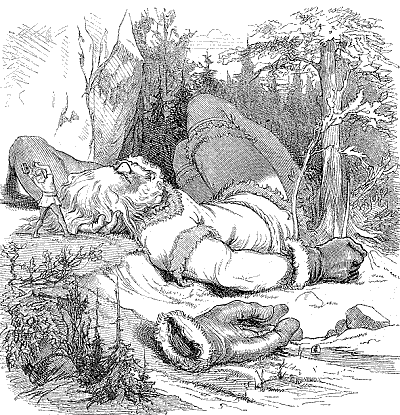
In the Norse corner, Jamie opened the night with the tale of Thor's Jounrey to Utgard. In the Ossetian corner, bringing the Nart sagas to MythOff for a historic first time, was yours truly with the story of Soslan and the Giant's Skull (this tale, in which the Nart heroes excavate, reassemble and resurrect a giant from his skeleton, has a soft spot in my archaeologist heart).
The prize was the Stallion of Giants, a "full-sized horse" that was supposed to make you feel like a giant yourself (a tiny, tiny horse in a tiny, tiny box, obviously). It was awarded to the tale that sounded the most sexually charged when taken out of context (Tom's take on the questionable wording we both used describing giant parts and giant sounds). Jamie, a first-time MythOff participant, carried the steed home to his feasting hall.

Round Two: Love and War
This round pitted two first time MythOff tellers against each other with thundering success. They did not only brave the stage and the stormy seas of myth, but they also battled the demons of the blender and the steaming machine, masterfully subduing them and incorporating them into their tales. In the Irish corner was Flannery, an Open Mic veteran with a passion for Irish stories, who delivered the most upbeat version of Deirdre of the Sorrows that I have ever heard, until she brought it to a stunning and shockingly deep ending. In the Russian corner competed Zack, our SCA bardic champion, with the tale of Ilya Muromets and the Magic Sword, which was as unknown as it was spellbinding.
The prize for the round was the Arrow of Love and Hate, an obsidian arrowhead fashioned into a necklace. It was awarded for the story that reflected most the nature of the storyteller performing it. It was awarded to Flannery, for her feminine and thoughtful take on Deirdre.

Round Three: Resurrection
This round was, sadly and tragically, cut short because one of our storytellers, Dan, had to leave to take care of an emergency. The other teller, Clarke, a second time MythOff participant, did take the stage though, with a gruesome yet colorful Aztec myth about the origins of the human sacrifice.
The prize for the round was the Globe of Resurrection, a shining bouncy ball symbolizing the ability to bounce back from the worst. It was awarded to the storyteller who seemed to be the most present in his tale. The vote unanimously went to Clarke on that one.

In the audience, we had a shifting number (around 30) of rapt listeners who followed us into the world of myth and awarded the tales with applause and appreciation.

All in all, it was an epic night. And a really nice strawberry banana smoothie.

Sunday, June 15, 2014

Legendary Fathers

When I set out to make a little list of traditional stories about fathers, I thought it was going to be a cake walk. Mothers die a lot more often in story, right?... And yet, once I started really looking, and setting some criteria, the pool got smaller and smaller.
I wanted stories where the father is good (there goes Hansel and Gretel), where he takes an active role in the story (there goes Cinderella), and, most importantly, where the father does something for his child(ren), rather than being the noble image to thrive for. I wanted fathers that are good examples of parenthood, likable, and on top of all of that, have good stories. They don't throw their daughters at strangers, they don't abandon their families, and they don't sit on a pedestal waiting for their sons to measure up, or for their daughter to explain why she loves them more than salt.
Well, damn.

Stories of this kind, I had to note once again, do exist. Quite a few of them, actually. But they are not always obvious, and not always easy to find. In honor of Father's Day today (in the USA and Hungary anyway), here is a list of my favorites.

Zal
Zal takes the prize. He always takes the prize, if you ask me. This amazing white-haired prince from the Persian Book of Kings is the main hero of one of the stories I love the most in the world. On top of starring in the oldest known (and best) version of the Rapunzel tale, he is also an excellent father figure. He is abandoned by his own father early on; and when his wife is about to die in childbirth delivering their son, Zal makes a stand: "My father abandoned me once; I am not giving up on you." And then he summons a giant mythical bird who teaches him to perform the world's first C-section with his own hands, saving wife and baby. Damn right.

King Metabus
The father of Camilla, one of the most famous characters from the early legends of Rome. Running from his burning city with his infant daughter, he has to cross a river. Tying the daughter to his spear, he throws her across the water before he also flees swimming. Not a very safe way of parenting (don't try this at home), but he gets points for paternal badassery.

Fionn Mac Cool
Once when I was telling the story of the Birth of Oisín in 10th grade, and got to the point where Fionn finds his son in the woods five years after his pregnant wife is kidnapped, a teenage girl started sobbing. The reunion of father and son is one of the most emotional scenes in the Fianna legends. Good fatherhood, by the way, runs in the family; there are also lovely moments between Oisín and his son Oscar (and also between Fionn and his grandson).

Peleus
Okay, so his marriage with Thetis is kind of forced, and definitely not romantic, but in at least one version of the story Peleus does display some serious paternal instincts. In the story I included in my book about how Achilles gained his superhuman speed, Peleus finds Thetis burning the baby over the fireplace at night, and freaks out, like a worried parent should. Turns out Thetis was going to make the child immortal (as an alternative to dipping him into water), and she flees after the ensuing fight, leaving daddy stranded with baby Achilles. Peleus takes the child to his own father figure, Chiron the centaur, to be healed from the burns.

Heimer
And finally, talking about stepfathers: Gotta give a shout-out to the guy who saves one of the most often forgotten legendary babies. Aslög, the daughter of Brünhilde and Sigurd, is spirited away after her parents' death by Brünhilde's stepfather, Heimer, who hides her in a lute, and travels from town to town, playing soothing music to keep the baby quiet and fed.

Tuesday, April 24, 2012

U is for Ullr, Norse god of Probable Awesomeness

Another short one (I know everyone is tired of me saying that because I am clearly a graphomaniac).

This one is about one of my favorite Norse gods, Ullr. It looks like I have a strange fascination with gods we know almost nothing about (because then you can make up your own stuff about them). We know a bunch of tidbits and pieces about him that you can go read for yourself on Wikipedia. The ones that matter to me are:

1. He is the god of archery. (We could stop right here, sold.) He also happens to be the god of skiing, hunting, fighting, and winter. You don't get any more Viking than that.
2. He is handsome.
3. He is Sif's (and, according to some theories, Egill's) son, and Thor's stepson.
4. He ruled over the gods for a while when Odin was in exile.

And now I shall leave you all to make up the rest for yourselves. Have sweet dreams about handsome Norse archer gods.

Wednesday, April 4, 2012

D is for Deities

I worked really hard to find something mythology-related with D so I can post this...
So, blogging about another blog is lame, but I don't really have time to write right now (thesis, argh), so I decided to post it anyway, because it totally made my day, possibly my week.

Myths Retold

Storyteller's diagnosis: Advanced Trickster.

The language would probably give the Jonesborough storytelling scene a collective heart attack (and yet I'd pay to be there to see it happen); but do not be fooled, and while you are covering up your children's eyes and ears, stop and take a minute to admire the layers. The guy knows his mythology and folklore. And his English language. Making fun of things only works really well if you know the thing you are making fun of really well.
I have been working on the Lokasenna for a class assignment (rather, the assignment was my excuse to spend precious time working with that story and not feel bad about not typing my thesis), and as I was reading his version and laughing so hard the nerd table in the diner thought I have lost it, I could actually follow the original song line by line between his lines. The awkward moment when you realize you are too much of a good girl to give the Lokasenna justice. I'll let the pros do the yelling. Creatively.

"... and Loki’s like PUSSY


and thor’s like HAMMER

and Loki’s like PANSY


and Thor’s like HAMMER


and Loki’s like YOU GOT PRANKED BY A GIANT


and Thor’s like HAMMER HAMMER HAMMER


and Loki’s like you’re not even listening to me are you


and Thor’s like hammer?..."


I want that on a T-shirt.

Nothing has changed since the Middle Ages, it takes a lot of smarts to be a good fool.