Monday, April 3, 2023

B is for Beards and some Buttocks (Body Folktales)

This year, my A to Z Challenge theme is Body Folktales. Enjoy!

There are actually quite a few body parts that start with B, so I had a great time picking through some of the most interesting stories. I decided to delve into tales about two things: Beards, and Buttocks. Because I couldn't resist. Here we go.

How the White Man got his beard (Cheyenne)

A white man travels without food and, seeing rich green grass, wishes he was a buffalo so he could eat. He finds some buffalo and begs to be turned into one of them. They take pity on him, and, by running at him five times and tipping him over, they turn him into a buffalo. White-Man-Buffalo grazes to his heart's delight - but then another white man shows up and wants to do the same. White-Man-Buffalo doesn't like the idea of sharing, so he starts chasing the other man. Eventually, he tips him over... but instead of turning him into a buffalo, he himself turns back into his human form. Only the buffalo's beard remains on his face, and since that day, white men have beards.

The Cloak of Beards (UK)

Among the legends of King Arthur we find not one, but two instances of beards being symbolically important. In a fashionable sense.
Early in Arthur's reign, he is challenged by a Welsh king (giant) named Ryence who keeps defeating other rulers and sewing their beards to his cloak - a total of eleven. He demands Arthur's beard as well, suggesting he should save himself the trouble and tear it off, and promising it would have a place of prominence on the cloak. Sir Balin ends up fighting and killing Ryence and saving Arthur's honor. In some versions of the legend, Arthur himself defeats the giant, and takes the cloak - adding the giant's own beard - as his trophy.
Later on, Arthur also runs into the giant of Mont-Saint-Michel in Brittany, who has defeated 15 kings, and in homage the humiliated rulers gave him a Christmas present: a cloak embroidered with their beards and decorated with gemstones. Arthur, once again, wins the fight and beheads the giant.

The count's beard (Italy)

A village is terrorized by a witch that keep stealing cattle. The count that rules the village does nothing to stop her. The villagers turn to a small but very clever man who does some stellar investigating, Sherlock Holmes style, and figures out that the witch is actually the count himself, with his luscious beard pined up into a hairdo.

Anansi and the pharaoh's beard (Suriname)

Same story as the ears of King Midas, except in this case a pharaoh has a very long and strange beard that he tries to hide, killing everyone who finds out about it. Anansi, the spider trickster is the one who whispers the secret into a hole in the ground - and in time, a tree grows from the hole, whispering the truth.

Beware the red beard (Bosnia and Herzegovina)

A young man is warned by his dying father to beware red-bearded men. As he sets out to seek his fortune, he is soon cheated out of all his money  by a red-bearded innkeeper, and a red-bearded judge refuses to rule justly. Finally the young man encounters a red-bearded hodja; and although he doesn't trust the man at first the hodja manages to help him, and set everything right. Proving that not all red-bearded people are the same.
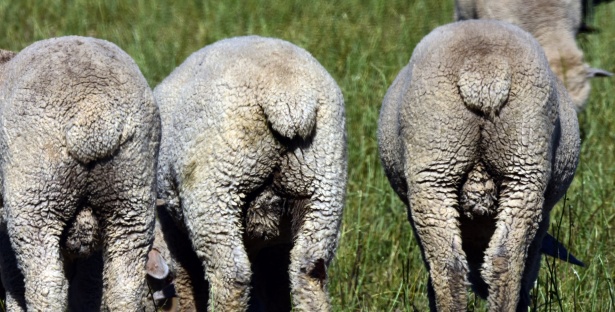
The spatula that makes buttocks sing (Japan)

A young man, by some luck, comes into possession of a magic spatula. If he rubs his buttocks with it, they begin to sing, and if he rubs them again with the handle, they stop. He finds a way to touch the butt of a rich man's daughter with this curious item, and her buttocks begin to sing day and night. The father pays him handsomely for curing his daughter's strange affliction.

The buttocks of Conan Mac Morna (Ireland)

One of my favorite episodes in the Fianna legend cycle is "The house of the quicken trees" (Bruighean Caorthuinn). In this story, some of the heroes of the Fianna are captured by an enemy prince. He invites them for a feast under false pretenses, and casts a spell that makes them all stick to their seats, unable to move. Some of the remaining heroes, outside the hostel, fight a fierce battle to protect their friends from an invading army, and procure the royal blood that can break the enchantment. Finally, they succeed.
However, by the time they sprinkle the blood on everyone, it runs out. Conan Mac Morna, the team's resident grump, is last in line, and there is no way to disenchant him, which makes him even more churlish (he tells Diarmuid, the rescuing hero and famous ladies' man "you wouldn't have left me for last if I was a pretty woman"). With no other course of action, Diarmuid pulls Conan from his seat by force, tearing off the skin of his buttocks. In some versions of the legend, the Fians mend Conan's injury with sheep skin - and after that, they have to shear him every year, procuring some fine wool in the process. (Sources herehere, and here.)
There is also another Fianna adventure that ends with Conan getting sheep skin on his butt, in a slightly more heroic fashion; you can read it here

From previous A to Z years, see my post about the Hungarian tale of Flowerbeard.

Which story is your favorite? 

Which one would make for the best movie adaptation? And in what genre?

Saturday, April 1, 2023

A is for Anus (Body Folktales)

This year, my A to Z Challenge theme is Body Folktales. Enjoy!

Yeah, I went there.

NSFW bodily functions ahead, ahoy! Although nothing sexual.


Here is the thing: Way more folktales feature anuses than you'd think. And many of them are very amusing.

(Let's not think about what this post will do to my search statistics.)

How the birds got their colors (Mocoví)

This story... keeps on giving. It begins with Fox getting into some sort of a fight, and accidentally landing butt-first on a tree branch. Because of this his anus becomes too big, and anything he swallows falls right out. To fix the issue, Fox asks the bees to plug up the hole with clay - a fix that is a little too successful, because now nothing comes out at all. When Fox begins to bloat, he asks Woodpecker to break the clay seal, and all the birds gather to watch the operation. The moment Woodpecker breaks through, things make an... explosive exit - splattering all the birds with the colors and patterns they wear to this day.

The parts of the body have an argument (Portugal)

Some of you may be familiar with the story of the argument between different parts of the body (also known in folktale terms as ATU 293: Debate of the Belly and the Members). It appears among Aesop's fables. In the well-known version, body parts all argue for their own supreme usefulness, and dismiss the stomach as lazy. But when the stomach stops digesting, all the other body parts start failing, until they admit the stomach is, indeed, useful. Moral A: Don't dismiss any member of a team without knowing their hidden talents. Moral B: Don't be angry at the ruling classes for being seemingly useless? Depends on what century the story was told in.
Anyway, there is another variant of this folktale type from Portugal where, instead of the stomach, the outlier body part everyone makes fun of is the anus. Everyone claims its useless. To teach them a lesson, anus decides to pucker up. With disastrous consequences, known to anyone struggling with severe constipation. Eventually, the body parts beg forgiveness and decide to vote anus MVP. Moral A: One a**hole can effectively ruin things for everyone. Moral B (worded by the folk tellers themselves): "In order to be a leader, it's not enough to think, you also need to be able to take a decent s**t."

The monster that devoured people (Kota people, India)

You thought man-eating monsters were bad? Meet Ponac, a terrifying creature from the stories of the Kota people. In the olden days, people didn't only have snakes, tigers, and elephants to worry about, they also had Ponac, who hunted humans, and devoured them whole - through his anus. He devoured ten to fifteen of them before a hero heard about what was going on, and set out to fight the creature with a sickle and a knife. When Ponac made an appearance, the hero held the sickle over his head and the knife pointing down to his feet, and thus he was crammed (their words, not mine) whole through the monster's anus. Once inside, he cut everything to pieces, and thus destroyed the creature. The village headman rewarded him with two wives.
Talk about true heroism.

Tafakula and the thieves (Tonga)

Tafakula is a deity in Tongan mythology with a very special... feature. In one story, some gods from Samoa visit an island under Tafakula's protection at night, with the intention of stealing one of the smaller islands from the lake on the larger island (islands within islands, people). As they are carrying the island away towards the east, Tafakula is notified by a subordinate deity of the theft. He stops the thieves in a spectacular fashion: he bends over and turns his anus towards them. Because his anus is "bright like the sun", the Samoans think they are seeing the sunrise, and drop their loot as they flee from the radiance. The discarded island can still be seen today.

Welcome to this year's A to Z Challenge! 

Don't forget to leave links to your blogs in the comments so I can visit ;)

Sunday, March 12, 2023

The 2023 A to Z Blogging Challenge Theme Reveal

Can you believe it has been a year? The A to Z Blogging Challenge is approaching again! This is my 11th year participating. It is always great fun, and it has led me to many new stories, fabulous new blogs, and lots of discoveries.

In the past 9 years I've always had a theme:

Weird Princesses (2013)
Tales with Colors (2014)
Epics A to Z (2015)
Diversity A to Z (2016)
WTF - Weird Things in Folktales (2017)
WTF Hungary - Weird Things in Hungarian Folktales (2018)
Fruit Folktales (2019)
Folktales of Endangered Species (2020)
Tarot Tales (2021)
Gemstone Folklore (2022)

This year I once again wanted to do a "Mythology and Folklore" theme, but I was out of ideas. I was going to do constellation myths, but the research didn't really yield good stories and I was getting frustrated. Then I was going to go through the Hungarian Legends Catalog, but I felt meh about it. I even started collecting songs for a "Music and Folktales" theme, but realized I did not have the energy to do it justice this year, so I changed my mind again.

Finally, an idea dawned on me, and it sounded so simple and ridiculous that I knew it would definitely be entertaining:

BODY FOLKTALES!


I am going to be researching folktales featuring 26 different body parts.

Yes, those too.

Yes, that too.

Once I started thinking about it, I realized how many tales I already know that feature various parts of the body. I am sure you can think of some as well. Rapunzel's hair, Cinderella's feet, Bluebeard, The girl without hands... I decided to make a list of body parts, A to Z, and try to find some of the most interesting, least well-known, most fun stories about them. The research has been very entertaining, and I can't wait to share the results with you!

The theme is not "adult" per se, but I'll post warnings occasionally when necessary.

See you in April! ;)

Are you participating in A to Z this year? Are you doing a Theme Reveal? Share your link in the comments so I can visit you back!

Wednesday, March 8, 2023

Folktales about women who slay monsters (International Women's Day)

It has become tradition on the blog to post a collection of folktales for International Women's Day. I've had a different theme every year: Women in war, Woman healers, Women helping women, and Badass Grandmas.

This year, I decided to collect stories about women slaying monsters. Many people cling to the belief in traditional stories monster-killing is a man's job, while women wait around helpless to be rescued. Often, this is raised as the main critique of telling folktales in "modern times" - "outdated values" and whatnot. And yet, people who complain the loudest tend to have no idea how many monster-slaying women exist in traditions around the world.

So, on this International Women's Day, let's hear it for them!

(You know the drill. Links in the titles. Image from here.)

Margaret the Giant-slayer (Ireland)

A prince sets out on his ship to seek adventure, and a girl named Margaret asks to join him. As they sail, a sea monster threatens the ship, and Margaret sacrifices herself for the crew. She manages to get away from the serpent, however, and reaches a land threatened by giants. Margaret accompanies her (returned) prince to the giants' castle, and while the prince is asleep at night, she battles the giants and kills them.

Rebeka (Transylvanian Roma tale)

There are several variants of the "Treasures of the Giant" folktale type (a.k.a. Jack and the Beanstalk) with women as protagonists. One of my favorites is the story of Rebeka, which I published on this blog in full English translation (see link). It's about a girl who rescues her sisters from a dragon, and then keeps returning to trick the monster out of various treasures. In the end, she even captures the dragon, although she doesn't kill it. (See also: Molly Whuppie)

The Ginkgo Fairy (China)

In this beautiful story a young man falls in love with a mysterious woman who turns out to be a ginkgo fairy (an old tree whose spirit took on human form). When her husband is kidnapped by evil serpents, the fairy takes up her father's sword, battles the serpents, and rescues her beloved.

The giant caterpillar (Ivory Coast)

A caterpillar as large as an elephant blocks a village road and swallows a little boy. The men of the village set out to fight the monster, but they get scared and run away. Then the women take up various household instruments and attack the caterpillar together, beating it until it's dead, and rescue the boy from its stomach.

The girl made of mud (Transylvanian Roma tale)

An old, childless couple fashions a girl from mud, and their devotion brings her to life. She soon turns out to have magic powers. First, she battles a cursed knight, then a dragon; she even follows the monster into the Underworld, fighting devils and serpents with an ax, and eventually manages to slay the dragon in a shamanistic duel of shapeshifting. (The book linked is in Hungarian).

Li Ji slays the serpent (China)

When a giant serpent threatens Fujian Province and demands maidens to devour, a brave girl named Li Ji volunteers to be sacrificed to it. She asks for a sword and a snake-hunting dog. She lures the serpent out of its cave with sweets, and kills it with the help of the dog. Then she buries the remains of the previous victims. (I blogged about this tale here.)

Durdana Chelmard (Pakistan)

Durdana is a famously clever girl; after a game of riddles, a king decides to marry her. His other wives, however, are jealous of the newcomer, and they convince their husband to abandon Durdana in the wilderness. Alone, she puts on her husband's clothes, and begins a new life as a warrior. She fights and defeats various monsters, goes on a quest, and even saves a princess. Eventually her husband shows up again, but she refuses to go back to him, returning to her parents with all he treasures instead.

Nana Miriam (Songhai, Mali/Niger)

When a monstrous hippo attacks a community, the best warriors and hunters try and fail to defeat it. It is not only ravenous, but it also melts any weapon thrown its way. Finally the chief's daughter, Nana Miriam, goes out to face the beast, and gets into an epic duel of strength and magic. When the hippo, as a last ditch effort, tries to attack her father, Nana Miriam simply grabs its hind legs, and yeets it away so hard that it is never seen again.

Aicha the Demon-hunter (Algeria)

Aicha, the clever youngest daughter of a merchant, traps and kills a man-eating ghoul. However, the ghoul curses her with its last breath, so she can never rest or stay in one place. Turning the curse into a blessing, Aicha sets out on a journey and has several adventures where she defeats sea serpents, ghouls, and werewolves with her expert skills in magic and swordsmanship. Eventually, she manages to get rid of the curse, and becomes a queen.

Hiiaka's battle with demons (Hawaii)

Hiiaka, younger sister of the Hawaiian volcano goddess Pele, has her own epic story in which she sets out on a quest and faces many obstacles. Among them, she fights Pana-ewa, a reptile-man and his army of creatures. Hiiaka has a magic skirt that summons lightning, and a knife to wield, and she puts up an epic battle against all kinds of monsters and creatures, eventually defeating them all.

Never let anyone tell you that girls can't fight monsters.

Happy International Women's Day!

Tuesday, March 7, 2023

Deities in the mountains (Folktales of South American Indigenous peoples 2. - Kogi)

As a sequel to the Following folktales around the world reading challenge, I decided to start reading minority and indigenous folktales. I am currently working my way through the folklore of South American indigenous peoples. You can find previous posts here, and you can follow the challenge on Facebook here.

Mitos Kogi
Manuela Fischer & Konrad Theodor Preuss
Abya-yala, 1989.

The Kogi live in the northern part of Colombia in the Sierra Nevada, numbering about 15,000 people. The book contains 27 myths collected by Konrad Preuss at the beginning of the 20th century, and 16 collected by Manuela Fischer in the 1980s. Most of these stories were told by chiefs when they were ruling on arguments, handing down laws and values through myths to the next generation. It is an interesting read, but didn't have enough notes to explain cultural elements, so occasionally I felt lost in what symbolic parts and actions meant.

Highlights

The first text in the book about the mother goddess was very beautiful; she is the goddess of dance as well, and the story noted that she is the mother of all people (including foreigners). There was a myth about Taiku, the Lord of Gold, who created ritual objects out of gold. The other gods sent him apprentices, but he turned everyone who was not working hard enough into statues of gold.
The story of Kasindukua was exciting: he was supposed to protect people from illness, but started eating people instead, turning into a puma. The other gods worked hard to trap him. There was also an interesting moment in the story where two gods rebelled against Namsiku; Namsiku grew hooks on the tails of armadillos, and when his rivals went hunting they got dragged underground.


Connections

Among the creation stories there was a flood myth, where the earth was first scorched (hence red soil), and then soaked by rain for four years. The motif of party in the sky was also familiar: in this case Bunkuei, the daughter of one of the ancestors flew to the sky and stole the seeds of various plants - which then were stolen and stolen again, spreading around the world.
There were multiple shapeshifter legends in the book. One of them was about a chief named Mama Teizu, who could turn into a tiger, and ate people. They only managed to capture him when another chief shot an arrow and tore off his transforming mask and shirt.

Who's next?
I'm not sure yet...

Thursday, March 2, 2023

Clever armadillos and shapeshifting jaguars (Folktales of South American Indigenous peoples 1. - Mocoví)

As a sequel to the Following folktales around the world reading challenge, I decided to start reading minority and indigenous folktales. I am currently working my way through the folklore of South American indigenous peoples. You can find previous posts here, and you can follow the challenge on Facebook here.

Folk Literature of the Mocoví Indians
Johannes Wilbert, Karin Simoneau, Maria Susana Cipolletti
UCLA, 1988.

The Mocoví are a South American indigenous people numbering about twenty thousand. They live in the Gran Chaco area (most of them in the Argentinian part). This book contains 222 of their stories in English translation, from multiple collection projects - many of them published for the first time. It also has literally everything a researcher could wish for: footnotes, sources, motif index, type index, glossary, map, etc. The introduction talks about Mocoví culture and history, and mentions that the oral tradition was endangered at the time of collection in the 1970s.
What I especially like about this book series is that they put versions of the same tale next to each other, so one can compare how different storytellers at different times remembered them, showing off the diversity of oral tradition.

Highlights

Among the constellation myths there was one about a man-eating rhea bird. After people defeated it with the help of a shaman, it was raised into the sky (as the Southern Cross). In a longer version of the story, the rhea was defeated by two siblings with the help of their loyal dogs after they fled from the court of an evil king (one of the rare tales where marrying the princess backfired). There was also a legend about the Morning Star, which in reality was a "black widow": she kept marrying and killing one man after another.
There were several fun origin stories in the book. My personal favorite explained how the birds got their colors due to a fox having diarrhea... another told about a party the animals had that ended in a mass brawl, leaving several creatures in their current form (e.g. the parrot's beak got punched in, the snake crawled home drunk, etc.)
The brasita de fuego birds had a love story attached: the male thought he'd lost his wife in a fire, but found her again and fell in love with her new red feathers. The story of the crespín cuckoo was very similar, and thus explained why their song is different in the few months when their ancestor was looking for its beloved. The scariest origin story was that of the locusts, which claimed that in the old days they used to be human-sized and hunted humans. There was also a legend about the giant King of Ants, who helped farmers in exchange for peace with his people.
A large part of the book was taken up by animal tales. I especially liked the character of the clever armadillo. In one tale, it caught animals with a lasso and anchored himself in a hole; when fox tried to copy him, things did not go well. In another, armadillo pinched jaguar's nose with his armor, curling up, and didn't let go until the predator changed its mind.
There was an entertaining story about a cat and a deer who made jaguars believe they ate jaguars - exiling the predators into the wilderness forever. In another one, a howler monkey chased a jaguar away, saving a goat; there was also one where a goat used a dead puma to scare a jaguar away. I especially liked the story of the three little yellow fish who were sisters, and got trapped in a crocodile's pond after a flood. They managed to convince the crocodile they wanted to marry him, avoiding being eaten until the flood returned to free them.
There was an exciting legend about a beautiful girl who was bullied by other women (they stole all her lovers) - in the end, using the power women had during their period, she sank her entire village underground with the help of a giant snake. In another version, a shaman convinced a girl on her period to anger a snake monster - and then lead it to the camp of hostile white conquerors.
At the end of the book there were several legends about shapeshifting jaguars. My favorite was the one where the shaman didn't only defeat the jaguar-man, but also robbed its house - bringing the first musical instruments into the human world. In another story a shaman defeated the jaguar with the help of two dogs born from his spit (which people didn't believe later). There was also a friendlier legend about an orphan boy who was raised by jaguars and taught how to hunt.


Connections

Mocoví mythology also had a sky-reaching tree, with branches that allowed people to fish in sky rivers. Sadly, when people became greedy, an old woman in the shape of a capybara brought the tree down. The motif of fire theft also appeared: Hawk stole fire for people, from none other but the grumpy-looking viscacha. In some versions the thief was a vulture, an animal the Mocoví respect greatly. There was also a flood myth (here, a mangy dog warned the kind hero to prepare in advance).
Among the creation stories there was one where a troublesome spirit (Nowét) tried to copy the creations of the Creator (Kotaá) - making goats instead of sheep, and tapirs instead of cows.
I was surprised to find a few familiar tale types: Father of Winds was a "rescued princesses" tale, where the shaman hero became the lord of the winds upon his return from the underworld. In another a mortal man married the daughter of Naiapék the shapeshifting giant - resulting in a Magic Flight story (at the end of which the young couple split up).
Among the animal tales there was the familiar "bystander intervention" tale where an ovenbird helped a dove save its chicks from a fox.
The resident trickster was the Fox, who mostly played tricks on Jaguar. He featured in many classics such as the false funeral, the ungrateful animal rescued from a trap, crossing a river on the back of crocodiles, and mutual dinner invitations with a bandurria bird. One storyteller noted: "Fox is not nice, but his stories are exciting." As I mentioned above, Armadillo was also a popular trickster - he could even trick fox (usually by making him try to copy the armadillo). Another trickster was a distant cousin on Mouse Deer called Brocket Deer, who also liked to trick Jaguar. In a few stories, Monkey also played tricks - once, he convinced Fox that if he followed the Bull around, eventually the bull's balls would drop like candy.

Who's next?
The Kogi people

Saturday, February 4, 2023

Folktale Selection: Sometimes you just have to let toxic people go

Folktales and other traditional stories carry a community's values. They teach us about important things such as empathy, forgiveness, acceptance, teamwork, and more. They are not always as black and white as one may think: heroes can make mistakes and learn from them; villains can be forgiven.

But every once in a while, forgiveness is not the answer. Just like in real life, abusive relationships cannot be mended by second, third, fourth chances; no matter how well you communicate your feelings, you can't negotiate with an abuser who doesn't care if they hurt you. In these cases, the pressure to "forgive and try again" only results in more hurt. In these cases, even folktales know that the best course of action is severing ties with the ones that keep hurting you.

I have encountered many folktales that have a "happy ending" that involve people returning to spouses or parents that hurt - or even tried to kill - them, without the other party showing any sign of remorse. To balance out the scales, I made a selection of folktales about people who walk away from toxic relationships, and never look back.

Links in the titles, as usual.

Holua-Manu (Hawaii)

This is a very strong story. A boy's parents have magic powers and solely use them to torture their child for fun. He wants to go and play, but there are always more chores to do, and he can never do them well enough to please his parents. When he makes a decision to go do something for himself anyway, his parents grow furious and attack him. In the end, he manages to get away, and makes a decision to leave for good. The gods, as punishment, take away the parents' powers.

Three orphan sisters (Tu/Monguor people)

A couple wants a son, but instead they have three daughters. With the birth of each child, they resent each other and the children more and more, for not having a son. In the end, they take the girls out into the wilderness and abandon them. The girls are found by hunters and taken to a good home; eventually, they marry good men and live happily. One day they return to visit their parents, hoping to reconcile... but they find their parents still busy praying for a son and showing no remorse. So the girls leave without a word.

Youngest Brother Returns Favors (Tu/Monguor people)

Four orphan brothers each pursue different trades; the youngest goes to school and studies for examinations. When he wants to travel to take the exam, only one brother lends him support, the others mock him and turn him down. In the end, the boy becomes emperor - but when his cruel brothers come to him for favors, he turns them away. Later drought hits the lands, and he makes sure to help the brother that had been kind to him.

Nisang shamaness (Daur people)

This is a long and fascinating epic about a brave shamaness who descends into the underworld to save the soul of a young man. On the way back she encounters the soul of her late husband, who berates her for not saving him too. She tries to explain that she can't, but he gets violent and threatens her - so Nisang summons spirits to lock him up and leaves him behind. It is implied that he had not been a good husband while he was alive.

The king and the weaver bird (Nigeria)

A king marries a woman he loves, despite the warnings that women in her family often give birth to twins (an offense traditionally punishable by death). When she does indeed have twins, the king decides that his family is more important than what people think, and they all leave, transforming into weaver birds to live in the forest.

My Beauty (Haiti)

A girl is tortured by her cruel stepmother in the absence of her (grown-up) brothers. The stepmother eventually promises her to the Devil. In the last moment the brothers come to the rescue and take their sister away. Years later they return, only to find the stepmother telling lies and the father claiming that he did not notice anything at all. They all leave again, to live happily elsewhere.

A woman and the king's treasury (Syria)

A kind and little simple woman is abused by her husband, until one day he throws her out of the home. She wanders away, and accidentally witnesses two thieves dividing up treasure they stole from the King. She tells her husband, who takes the treasure, covers his tracks, and threatens her into silence. She decides to stand up for herself, and goes to report it all to the King - the thieves and the husband are arrested, the woman gets half the treasure, and she can live in wealth and peace for the rest of her life.

I also wrote a blog post about folktales that feature divorce, among them stories where people leave abusive spouses. You can find that post here.