Wednesday, April 2, 2014

B is for Blue Princesses, Blue Oxen, Blue Coats, Blue Belts, Blue Roses...

Two by two, tales are blue.

When I revealed my theme for this year, a surprising number of people indicated in the comments that they have a special place in their heart for the color blue in its many shades. I can't really argue with that. I love blue as well. And guess who else loves blue?
Stories!
Instead of telling one selected story today, I will just make a squirrel pile of all the blue tales I can think of. Everyone is happy. Here we go.
The Blue Princess
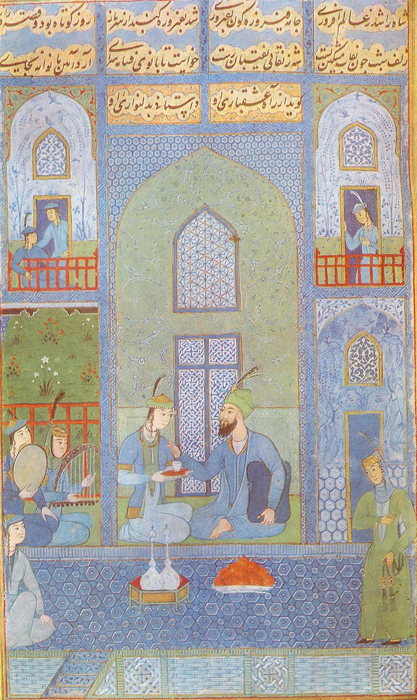
Today is also the first stop on our journey into the tale that gave the theme to my challenge: Nizami's enchanting Persian epic poem, Haft Paykar (known in English as The Seven Wise Princesses). Barham Gur, the King of Persia, is courting seven princesses who live in the seven pavilions he built for them, each in a different color. He visits one princess every day of the weak, and each princess in turn tells him a story related to the color they chose for their pavilion. I will get to all of them in time by the end of April.
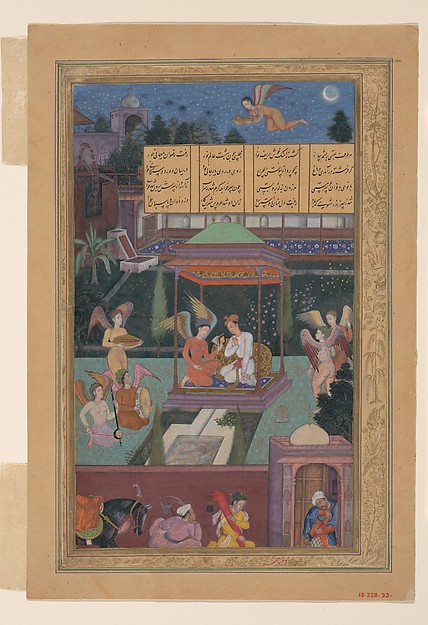
The resident of the Blue Pavilion (sometimes called the Turquoise Pavilion) is Piruza, a princess from... well. Some sources say Morocco, some sources say Maghreb, some sources say Khwarezm. She has blue eyes, and her pavilion is dedicated to Mercury. She tells a tale to the king about a young man who was lazy and a drunkard, until one night he was lured on a mysterious journey to an enchanted garden that turned out to be the lair of demons. After miraculously escaping for this predicament, he vowed to wear only blue, the symbol of clarity and salvation from evil.

Babe the Blue Ox
I adore Babe the Blue Ox. I realize that Paul Bunyan stories are generally considered "fakelore," but they are still tons of fun to tell. Especially to audiences outside the US who have never heard them before.
I love asking my audiences (American and non-American) if they know what made Babe blue. Do you?
(Also, the Jack of Fables comic book series did wonders with Babe's character.

The Blue Rose
A Chinese folktale that says a lot about the nature of Love. A princess vows to only marry a man who can bring her a blue rose. I love this story because it is a creative take on how fairy tale quests can be manipulated by a clever princess who wants to pick her own husband...

The Blue Light
A classic Grimm fairy tale. I remember loving it when I was little, especially because of the dogs with eyes of various sizes guarding the treasure underground. Lovely tale to tell.

Bluebeard
He does not need an introduction. Although, sadly, we never find out why the beard is blue...

The Blue Belt
Norwegian folktale. Giants. Need I say more.

The Blue Coat
A Jewish folktale that storytellers adore. Nothing is ever completely useless.

The Blue Lily
A very creepy Hungarian folktale where a girl accidentally flirts with the devil. Oops. Once she finds out who the handsome stranger at the ball really is, she tries to get away, but it is too late. The devil keeps showing up at her house until she dies from the curse. A blue lily flower grows on her grave; the lily is picked by a prince, whose love will eventually transform the girl back into her original form. This folktale also exists in Russia.

The Blue Jackal
A folktale from India, included in the Panchatantra. A jackal falls into a pit full of indigo dye, and then passes himself off as a divine being. A very entertaining story to tell.

Okay, that's enough blue for one dye. I mean, day.

Tuesday, April 1, 2014

A is for the Azure Lion


Azure is the color of the bright sky. It is named after lapis lazuli, a mineral of an enchanting bright blue color. It is also the shade of blue used in heraldry. In Chinese mythology, the Azure Dragon symbolizes the East (which makes sense, since geographically the East from China is equal to the ocean and the endless sky). When someone is looking for a good story however, another azure creature definitely takes the cake.

The Azure Lion is one of the antagonists in the old Chinese epic Journey to the West. At one point in their journey (Chapter 74 in the book) the Monkey King and Co. get word that on the mountain blocking their way there are three terrifying demon kings surrounded by an army of smaller demons. The three kings of Lion Camel Ridge are the Azure Lion, the Yellow Tusked Elephant, and the Golden Winged Great Peng who is essentially Garuda gone bad. Monkey uses some trickery to get rid of the small demons, by spreading rumors so horrifying about himself that even the kings start panicking. But while he is enjoying the chaos he created, Monkey gives himself away (with a giggle...), and gets captured by the Great Peng, who puts him in a magic jar that can liquefy any person in under an hour. Monkey gets very close to panicking himself, but in the end drills a hole in the side of the jar and escapes. He returns shortly after and fights the Azure Lion head on. It is a match between equals: just like Monkey, the Azure Lion had also stolen some of the Peaches of Immortality once upon a time, and fought the armies of Heaven. While Monkey can transform into many shapes, the Azure Lion can grow big enough to swallow an entire army. Taking advantage of this move, Monkey allows the demon to swallow him.
An amusing scene ensues when the Azure Lion returns home and tries to throw up the Monkey King... in order to cook him and eat him again. Monkey anchors himself in his stomach and refuses to be purged out, claiming that he had been looking for a nice warm cave to spend the winter in anyway. He explains how he will just nibble on the Azure Lion's intestines until spring rolls around. The Lion tries to purge him with copious amounts of wine, but instead of drowning, Monkey gets drunk. Finally he makes a deal with his host to come out, but suspects that the Lion will bite him in half on the way out, to sticks out his brass bo staff first, and the Azure Lion losses a few teeth in the deal. In order to ensure there will be no more shenanigans, Monkey ties a rope around the lion's heart; if he gets up to any more tricks, he can just yank on the rope and kill him. On order to stop the lion from biting down on the rope, Monkey comes out through the demon's nose, and gets sneezed into freedom.
This, however, is not the end of the Monkey-Lion situation that extends for another two chapters in the book. Long story short, in the end Monkey has to go and ask the help of the Buddha, who tells him that the Azure Lion and the Yellow Tusked Elephant are heavenly mounts that escaped, and sends their masters to subdue them. Manjusri, the bohisattva of wisdom, orders the Azure Lion to heel, and takes the unruly pet back home to the Western Heaven.

(This delightful episode is technically not the first time Monkey runs into the Azure Lion. Earlier in the story they fight him once, disguised as the Lion-Lynx Demon. In that case the Azure Lion was acting as an obstacle with Manjusri's knowledge and expressed permission at the Buddha's order, who decided that the heroes needed some extra villains to fight on the road to the West. Go figure.)

Literary note: Lapis lazuli is used to create the color known as Sacré Bleu. If you want to read a masterful, engaging, entertaining and hilariously funny novel on the magical history of the sacred blue, go and buy Christopher Moore's Sacré Bleu immediately.

Monday, March 31, 2014

Storytellers A to Z!

This year's A to Z challenge has many wonderful categories to help you pick and choose blogs to visit. Whether it is gaming, gardening, crafting, or writing that you are interested in, there is a shorthand on the list to point you in the right direction.
Sadly but understandably, Storytelling is not one of those categories (yet). But storytellers are participating in the blog challenge in increasing numbers, so I decided to gather them up in one post, in case someone wants to hop around and see what the fuss is all about.
There. Shall. Be. Stories.

Without further ado, here is a list of storytelling blogs participating in this year's A to Z challenge:

Storytelling Matters (Jeri Burns)


Storytelling and Life (Mary Garrett)

Fizz Boom Read Listen Imagine (Mary Grace Ketner)

Story Crossings (Pam Faro)

Adventures in Barding (Barra the Bard)

Power of Story: Artifacts! (Sue Kuentz)

Ellouisestory (Ellouise Schoettler)

Storytelling - resources for storytellers (Tim Sheppard)

And, of course, yours truly.

Enjoy the challenge!

Friday, March 21, 2014

The Great and Powerful A to Z Challenge Theme Reveal!

DRUMROLL.

The time has come to reveal what the theme of the blog is going to be for this year's April A to Z challenge! For those of you who are (still) not familiar with this awesome whirlwind of blogness, you can find more information on it here, it's not too late to join the fun!

And now, without further ado: My theme for 2014 is...

TALES WITH COLORS.

I love colors. I love colorful things (in case the blog's title did not cue you in). This year, I am going to be posting about folktales, myths and legends that have something to do with a certain color of the day. The A to Z will be given by the colors, which is fun in itself: there are more colors (and especially names of colors) in the world than you could possibly imagine. Surely there will be at least one for every single letter in the alphabet. Right?... Right?

Happy A to Z, everyone! What's your favorite color? ;)


(Original photo is from here)

Friday, March 14, 2014

Train your storytelling brain, overachiever edition

It is a dangerous keg of gunpowder when a storytelling spirit is teamed up with a gamer mind. Give me achievements to unlock and I will be burning through free time faster than the water I put on for tea and then proceed to completely forget about every singer morning.
(Spare kettle, anyone?)
The best you can do to manage this dangerous condition, I came to find, is to turn it into an exercise to expand your storytelling repertoire and cultural awareness, chalk it up to professional research, and move on.
(Observe how I am writing a blog post about it, instead of grading papers. Case in point.)

I found this fun little website a couple of weeks ago, and promptly fell down the rabbit hole. It is a collection of quizzes and trivia that are timed. That is really all there is to it. But for those of us who cannot turn down a timer and a challenge, it is dangerous territory.
Try this gem, for example. All you have to do is type in all the countries in the world in 12 minutes. Fun, right? It even tracks your progress, and arranges the countries into lists by continent, so you can check and see what letters you are missing. It gives you stats and information after you are done, and if you make an account, even keeps track of your high scores.
The first time I tried it, I got 126 countries down (there are 196, total). With a week of obsessive training and a bunch of other, partial map quizzes on the site, I worked my way up to 186. I am still missing island states and most of Polynesia, but I am getting there.
In the meantime, my storytelling brain is busy feeling ashamed for myself as a teller and as a cultural studies major for not being aware of all the million cultures and countries and languages and stories that are all out there waiting to be explored. Finally around Round No. X, I decided to turn this into a storytelling lesson instead of fervent procrastination.
Here is the game: Do the world map. Do your damndest best. Then take down a list of all the countries you missed (or never even heard about). Try again. Give yourself two or three tries, or however many you are comfortable with (some of us are more lenient with themselves than others). Once you have a list of places you keep missing, go hit up a library. Or Amazon. Or, you know. The Internet. The goal is to find at least one story from each of those countries. Or, for overachievers, a story collection.
I just walked home today with my first book of tales from Nicaragua (formerly known as "WHAT is that blank spot in Central America I am staring at?!?!") (my sincere apologies to Nicaragua).

I don't know all the countries in the world yet. I definitely, undoubtedly don't know all the stories in the world either.
But I am working on it.

Thursday, March 13, 2014

Dragons of many colors

Since two full days of Irish stories got snowed out this week (NOOOOOO) I am stranded at home once again, and decided to amuse myself with this little compilation of dragon tales. The goal was to gather as many different kinds of dragons as I could off the top of my head. I have a standing repertoire of dragon tales (I think most storytellers do), so this post is also supposed to freshen up the list. Here we go.

Flower Dragon - A Chinese folktale I really love even though it was almost impossible to track down (and I am not a 100% sure it's a folktale at all). It is about a girl called Pear Blossom that befriends a Golden Dragon that has a thing for flowers, and in exchange the dragon makes her and her mother rich for life.

The Azure Dragon of the East - A Chinese constellation and also a symbol of the East and spring in Chinese cosmology.

Ryujin - The Dragon King of Japanese mythology who lives deep in the ocean in a palace made of coral, and features in many a folktale. He also has two daughters, dragon princesses who apparently have a thing for human men (although they rarely stick with them for long, one of them is credited with being the ancestor of Japanese royalty). Also features in the legend of the Tide Jewels that I included in my collection of folktales with superpowers (link on the left) under Water Control. 

Thora's serpents - Remember the guy from History Channel's Vikings? Here is the story he is based on. But he is not even that important. Look at Thora instead, a girl who apparently raised two dragons that slightly got out of hand when they grew up. Still, how cool is that. Also, sounds vaguely familiar?...

The Dragon Prince and the Stepmother - A Turkish folktale (collected by a Hungarian folklorist) about a girl who tames a dragon (also a take on the Beauty and the Beast story type). In the translation I know it, the dragon is called "the black-eyed prince."

The Red Dragon and the Black Dragon - Turkish folktale from the same book. On top of being a good story, it also includes baby dragons, and we learn that very young baby dragons are blind, just like kittens. You are welcome.

Fafnir - I don't really have to introduce Fafnir. I love the bit though in Legends of the Rhine where he does not keep the Dragon Hoard in a cave; instead he spreads it out on a field and rolls around in the glittering gold. The stories call it the Glittering Heath.

Zahhak - The evil Persian king turned into a three-headed dragon, chained under Mount Damavand (actually a potentially active volcano and the highest peak in Iran). Zahhak, since he used to be human before he was corrupted and defeated, has a bloodline in later Persian legends. This line includes Rudaba, the "original" Rapunzel, and the heroine of one of my favorite tales ever. Talk about "blood of the dragon."

Yamata-no-Orochi - The eight-headed dragon of Japanese mythology who apparently has a thing for eating virgins and drinking sake.

Hungarian dragons - Hungarian dragons are often depicted as human, but that does not stop them from having multiple heads. In fact, the number of heads is very important in the grand scheme of things. Seven-headed is your standard folktale dragon (hétfejű sárkány), while the more bothersome ones can grow in number of heads exponentially to nine, twelve, twenty-four or twenty-seven. There is also a popular children's story about a dragon called Süsü who is bullied by other dragons because he only has one head.

Storm serpents - The other kind of dragon in Hungarian folklore. Flying snake that can be many different colors. Serves as a mount for a type of weather wizard called garabonciás, and usually associated with storm clouds, whirlwinds, hail, and lighting. (Stories about these are also included in my book).

El Amarú - The dragon of Peruvian myth, a serpent of all the shimmering colors of the rainbow on its piscine scales, that sleeps under a lake until it is awakened to bring rain and end an epic drought.

Piasa - A supposedly Native American dragon-creature depicted in a rock painting along the Mississippi river. There are many speculations about what it is, and why the painting was created. It is a winged and scaled creature depicted in red, green and black.

Okay kids, that's enough dragons for today.

Wednesday, March 12, 2014

I am thinking of stolen light

I am also starting to understand the concept of cabin fever.
I knew something was wrong with the weather in Bowling Green when all my attempts at debunking the stereotypes of bitterly cold winters were met with a resigned "Yup, you're pretty much gonna die" on the locals' part. No one even tired to sugarcoat it for the poor foreigner. That, in hindsight, was probably a red flag.
And then the Polar-Vortex-Polarbearnado-Frozen-on-Acid hit Ohio, and we have been sitting in this weather since December. My skin is practically translucent, and I resolved to crafting. That's how serious this is, people.
In the meantime, being a storyteller, I also cannot help but find new meanings in stories I never paid much attention to before.
I am thinking of times when people didn't yet know that spring is bound to happen again, sooner or later. Times when winter and summer depended on some higher power instead of the movement of bodies in space. Times when people had no scientific fact, no guarantee, no satellite imagery and winter storm advisory to tell them the weather was going to turn for the better or worse. Times when Nature was much, much bigger in our eyes.
I am thinking of all the stories of stolen light. Tales of endless winter. Sun, Moon and Stars disappearing from the sky without explanation. Frost Giants roaming the earth. (Seriously, how come Frost Giant is not a mascot up here?) The weariness of winter dragging out with warmth and sustenance slowly leaking away. All those stories of elemental fear of the endless cold and dark are starting to take on a meaning now.
And though I know that I, a child of the 21st century, being mildly inconvenienced by having to stay in my warm and comfortable apartment for days on end is the exact definition of a FIRST WORLD PROBLEM, it did get me thinking. Maybe I am just that bored. But every time I see a portion of my repertoire of folktales in a new light, I like to take note of it.
Maybe I'll go back and take a second look at some of those tales. We tend to laugh at stories that explained solar and lunar eclipses, or even night and day though colorful imagery and symbolism, and we tend to make fun of the fears of people who stopped or started battles over a change in the skies. But can we really imagine what it would be like to not understand why the Sun suddenly goes away, or not having any knowledge on when and if it will return? Do we still have a fear tucked away somewhere in our subconscious of the day winter will never leave? Are these stories still telling us things that we need to know to endure long winters and times of darkness?
What stories do long winter nights bring to mind to you?

(In case you are interested in some of the tales I am talking about, here is a post I wrote a while ago on Storyspotting.)