Showing posts with label saints. Show all posts

Friday, April 11, 2025

J is for Juliana (Women's Epics A to Z)

This year my theme for the A to Z Blogging Challenge is Women's Epics. My goal was to read 26 traditional epics from around the world that have women as their heroes. Because epics like this do exist, and they are fascinating! Read the intoduction post here.

CW: Torture

Juliana

England

Juliana is a 9th century Old English epic poem telling the story of St. Juliana of Nicomedia. It is attributed to a poet named Cynewulf. It was preserved almost complete, with only one page missing, and published with comments by Rosemary Woolf. For a modern English translation, I used this site. The introduction to Woolf's edition talks about the linguistic intricacies of the poem as well as the dating, and points out that the poet knowlingly imitated the style of the epic Beowulf. The translator also discusses how the Anglo-Saxon poet changed the saint's existing legend to fashion it more to the taste of his own audience - with villains more evil, characters more black and white, and punishments more severe. Therefore, while the legend itself is not typically Anglo-Saxon, the way of retelling the story is; to the point where the characters are treated as characters from heroic legends. It also uses language that is reminiscent of old sagas.

What is it about?

TL;DR: Juliana, a Christian virgin, refuses to marry a pagan man, therefore she is tortured and eventually killed. However, before her death she fights a devil and beats it into submission.

Young Juliana is promised by her father to a wealthy pagan man named Eleusius, who greatly desires her. She, however, is Christian, wants to stay a virgin, and publicly declares that she would only marry if her suitor was Christian too. Eleusius is angered, and her father gives Juliana over to him to do as he pleases. Eleusius tries to convince her to sacrifice to the pagan gods and marry him. When she repeatedly refuses, he tortures her to get what he wants, but she doesn't break. He then locks her into a cell. 

In prison, a devil visits Juliana disguised as an angel, trying to talk her into avoiding death and torture by giving up her faith. Juliana prays to God, and she is told to grab the devil and make him confess his true nature. So she does. Unfortunately, the actual fights scene is the part that is missing from the folio. But somehow Juliana overcomes the devil, who confesses all the evil he had done before, and also explains his methods of corrupting people, before he begs for mercy.

The next day Juliana is brought up from prison, and she drags the devil along in chains, showing him off before she finally sets him free. Another part is missing, but the point is that they put Juliana on a pyre to burn, however, an angel puts out the flames. They then set a cauldron of lead to boil and throw her in it - but while the splashing lead burns everyone around, she is still unharmed. Eleusius then orders her to be stabbed with a sword.

At this point the devil shows up again, singing mocking songs about Juliana... but as she turns and gives him a look, he panics and flees. Juliana is led to a place of execution where she preaches to the crowds, and accepts her death. Soon after, Eleusius and his people are shipwrecked on an ocean voyage and they all drown. The story ends with an epilogue by the poet who expresses hope that people will recite the song and remember his name.

The highlights

The poem begins with a very effective and epic introduction to the dark times when the emperor persecuted Christians. "Fiend-ship was aroused, heaving up heathen idols and slaying the holy, breaking the book-crafty and burning the chosen, terrifying the champions of God with spear and flame."

I am really sad that we are missing the part where Juliana actually fights the devil. I am sure it was epic. But from later lines we can surmise that she wrestles him, beats him, and binds him in chains - "battle-bold beyond all woman-kind." He also complains later that her treatment is "excessive punishment," and that over centuries no prophets or kings dared to treat him like this.

(World's smalles violin plays in the background)

I also enjoyed the part there the subdued devil tried to explain to Juliana that he was just following orders (given by his father, the King of Hell). "We are sad-minded, frightened in spirit— He is not a merciful lord, but a terrifying prince. If we have not done anything evil, we dare not afterwards come anywhere near his presence." He then describes how he would be tortured if didn't do what he was told (corrupting humans). The part where he describes the psychological warfare against the faithful is also pretty on point.

JULIANA IS A CHRISTIAN SAINT, BUT THIS POEM ECHOES OLD LEGENDS OF WARRIOR-HEROES.

Can you guess what, or who, Juliana is the patron saint of?

Saturday, April 22, 2023

S is for Saliva (Body Folktales)

 This year, my A to Z Challenge theme is Body Folktales. Enjoy! 

NOTE: I am sorry I have not been visiting back. I really miss seeing all your posts! I was traveling, my phone died, and then the Internet went down at home. I will catch up as soon as I can!

I could not find a single image that was not gross,
so here's a puppy.

CW: These stories will get gross.

Spitting and saliva have long featured into all kinds of customs and folklore. This book has a long list of them. I also blogged about a Japanese legend earlier about a samurai killing a giant centipede with arrows he'd spat on. Here are some other interesting tales I found:


In this 5th century legend a saint slays a dragon by spitting into its mouth. The trick works, says the notes, because there was a long-standing belief that human saliva is scalding to serpents. In another 13th century text, people trap and kill a dragon by fasting and then spitting a circle around it.
(This is a whole D&D adventure waiting to happen...)

Juan and the Princess (Philippines)

A poor boy is challenged by a king to find his hidden daughter. He succeeds, but the king still doesn't want to keep his promise and marry him to the princess. Juan receives help from some birds, who give him a pen-point but no ink, telling him to use his saliva. Whatever the king makes him write turns to gold, proving that the boy is special.

Kvasir (Norse mythology)

In Norse mythology there is a wise being named Kvasir, who was born from a bowl of spit. The Aesir and Vanir gods once had a fight, and decided to make peace by spitting into a bowl together (try this next time you have a family fight). Thus, Kvasir was born, blessed with all kinds of knowledge. Later, two Dwarves killed him, and from his blood they made the Mead of Poetry.


Chasing a monster that has been stealing apples from the garden, the hero of this story ends up in the depths of the underworld. There, he meets a woman who is making dough with her own saliva instead of water, for her six children. She tells the hero that there is no water in their realm because a monster is guarding the well. Of course the hero manages to defeat the monster, and bring water back.

Glaucus (Greece)

Glaucus, son of King Minos of Crete, dies, and the seer Polydius brings him back to life. Against his will, Minos forces the seer to teach Glaucus the art of divination. However, when Polydius is finally allowed to leave, he asks Glaucus to spit into his mouth, and the boy forgets everything he'd learned.

The fairy midwife (Guernsey)

This is a common tale type I have blogged about before, where a woman acts as midwife to the fairies, and accidentally gets something in her eye that allows her to see through enchantments later on. In a version from Guernsey, that something is the saliva of the newborn fairy baby.

Talking spit

This is a folktale motif, rather than an individual tale. There are many stories around the world where someone escapes captivity of witches / ogres / devils / abusive parents / etc., and spits on the floor on the way out. Later on, the spit answers in their name, delaying the discovery that they'd escaped. (D1611: Magic spittle impersonates fugitives)
In the tale of Dhon Cholecha from Nepal, a girl escapes from demons by leaving spittle behind and putting charcoal in it. The motif is especially common in Blancaflor tales from Spain and Latin America (see here, here and here).

Would you tell any of these stories to your audiences? 

Monday, May 13, 2019

Saints and lessons (Following folktales around the world 106. - Mauritania)

Today I continue the blog series titled Following folktales around the world! If you would like to know what the series is all about, you can find the introduction post here. You can find all posts here, or you can follow the series on Facebook!

Shinqiti ​Folk Literature and Song
H. T. Norris
Clarendon Press, 1968.

The book is a selection from the oral tradition of Mauritania's Hassaniya-speaking "Moorish" people. Shinqit is the name of a trade city as well as the region spanning from the Senegal River to Morocco. Cultures have been split up by political borders, but there are still close to ten million Hassaniya speakers in West Africa, the majority of them living in Mauritania. The landscape, between ocean and desert, left its mark on the stories and the poetry. The book has a lengthy introduction to the culture, language, music, poetry, and oral tradition of Shinqit. There is one chapter for poetry (bilingual print), and a chapter that contains fourteen stories, both folktales and saints' legends.


Highlights

I was fascinated by the stories of local saints. One of my favorites was about how Aba Zayd and Baba Ahmad outwitted a notorious trickster, al-Arusi, to protect the reputation of a friend of theirs. The troublemaker tried to trick them with riddles, but they solved all of them in the end. Another fun story was that of Sid al-Amin, and how he tried to cure his consumption by drinking vinegar and honey. He listened to the medicine arguing with the illness inside his chest; Vinegar was mean, but Honey was polite, and yet the latter was the more terrifying. I also adored the story of Saint Barakallah and his slow and ugly, but loyal and kind donkey. The animal carried water for the saint in his life, and after his death stood by the grave, and could not be moved by any force.

Connections

I have encountered stories before (e.g. in Mali) where a smaller animal defeated a larger, stronger one from the inside. In this collection, it happened in The fight between the lion and the fly, where the fly killed the lion by crawling into his brain. I was reminded of a Hungarian tale by The murabit and the shepherd, in which the wise man preached about hell and the afterlife until the shepherd began to cry - but when consoled, he admitted that it was not the thought of hell that made him cry, but rather the wise man's beard, which reminded him of his favorite goat that had been eaten by a beast...


Where to next?
Cape Verde!

Monday, September 24, 2018

Between the mountains and the sea (Following folktales around the world 84. - Monaco)

Today I continue the blog series titled Following folktales around the world! If you would like to know what the series is all about, you can find the introduction post here. You can find all posts here, or you can follow the series on Facebook!

Once again, it was not easy to find a book for a tiny country, but I managed to scrape by...

Monaco
The beauty spot of the Riviera
Thomas Henry Pickering
Kessinger Publishing, 2010.

This book was originally published in 1882, as a sort of guide for Victorian tourists. The author notes in the first chapter that people tend to think of Monaco as a casino and nothing else; but of course visitors can only be so wrong if they try to "do" Monaco in one day, and never leave the casino at all. I don't think much has changed since then. The author introduces the natural and cultural beauties of the small country, suggests trips and walks, describes the government and the economy, and, among other things, spends a chapter talking about the history and legends of Monaco. It was in this chapter that I found some stories to read.

The stories

Monaco's connection to Greek mythology is through Heracles: Legend says he stopped here on his way home with Geryon's cattle, and founded the port and the fortress. The author also claims that Phoenician traders worshiped Melkarth here (whom he identifies with Heracles). The most famous local legend is that of St. Devote, patron saint of Monaco, a martyr from Corsica whose remains were shipped to Monaco, and whose feast is still celebrated every year.
There was also a love story about Anna, a Christian captive, and Haroun, a Moorish leader; the girl eventually got her captor to convert, and they ran away together. The Moorish army, losing its leader, soon left the area. Another legend had a more somber tone: When the Duke of York, brother to George III, died in Monaco, and his death was announced by his ship flying the flag on half mast, a woman clad in white was seen throwing herself into the sea from the cliffs. According to the author, locals still remember her.
There was one more story, about the town of Roquebrune - it said that the town was originally on the summit of the mountain, but it started slipping one day, and only the prayers of a devout monk managed to stop it halfway down, before it would have crashed into the sea.


Where to next?
France!

Monday, September 17, 2018

The Devil did it (Following folktales around the world 83. - The Vatican)

Today I continue the blog series titled Following folktales around the world! If you would like to know what the series is all about, you can find the introduction post here. You can find all posts here, or you can follow the series on Facebook!

I have been wondering what I could read for the Vatican. Eventually, since saints' legends have been featured multiple times before anyway, I decided to choose a classic that I've wanted to read for a long time.

Legenda Aurea
Jacobus de Voragine
Helikon, 1990.

The Golden Legend was one of the most popular bestsellers in Europe in the Middle Ages. More than 1000 of its manuscripts survived from between the 13th and the 15th century. The author, Jacobus de Voragine Dominican monk collected the popular legends of saints and their miracles, organized around the Catholic calendar, in order to provide a resource for sermons and readings at monasteries. The full manuscripts contain somewhere between 180 and 243 saints, depending on the edition; the one I read (in Hungarian) had 110 chapters, sometimes with multiple saints in one. The full edition would have also contained descriptions of the non-saint-related Christian holidays, but I was less interested in those anyway. (I was raised Catholic, I know the drill.)
Most of the stories revolve around martyrdom. It is noted in the Introduction that the Legenda contains 81 distinct torture methods, mixing and matching them in all kinds of creative (and gory) ways. It is not exactly a historical source (the dates of Roman emperors' rules are not even remotely correct), and it is less than kind to women, Jews, and pagans, but it does contain a whole lot of folklore motifs, tropes, and legends, that are a part of the larger European oral tradition. In that sense, it was both an entertaining read, and an intriguing comparison to the folktales I have read so far.

Highlights

I liked the legend where a saint and the devil had a contest of questions and answers. It appeared twice, once featuring St. Andrew, and once St. Bartholomew, and the answers were sometimes surprisingly beautiful. When the devil asks what the greatest miracle is that God worked on a small thing, Andrew responds: "The variety and beauty of faces. On a small human face God placed all the feelings of an entire body." St. Bartholomew said "the place of the Cross," but he was corrected by the (female) devil: It is the human head, because as such a small thing, in contains worlds. To the question of what it is that is the most human in a person, Bartholomew answered "the ability to laugh." But the snappiest of all answers came from Andrew, who, when asked by a decadent bishop how far Heaven is from Earth, simply said: "Ask your friend, he probably measured it when he fell." Boom.
Pic from this great Twitter account
I enjoyed the legend of St. Juliana, who tackled the Devil, bound it, and beat it into submission with chains so badly, that later a glance was enough from her to send it running. I was also entertained by the story that claimed that Vespasian had wasps (hence the name) up his nose, until a man named Albanus cast them out in the name of Christ. I don't remember this from History class... neither the story where Nero swallowed a frog, thought he was pregnant, then threw it up, and thought he gave birth. Legend claims that's why the Lateran is named after (latuerat rana).
There was a lovely story about the tame lion of St. Jerome, who guarded the monastery's donkey, and was in distress when it went missing. My favorite animal appearance, however, was the "camel yelling in a human voice" that told people where to bury the bodies of St. Cosmas and Damian. Camel ex machina.
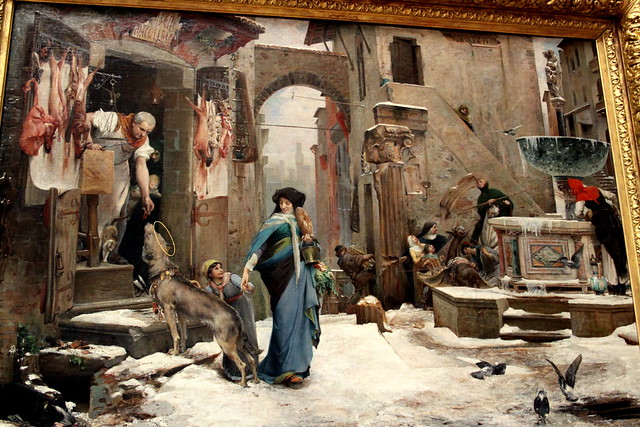
Of course, being the legend collection of the Middle Ages, the book contains some well known stories: St. Nicholas' gift (hence Santa), the legend of the Castel Sant'Angelo (where St. Michael appeared to signal the end of the Roman plague), St. George and the dragon, Attila the Hun meeting Pope Leo, St. Peter's "quo vadis" moment, St. Christopher the Giant, St. Martin and the beggar, and even Roland's last battle. At the same time, there are also some surprising omissions. St. Valentine's legend does not say anything about love, St. Patrick's is very short and devoid of all colorful Irish details, and St. Elizabeth of Hungary was missing the famous Miracle of the Roses. Too bad.

Connections

I have seen the tale type of the gold returned through cheating (in Burma, among other places). A man swears he returned money to its owner, while all he did was put the money inside a walking stick, and ask the owner to hold it for a second. In this case, St. Nicholas made sure the cheater was punished in the end. I have also encountered the legend in which a man entrusts his fortune to an image of St. Nicholas, and threatens the saint when he gets robbed, so that Nick has to bring the stolen goods back (see also: Macedonia). The legend of St. Felix contained the popular trope of spiders spinning webs to disguise the hiding place of the persecuted saint. I was reminded of an Appalachian folktale (about two foxes) by the story in which two monks in St. Agathon's monastery made an attempt to fight, but did not know how, and ended up being too nice to each other.
Dragon-slaying was a popular element of the collection. Next to St. George, dragons were also dispatched by St. Sylvester, St. Philip, St. Margaret, St. Martha, St. Donatus, and St. Matthew. Margaret allegedly was swallowed whole by the dragon, and burst forth from its stomach (the author says that is dubious), while Martha defeated the legendary Tarrasque of the River Rhône, a monster that "shot its excrement over an acre's span at its enemies."
The legend of St. Patrick included a nice, colorful walk through hell and back that would have made Dante proud.
The book does feature some elements of classical mythology, usually in the role of the enemy (the goddess Diana attacks saints with alarming regularity). In the legend of St. Anthony, however, a very helpful centaur and a satyr made an appearance, guiding the saint on the road to St. Paul. I was reminded of the legend of Oedipus by the story of the birth of Judas, and his marriage to his own mother.
Last, but not least: I always considered Monty Python's Life of Brian a genius piece of British humor - and here I found the original story of the ex-leper! St. Martin's legend contained the story of two beggars, one lame and one blind, fleeing from the saint's funeral procession, in fear of being cured and losing their livelihood. The saint cured them anyway. Bummer.

Where to next?
Monaco!

Monday, September 3, 2018

Children of San Marino (Following folktales around the world 81. - San Marino)

Today I continue the blog series titled Following folktales around the world! If you would like to know what the series is all about, you can find the introduction post here. You can find all posts here, or you can follow the series on Facebook!

The most famous collection of San Marino folktales was written by Walter Anderson at the beginning of the 20th century. Unfortunately I could not locate the full book, but managed to find a short selection of 10 tales online.


Novelline Popolari Sammarinesi
Walter Anderson
Republica di San Marino 2000.

This short collection, much like the original book, presents the tales both in the San Marino dialect and in standard Italian. The original book contained 118 tales, gathered by Anderson in the 1920s with the help of schoolteachers and their students. Each tale is marked with the name of the original teller - since this was a school project, most "sources" were between 8 and 13 years old, which makes the tales short, to the point, and occasionally surprising. I used a combination of my sporadic Italian, my more confident Spanish, my college Latin, and Google Translate to read the tales online.

Highlights


The legend of Saint Peter's mother was all kinds of interesting. She was portrayed as a greedy and cold-hearted woman, who only gave one leaf of celery to the poor all her life, and even that only because she accidentally dropped it. Even so, Peter tried to talk God into letting her into Heaven, on account of that one gift - but when she began bragging how she deserved to go to Heaven because her son was a saint, and she was better than everyone else, she got sent back to Hell.
The ending of Madonna's House was much nicer. The tale began exactly like Hansel and Gretel, with children being sent to the woods, and not finding the clues they left to go home. But here the small cottage they found belonged to the Virgin Mary, and they grew up there safe and happy.
I was reminded of Vasilisa's doll a little by the story of the poor girl who bought a doll instead of bread. Her sisters scolded her, but the next morning, while changing the doll, she found gold pieces in its diaper.

Connections

The local trickster seemed to be the fox (a female one) - for example, I found a version of the "sick carrying the healthy" story with her and a wolf. There was also a variant of the Three Little Pigs, where after a straw house and an iron house, miraculously a glass house protected all three. The tale of the Seven-headed wizard was also familiar, with a boy exchanging sheep for dogs, and the dogs helping him defeat evil in the end. And I even found a Thumbling story, where the tiny hero named Fagiuolo decided to become a thief, and made good money from it.

Where to next?
Italy!

Monday, May 21, 2018

God and taxes (Following folktales around the world 66. - Macedonia)

Today I continue the blog series titled Following folktales around the world! If you would like to know what the series is all about, you can find the introduction post here. You can find all posts under the Following Folktales label, or you can follow the series on Facebook!


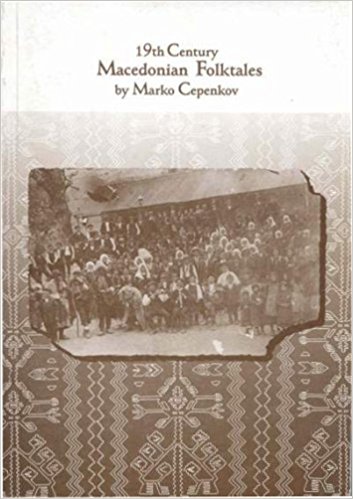
19th century Macedonian Folktales
Marko Cepenkov
Macquarie University, 1991.

This book (which you can find online) contains 66 tales from the 19th century collection of Marko Cepenkov. Interestingly enough, even though Cepenkov gathered more than 800 folktales in his life (as well as legends and other folk texts), he was not really a folklorist or researcher. Rather, he listened to the stories, then mulled about them until they were "ready", and then wrote them down with his own words. In that way, he is another link in the chain of oral tradition that formed the stories, rather than an academic.
There are not many classic "fairy tales" in this collection. Most of the stories are legendary tales, funny anecdotes, and realistic tales. In exchange, they really are an excellent lineup of stories: The jokes are amusing, the legends are clever, and many stories mirror directly some issues and social situations that exist even to this very day (you'll see). The translation is also entertaining, although I wished there had been some notes accompanying the tales.

Highlights


I was sad that the Bulgarian volume did not contain the tale of Silyan the Stork... and lo and behold, I found it in this one! The book says it is one of Cepenkov's most famous tales. Not sure if the Bulgarians would agree with that statement, but it is a great story anyway. Silyan the good-for-nothing husband and father goes out into the world, and gets shipwrecked on the Island of Storks. The storks of the world are people, who live as humans for half a year, and as birds the other half. Silyan also learns the secret of transformation, and flies home with them... but then gets stuck in bird form, and can only watch his family from afar. Eventually, the tale does have a happy ending, and we also learn a lot about storks along the way. The people's love for animals (and storks especially) also showed through in other tales. One had a poignant moral: If you help a wicked man, you help the devil. In this, a kind man saved a snake and a stork, and they both helped him in return; then he saved a wicked man, and almost got executed because of his shenanigans. The story concluded: "You don't have to harm wicked people, but you should not help them either." Words to live by...
I also loved the moral of the tale of The rich man who bought a liver for a poor man. A rich man bought a liver as a gift to a poor man, and then asked him to carry his own shopping home "as a thank you." On the way, the rich man boasted to everyone what a great charity he had done, then made the poor man do some more chores "as a thank you," while basking in his own charity. Finally, the poor man decided one liver was not worth the humiliation, and left. I want to use this tale for teaching about privilege... Similarly, the one titled The poor man who lost a thousand eggs on the way to Istambul. In this one, the poor man had to give his eggs away little by little to corrupt customs officers. Eventually, he decided to set up a toll booth at the cemetery, and grew rich from taking a "burial tax." Only at the end of his life did the Emperor discover the trick, and with it, the corruption in his kingdom. (Fun fact: This story still goes around on the Internet as an urban legend!).
I had a feeling of déja vu reading the tale of The man who had the emperor's permission to murder. A man made a bet that the judges of the city were so corrupt that he could get away with killing someone on the marketplace in broad daylight, if he paid them off. He did prove his point, and won the bet, by presenting a "licence" made of money to the judge. Hmmm.
Some of the animal tales were also delightful. That of The Wolf told about a hungry wolf that tried to devour various animals, but they all tricked him in various ways. Even better was The fox who had a hundred ideas, and the badger who only had two: The fox kept taking advantage of the badger and stealing his ideas, until he outsmarted her in the end.
There were several religious legends in the book where humor and moral went hand in hand. My favorite was that of St. Peter and the poor man. The saint took pity on a freezing beggar, and asked God to make it so that it would be summer all year round. But he soon found out that eternal summer came with consequences: Amphibians and reptiles began to proliferate, grow, and become sentient. Eventually, when King Toad asked for Peter's daughter in marriage, he had to admit the whole thing was a bad idea... I was also amused by The poor man and St. Nikola, in which the protagonist bought two icons, that of the Virgin and that of St. Nikola, to guard his house from thieves. When the house was robbed anyway (obviously), he threatened Nikola until the saint made sure the goods were returned. I loved it that the poor man decided to let the Virgin off easy, because "she was probably changing diapers at the time."
The tale of Truth and Falsehood was similar to the popular "Truth and Story" tale, except here the truth was dressed up in lies, and felt very embarrassed about it. Finally, there was a very clever story about A man who kept a written record of all the female wiles. He collected all the tricks that women used to cheat on their husbands with him (!!!), and then tried to control his own wife by consulting the list. Of course, the wife, who was actually faithful, still managed to prove that she could have tricked him if he wanted to.

Connections

It is not all that surprising that there is a Macedonian version of King Midas - except instead of donkey ears, here The king had a horn in the middle of his forehead. The lucky boy's story was very similar to that of the Devil's three golden hairs, except here the boy's lucky fate was decided by The Three Fates (and written down), and it was the daughter herself who changed the letters to be able to marry him. Also, I loved the variant of the Blacksmith and the devil in which the protagonist showed up in Heaven with twelve devils in the end (his card-playing buddies), and insisted that if he had to treat all the twelve apostles when Jesus visited him, then he was entitled to bring his friends in too. St. Peter couldn't argue.
There was also another variant of 'why old people are not killed anymore' - in this one, The old folks were taken up to the mountain to die. Interestingly, in this one the king gave young people impossible tasks on purpose, to make the realize they needed their elders' wisdom. There was also another tale where a child helped serve justice to thieves (and his name just happened to be Solomon).
After Greece, I once again found a tale about a man who would his Fountain of Luck... and tried to broaden the tap with a stick, but the stick broke, and blocked his luck. He eventually died from an accidental self-inflicted cannonball wound.
I grew up hearing the story of the stubborn donkey and the chili pepper from my grandfather. Here, there was yet another version after Nasruddin, but with Six donkeys.

Where to next?
Kosovo!

Friday, April 7, 2017

F555.7. Poisonous white hair in eyebrow that causes death to the first person who sees it each day (WTF - Weird Things in Folktales)

Welcome to my A to Z Challenge blog series titled WTF - Weird Things in Folktales! Find the introduction post (explaining the theme) here. Find all other participating blogs in the comments of each day's post on the main blog! You can also follow us on Twitter and Facebook.

F in the Motif Index describes the abundant category of Marvels. It is just as varied as the tales of the world are; it includes things like "F57. - Road to heaven," and "F95.2. - Broad path to hell," (heh), as well as "F200. - Fairies (elves)," with all their shenanigans. As you can tell from the long list of runner-ups, this one was a hard choice - but there was one entry that immediately jumped out at me:

F555.7. Poisonous white hair in eyebrow that causes death to the first person who sees it each day 

Of course it is an Irish story.

St. Molaise
The entry refers to the legendary meeting of two Irish saints - Saint Molaise and Saint Sillán - in the 7th century AD. According to legend, Saint Sillán had a magical white hair in his eyebrow that had a very peculiar power: Whoever saw it first early in the morning would die immediately. (Good thing Sillán didn't own a shaving mirror, I guess). As horrible as that sounds, the legends claim it made Sillán very popular with people who were gravely ill or suffering, as they all hoped to be the first one to see his eyebrow in the morning, and thus gain a painless death. 
One day, early in the morning, Saint Sillán was taking a walk around the graveyard, when Saint Molaise ran into him, and said "This hair shall not be killing everyone," and plucked it right out of Sillán's eyebrow (ouch). Of course the power still worked, and Molaise dropped dead immediately - but in the comforting knowledge that the dangerous eyebrow hair was no more.

This story was preserved in the calendar of Óengus of Tallaght, a 9th century Irish bishop (read it here or here, and an article about it here). Saint Sillán's feast day is September 11th. Some folklorists seem to claim that the story has some solar mythology hidden behind it.

I personally think this power could be fitting for a great Marvel character.


Runner-ups
F57.2. Person‘s tongue as path to sky
F57.3. Path to heaven on beard
F112.1. Man on Island of Fair Women overcome by loving women
F130.2. Spain as otherworld
F162.7. Rainbow of honey appears regularly in otherworld
F167.11.2. Hogs with bath of molten lead (iron) in otherworld
F167.15. Great tattooer in otherworld
F183.1. Automatic service in otherworld
F232.1.2. Fairy has back rough like pine cone
F232.2. Fairies have breasts long enough to throw over their shoulders
F233.7. Fairies are multicolored
F241.5.1. Fairies own herd of ibexes
F242.1. Fairy car
F254.5. Fairies commit adultery
F285. Anchor falls on fairies
F343.16. Gigantic ox rib as gift from fairies
F366. Fairies abuse livestock
F369.8. Elephants become lean from listening too much to fairy music
F438.2. Spirit of earthquake has very long mouth
F451.1.5.1. Dwarf as reincarnation of rat
F451.2.0.4. Dwarfs appear nodding and anxious to speak
F451.3.7.1. Dwarfs dislike caraway seed in food
F481.0.1.4. Cobold accidently acquired
F516.1.1. Armless people have legs growing from their shoulders
F517.1.5.1. Men whose feet turn backward so that they will not stub toes
F521.3.3.2. Person with golden anus
F529.3. Man with grass growing from his joints
F529.4. Person has small animal within his body
F529.7.1. Person without joints
F544.3.2.1. Luminous tooth of saint
F545.1.6. Beard travels detached from owners
F546.2. Woman with three breasts
F546.4. Thorns around nipples
F546.5. Woman with breasts hot enough to cook food
F547.5. Extraordinary vagina
F547.3.3. Toothed penis
F559.8.1. Person’s urine melts rocks
F569.2. Men menstruate
F594. Man whose entrails are visible when he laughs
F610.3.3. Twelve berserks
F615.3.1.2. Camels having fallen from sky into girl’s eyes
F624.1.2. Strong man throws walrus
F628.2.7. Strong man uses man as weapon
F635. Remarkable spitter. Spits lake of soap
F811.11. Trees disappear at sunset
F989.19. Cock with enormous silver ears
F989.22.3. Pig swallows necklace
F1034.2. Magician carries mistress with him in his body. She in turn has paramour in hers

Thursday, April 24, 2014

U is for Umber, Umbra, and Wolves

Umber is an earth tone, ranging from dark yellow-brown (raw umber) to dark red-brown (burnt umber). It has been used in paintings since the Renaissance. While the pigment itself was named after the soil in Umbria, it is also related to the Latin word for Shadow, umbra (something White Wolf gamers are probably familiar with).
Umbria is not a land of shadows - in fact, it is quite a beautiful place. Venturing into the world of stories, one doesn't have to reach far: Assissi is located in Umbria, and it gave the Catholic Church one of its most famous saints. On a related note, Gubbio is also located in Umbria, and it gave said saint one of his most exciting stories.
According to legend, while St. Francis was living in Gubbio a ferocious wolf descended on the lands of the town, hunting livestock, and killing everyone that tried to stop it. The situation got so bad that the people of Gubbio did not dare to leave their houses anymore; the wolf was even known to venture inside the town. Finally the people turned to Francis, who promised to put an end to the terror. He walked out of town and into the woods where the wolf's den was; he was followed by a number of people too curious to be scared. When the wolf appeared from its den, baring its fangs and ready to pounce, Francis calmed it with the sign of the cross. The Francis talked to the wolf; he promised the beast that if it stops killing animals and people, the citizens of Gubbio will make sure he never goes hungry again. The wolf put his paw into Francis' hand as the sign of agreement, and then followed him back to town. For the next few years, the wolf was one of the citizens of Gubbio, and people took turns feeding him and caring for him.
The moral of the story, according to St. Francis: How can you not be afraid of the jaws of Hell, if you are scared of a beast of nature?
The moral of the story, according to storytellers: ... you'll have to figure that out for yourself ;)

Note: There is a children's book (this probably should be on my other blog since it's a Hungarian curiosity...) written by Katalin Varga that features a place called the Umbra, an alternative universe where many things can happen. In the book, the main character uses the Umbra to travel in time and make friends with people like King Tut. I loved that book as a kid.

Tuesday, April 16, 2013

N is for the Nun Princess

Straying more than a little bit from folktales, here is one of the most famous Catholic legends of Hungary.

About a real princess who was also a nun. And a saint.

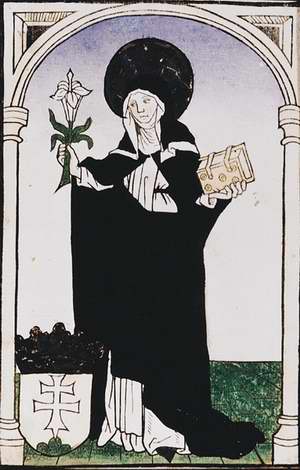
St. Margaret of Hungary was born as the daughter of King Bela IV in 1242, just months after the Hungarian army was beaten and the kingdom devastated by the Mongolian invasion. The king and his family fled to Klis in Croatia - the baby princess was born in that castle. The king offered her to God in exchange for liberating the kingdom from the Tartars.

The Mongolian invasion ended. The royal family returned home. Princess Margaret was raised from the age of three to become a nun. She spent most of her life on the island that was later named after her - Margaret Island on the Danube, now the green heart of Budapest.

Everyone in Hungary knows about St. Margaret. We learn about her in school. She was devout, religious, humble, and apparently, more than a little bit overachieving when it came to torturing herself. To pray for her country and her father she offered herself to God, in all kinds of disturbingly painful ways, ranging from whips and beatings to hedgehog-skin belts. She did not wash, she did the dirtiest jobs in the monastery, and she never knew anything in life except devotion.

The King himself tried to marry her off more than once, but she always refused. She remained a nun until she died at the young age of 28.

The process to make her a saint of the Catholic church was put in motion practically at the moment of her death; testimonies were collected and written. She was beatified in 1276, but she only became a saint in 1943.

My personal reason for including this princess is because her legend has the only mention of a namesake of mine. Csenge, although very old, was not a popular name through the ages - but apparently there was one noble girl who was a nun the same time as Princess Margaret who bore this name. My infamous namesake was recorded in the saint's legend for one reason only: she beat the princess in the face with the dishwashing rag.
Go figure.