Showing posts with label FolkloreThursday. Show all posts

Thursday, March 26, 2020

How the women saved Guam (Feminist Folktales 13.)

Another Thursday, another post for Feminist Folktales! It's a series of traditional stories from around the world that display motifs that reflect feminist values. I am not changing any of the stories, merely researching and compiling them, and posting them here as food for thought. You can find the list of posts here.

Origin: Guam (Micronesia)

The story


Image from here
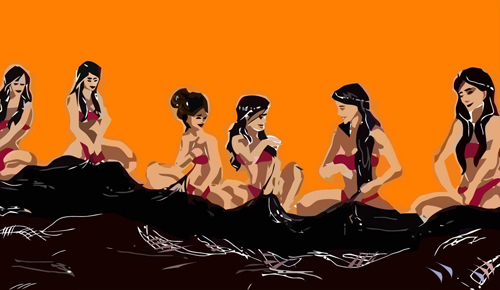
The people of Guam anger the spirits of nature, and one day they wake up to an earthquake: a giant fish is eating the island. They manage to spot the giant palakse (parrot fish), but they can't capture it. The men hold a council but keep the women out, and when they go up against the fish they tell the women to stay behind, because fishing and hunting is a man's job.
Meanwhile, the women have their own council, and come up with a plan. They all cut their hair and use it to weave a large, strong net. A girl notices orange peel floating in the bay, and knows women on the other side of the island use orange peel to wash their hair; this is how they figure out there must be a tunnel under the island. They cast the net at the exit of the tunnel, catch the fish, and manage to pull it ashore with the help of the men and children. The island is saved.

What makes it a feminist story?

This is one of those rare traditional stories where women act as a community. While men try to push them aside in a time of crisis - not letting them into the council, not letting them go fishing - they come together and thing of alternative solutions, since it is obvious that the direct approach is yielding no result. The women's council listens to everyone (in various versions little girls and old women all get a turn to speak), and they pool their knowledge to come up with a solution. Someone discovers the orange peel (observation); someone knows where it's from (knowledge); someone realizes the meaning of their presence (logic); someone suggests possible next steps (strategy); someone suggests tools to use (practicality); and in the end, they all contribute their hair, work together, and catch the fish. (Added bonus that they sacrifice their hear, a symbol of feminine beauty - highlighting that the survival of the community is more important that beauty standards.)
The women of Guam are a symbol of good teamwork and supportive community. At the end of the story, the men join them in pulling the net, admitting that they had made a mistake when they kept the women out of trying to solve the problem. The island is saved, the community comes together.

Image from here

Things to consider

When I tell this story, some things usually need explaining (e.g. the shape of the island of Guam, or what a palakse is). This story only really comes alive in its cultural context.

Sources

Eve Grey: Legends of Micronesia (Department of Education, 1951.)
Bo Flood, William Flood, Beret E. Strong: Micronesian Legends (Bess Press, 2002.)
Bo Flood, William Flood, Beret E. Strong: Pacific Island Legends (Bess Press, 1999.)
Evelyn Flores, Emelihter Kihleng: Indigenous Literatures from Micronesia (University of Hawaii Press, 2019.)
Lawrence J. Cunningham, Janice J. Beaty: A history of Guam (Bess Press, 2001.) https://www.guampedia.com/how-the-young-maidens-saved-guam-folktale/

Notes

It's a great story about the relationship between humans and nature. I had it on my folktales and climate change list.

Thursday, March 19, 2020

Bahram Gur and Fitna (Feminist Folktales 12.)

Another Thursday, another post for Feminist Folktales! It's a series of traditional stories from around the world that display motifs that reflect feminist values. I am not changing any of the stories, merely researching and compiling them, and posting them here as food for thought. You can find the list of posts here.

Origin: Iran

The story


The king Barham Gur loves to hunt, and loves even more to show off his hunting skills. One concubine forced watch and applaud him gives him an impossible challenge: to pin an antelope's back hoof to its horn with one arrow. The king wins the challenge, but the lady, named Fitna, only shrugs: "Practice makes perfect." The lack of praise angers the king, and he exiles her into the mountains to die.
Fitna finds a new home in a tower, and the first thing she does is buying a calf from a nearby village. After that, ever day she carries the calf up the stairs of the tower on her shoulders. As the calf grows, so Fitna grows stronger, until she can easily carry a fully grown ox up the stairs. Four years later the king shows up, and is amazed by the sight of a lady carrying an ox. Fitna just smiles at him, and makes her point: "Practice makes perfect." Bahram Gur admits she was right.

What makes it a feminist story?

Well, if we are talking strong female characters, here is one who is literally, amazingly strong - as an audience member once told me after this story, "that lady musta been ripped!" Fitna manages to prove that physical strength and stamina can be built up over time with patience and perseverance. This might seem like an obvious thing, especially because other famous characters in legend have also done the calf thing (Milo of Croton, the famous Greek Olympic wrestler, was one of them). However, the fact that this feat is done by a woman - a concubine, singer, handmaid, or queen, depending on the text - is extra important. Even today, there are many debates concerning women doing jobs that require high physical strength (military, law enforcement, firefighters, etc.), and one of the arguments that keeps coming up is "how is she going to carry someone who injured?" The question is flawed from the start: it should be "who can carry the weight required to do this job?" regardless of gender whatsoever. 
Fitna's name means "rebel." She stands up to the king. Instead of politely applauding his bragging, she takes him to task about the meaningless slaughter of his hunting trips. In some versions she specifically comes up with the impossible shooting challenge to make him stop killing animals left and right. She is not impressed by a show of strength, but rather looks at the values behind it. And she speaks up when she dislikes them. She is not supporting the king's (her master's, ruler's, husband's, etc.) ego by pretending that he has done some amazing thing. Women are often expected by society to be the main supporters of the male ego: admire them, praise them, applaud them for helping with chores, depend on them, serve them, or even be shorter so they can literally look up to them. Fitna rebels against this notion. "Practice makes perfect" is an obvious claim, and yet the king's fragile ego takes it as a threat, and he reacts the only way he knows how: with violence. But, by the end of the story, Fitna presents undeniable proof that her claim had been right, and shows a spectacular feat of strength - and Bahram Gur, in his wisdom, admits that she had been right, and he had been wrong. This is a very important message.

Things to consider

Or not. In the older versions of the tale (such as the Shahnameh) the king orders the lady, here called Azada, to be trampled to death by a camel for her impertinence.  Obviously I don't like this version as much as Nizami's tale about Fitna.

Sources

Nizami Ganjavi: Haft Paykar (c. 1197)
Sir John Malcolm: The History of Persia (John Murray, 1815.)
W. S. W. Vaux: Nineveh and Persepolis (Arthur Hall, Virtue & Co., 1855.)
H. Beveridge: Nizami’s Haft Paykar (The Asiatic Quarterly Review, I/1-2, 1913.)

Notes

I wonder if Milo of Croton had this great idea first (metaphorically) and then it spread to the Middle East, or if it was the other way around...

Thursday, March 12, 2020

The Dwarf (Feminist Folktales 11.)

Another Thursday, another post for Feminist Folktales! It's a series of traditional stories from around the world that display motifs that reflect feminist values. I am not changing any of the stories, merely researching and compiling them, and posting them here as food for thought. You can find the list of posts here.

Origin: Spain

The story

Traditional costume
from Asturias
A girl accidentally runs away with a stranger instead of her lover. Since she doesn't want to return home, she sets out wandering, and finds a new home with a childless couple in a small shepherd village. She lives happily with her new family.
However, tragedy strikes the king of their land: his only daughter becomes sick, and whoever watches over her at night dies by the morning. The king starts drawing names to designate people to watch every night, hoping one will survive and solve the mystery. When her foster-mother's name is called, the girl volunteers (insists) to go in her place.
At night she pretends to be asleep in the princess' bedroom, and witnesses a horrible scene: a Dwarf sneaks into the room, and strikes a pin into the princess' ear. She starts screaming, thinking she is being consumed by fire. When the Dwarf takes a break in her torture, she begs him to let the girl live. The Dwarf decides the girl is indeed pretty, and promises to let her live until morning. The he continues the torture. Eventually he leaves through a secret door, and the girl follows, finding his secret chamber. There she observes as he writes spells on pieces of paper; every time he throws a paper into a large cauldron, she can hear the princess scream. Eventually the Dwarf goes to sleep; the girl takes the chance to pour the contents of the cauldron over him, and he burns to ash.
The next morning the king is surprised and delighted to see both girls alive and healthy. He announces the name of the heroine in his kingdom. Eventually the news reach the poor guy who has been looking for his lover. They are reunited, and get happily married.

What makes it a feminist story?

Once again, we have a brave girl who knows what she wants. She doesn't just feel sorry for herself; rather, she makes a decision to elope with her lover, get married, and start a new life elsewhere. Sadly, it turns out she ran away with the wrong guy (it happens...). Let's also give a shout out to this stranger, who, while he doesn't question his luck when a girl drops into his lap, stops his horse at the first "no!" and lets her go her way.
I also like seeing adoptive families that work, instead of just being a temporary stop before the hero returns to the "real" family. The girl and her adoptive parents have a loving, caring relationship, and she is willing to sacrifice herself to save her mother's life.
It is interesting to note that in this story the heroine is not helped by a magic item or helper - she conquers the task by sheer force of will. This is accompanied by her bravery, which lets her act when she has the chance to destroy the villain.
I especially love this story because a girl saves a girl in it. Traditional stories with this motif are extremely rare, especially the kind where the two women are about the same age (as I assume they are here).

Things to consider

It would be worth it to look deeper into the folklore of Asturias to find out more about Dwarfs. To some audiences "Dwarf" might be a sensitive term; in those cases, another villain, eg. a demon could be substituted.

Sources

José María Guelbenzu: Cuentos populares españoles (Siruela, 2011.) Aurelio de Llano Roza de Ampudia: Cuentos asturianos: recogidos de la tradición oral (Impr. de R. Caro Raggio, 1925.)

Notes

Volunteering as tribute will no doubt remind some audiences of the Hunger Games. You can play this up or down as needed.

Thursday, March 5, 2020

Herburt and Hild (Feminist Folktales 10.)

Another Thursday, another post for Feminist Folktales! It's a series of traditional stories from around the world that display motifs that reflect feminist values. I am not changing any of the stories, merely researching and compiling them, and posting them here as food for thought. You can find the list of posts here.

Origin: German, from an Old Norse source

The story

Count Herthegh has three sons. The youngest, Tristram, accidentally kills his middle brother in a duel, and flees from home. The father blames the eldest son, Herburt, for not keeping his siblings out of trouble, and chases him away. Herburt goes to the court of his uncle, King Thidrek (Dietrich, Theodoric the Great), and becomes a knight. He serves his uncle so valiantly than when Thidrek decides to marry King Arthur's daughter, Hild, he sends Herburt do deliver his proposal.
Herburt goes to King Arthur's court where he distinguishes himself as a knight, but can't get near the princess. By law no one can lay eyes on her. Eventually one day when she goes to church he finds a way to catch her gaze (he sets a bunch of mice free inside the church), they exchange smiles, and even a few words in secret. Hild soon asks her father to give Herburt ho her as a personal servant. Herburt now has a chance to deliver Thidrek's proposal, as he spends time with the princess every day. They talk, they get to know each other, and Hild asks a lot of questions about Thidrek (Herburt even draws his face for her). She decides she doesn't want to marry the king - she is in love with Herburt, and he with her.
The lovers decide to run away together. Arthur soon notices the escape and sends soldiers to bring back Hild and kill Herburt. The lovers decide their only chance is for Hild to not be a maiden anymore, so they jump into some bushes and do the deed. By the time the soldiers catch up, she has lost her virginity, and thus by custom belongs to Herburt. Herburt fights and kills anyone who objects, and the lovers flee to another kingdom, where they marry and live happily ever after.

What makes it a feminist story?

I picked this story for the series because it is such a beautiful counterpart to Tristan and Iseult. T&I's tragedy is started by a love potion, and the devastating ending is the result of the tension between love and honor: Tristan loves Iseult, but he owes his loyalty to his uncle King Mark of Cornwall, so he hands over the lady out of honor.
Herburt's story also features a Tristram, but he is a violent and dumb fellow. Herburt is the sensible eldest sibling who has to take the blame for everything. Leaving this toxic family environment behind, he finds honor and a new home at his uncle Thidrek's court... but he is not blindly loyal to him. When he first finds a way to talk to Hild, he delivers the proposal without an ulterior motive, praising Thidrek and painting him (literally) as a great king. He is not trying to seduce Hild, but they fall in love anyway. They have two choices from that point on: Herburt delivers the bride to Thidrek and keeps his honor at the expense of her living in an unhappy marriage forever - or they elope together, leaving both their honors sullied, and seek happiness elsewhere together.
In this story love conquers social pressure. Herburt does not sacrifice his own (and Hild's) happiness for his honor and status. In the end, they find a third solution: a third kingdom where they can be happy together, and where the king hold Herburt in "great honor" and his service results in "many stories of his deeds."
Hild makes an independent choice as well. She decides who she wants to spend her life with, and stands up for her choice; she doesn't become a martyr for her honor, or for Herburt's protection. She trusts him, and trusts that they can find happiness together; she gets on a horse and rides away with him, leaving her status and wealth as Arthur's daughter and Thidrek's bride in the dust. This is a bold, daring choice, but not an impulsive one. Herburt and Hild are not brought together by an accidental potion, or love at a distance: They know, love, and trust each other.
The end of the story takes a very practical turn. The lovers get down to business among the bushes, taking advantage of their time's general ideas of purity to tie their lives together. They know Thidrek would not marry a woman who has been 'spoiled' by one of his knights. This is an outdated, literally medieval way of looking at virginity, which serves as a genius loophole for our heroes. If someone values a woman as much as her virginity... well, tough luck.
What I love about this story (apart from the cute romance) is that it doesn't include any self-inflicted angst. Herburt and Hild step over social limits that stands between them and their happiness, and demonstrate how those limits are useless and arbitrary. "Honor" is subjective, and no royal pat on the head is worth a lifetime spend in an unhappy marriage.
(Thidrek, by the way, happily marries some other random princess in the end.)

Things to consider

Age limits, obviously. I'd totally tell this to teens, though.

Sources

The saga of Thidrek of Bern (Garland, 1988.)

Notes

I would love to tell this story parallel to Tristan and Iseult. Especially because I like to imagine that the Tristram in this story is the same as Tristan in the other one...

Thursday, February 27, 2020

The wooing of Pumei (Feminist Folktales 9.)

Another Thursday, another post for Feminist Folktales! It's a series of traditional stories from around the world that display motifs that reflect feminist values. I am not changing any of the stories, merely researching and compiling them, and posting them here as food for thought. You can find the list of posts here.

Origin: Oroqen (China)

The story

Art by Laurent Diána
(for my book Hősök és pimaszok)
A young hunter named Yanjiao sees a beautiful girl across the river, with a red poppy in her hair. He decides to flirt with her by shooting an arrow through her bark bucket. The girl gets angry at him for ruining the bucket, and tells him he'd be a better man if he tamed the wild horse of his father. Yanjiao goes to the forest and tames the giant beast, returning to the river the next day, and shooting another arrow. This time, the annoyed girl tells him he'd really be someone if he went off and on Pumei, the most beautiful girl in the world, for himself as a wife. Yanjiao takes on the challenge and sets off, ignoring his father's warnings about the long journey.
As he journeys, he saves a group of girls from a terrible dragon - the red poppy girl among them. She agrees to travel with him "as brother and sister" and show him the way to Pumei. They go through several adventures together, fight demons, wade through giant mosquitoes, and they save each other more than once. When they finally reach Pumei's home, she says goodbye to him.
Yanjiao has to pass three tests for the girl's hand. The first too are easily done, but for the third, they put the red poppy girl on a blazing pyre. He saves her from the flames, and it is revealed that she herself is Pumei. When the shocked hunter asks her why she made him travel so far, she says "I had to see for myself what kind of a man you are before I could marry you." Yanjiao admits that she is wise, and they happily get married.

What makes it a feminist story?

If I had to name my top ten favorite folktales ever, this would be one of them for sure. I fell in love with it at first read.
Oroqen girl, image from here
It is very rare to find a folktale where hero and heroine overcome obstacles and go through adventures side by side, without the whole story already being about their love. Yanjiao, after his "flirting" is rejected, treats the poppy girl as a friend, partner, or "sister" along the way - so much so that he even promises to help her find a husband once he's married Pumei.
Let's take a moment to talk about the "flirting", by the way. Yanjiao thinks he'll win the girl's good graces by showing off his archery skills; he doesn't even care that he destroys her water buckets in the process. It is very inconsiderate of him, and the girl calls him out on it: "this was neither brave nor clever", she says, and gives him other things to do to prove his worth. Taming his father's wild horse is strongly symbolic for taming rampant destruction, and the journey he undertakes for Pumei is also a journey of proving that he is capable of learning, and behaving like a decent person. He is not a hero because he "wins" an unknown bride - the important part is how he treats the poppy girl along the way. Toxic masculinity is replaced by respect and caring. "Flirting at" someone in violent ways is one of the signs of toxic masculinity, and it is high time we started calling out those behaviors, just like Pumei does. No more "He pulls your hair because he likes you! It's a compliment!" nonsense.
It is important to highlight Pumei's closing words: "I needed to see what kind of a man you are before I could marry you." This attitude stands in contrast to many love-at-first-sight, marriage-or-death folktale types. Pumei wants to see with her own eyes what she's getting into, so much so that she accompanies the hunter on his journey, they talk, travel together, fight together, save and support each other (they even switch horses for practical reasons at one point). They get to know each other. Along the way they don't only fall in love, but they also learn to treat each other with respect, which becomes the stable foundation of a marriage of equals.
(I also have to add that as a demisexual person [for us, attraction is based on emotional connection] I love tales where people get to know each other first, and their attraction grows out of friendship.)

Things to consider

In the original text I found Pumei tells the hunter who she is first, and throws him a red poppy, before he jumps into the flames to save her. When I tell the story, he saves her first, and then she reveals who she is. I like to believe he would have saved her no matter what.

Sources

The Seven Sisters: Folktales from China (Foreign Language Press, 1982.)

Notes

Like all folktales, this one also comes with a rich cultural context, especially regarding the role of women in Oroqen culture. I recommend reading this Oroqen folktale collection, which is available online, and is full of great stories.

Thursday, February 13, 2020

Li Ji and the Serpent (Feminist Folktales 7.)

Another Thursday, another post for Feminist Folktales! It's a series of traditional stories from around the world that display motifs that reflect feminist values. I am not changing any of the stories, merely researching and compiling them, and posting them here as food for thought. You can find the list of posts here.

Origin: China

The story

Fujian Province is threatened by a giant, man-eating serpent that keeps snatching livestock and people. Through a dream, the serpent demands a sacrifice: a twelve-thirteen year old maiden every year on the eighth day of the eighth month. For nine years, the sacrifice is given out of fear, from the daughters of servants and convicts. In the tenth year, a girl named Li Ji volunteers for the task. She is the sixth daughter of her family, and has no brothers, so she volunteers hoping her family would get money for her sacrifice. However, her parents refuse to let her go because they love her. Li Ji, determined to go, sneaks out in secret.
Armed with a sword and a snake-hunting dog she sets out for the serpent's lair in the mountains. At the entrance she sets rice cakes, soaked in malt sugar, on the ground. The the serpent comes out to devour the cakes the dog attacks it, and so does the girl, and the two of them together manage to kill the monster. Entering the cave Li Ji finds the skulls of the previous victims. She collects them and says "You were timid, and you were devoured. How sad!" The ruler of the state of Yue hears about the heroic girl and makes her his queen, and her family is brought to the court to live in comfort. No more monsters haunt the mountains.

What makes it a feminist story?

A female monster-killer, who saves other girls from certain death. The trope of St. George and the dragon, but with a girl protagonist. Next to the whole yassss, cool girl with sword and a dog factor, there are also smaller details in this story that are worth talking about.
The serpent does not demand just any sacrifice: it wants maidens twelve-thirteen years old, at the start of puberty. We could go into the whole Freudian analysis of what a snake symbolizes in this story, but even setting that aside, the fact remains that young, defenseless girls are being sacrificed here for the greater good. There are variants where warriors try to defeat the serpent and fail, while in others the monster simply states its claim, and is given the girls. In the spirit of intersectional feminism, we should also note that these girls are not selected at random, or in a democratic fashion: they are taken from the most vulnerable population, the families of bondservants and convicted criminals. They are seen as expendable.
And then enters Li Ji.
Li Ji doesn't want t be a hero. She doesn't volunteer to save other women as much as she, in a very Katniss Everdeen moment, offers herself as a sacrifice to help her family. She is a sixth girl in a family of no boys, and in the cultural and social context of this story she is simply one more mouth to feed. She says this to her parents, asking them to allow her to at least help them by selling herself as a sacrifice. The parents, however, refuse. While her reasoning makes a kind of sense, they choose love over practicality; they value and love Li Ji for who she is. In the end, she sneaks away without their permission.
She has a plan, though: she asks for a weapon and a dog, things she'll need to fight. She knows what she needs and she voices that need. She prepares the rice cakes to distract the serpent, and when her moment of opportunity comes, she does not hesitate. Li Ji is not a victim who throws herself to the monster; she set out with a plan to survive and triumph. In many traditional stories, dogs represent intuition; Li Ji trusts her instincts, and takes advantage of them in the fight.
The closing scene of the story is also interesting. When Li Ji defeats the monster, she collects the skulls of the nine previous victims. She says a sentence over them that can be interpreted in various ways (see below), but the fact remains that the previous victims are acknowledged, and the audience is reminded how many of them perished before Li Ji came along to win. Remembering the victims of cruelty, abuse, and painful customs is an integral part of ending the cycle.

Things to consider

I read various English translations of the sentence Li Ji says over the skulls, and I even got help from a friend in looking at the Chinese original. Essentially, Li Ji says something like "You were weak, devoured by the serpent. How miserable." In other versions she says "For your timidity, you were devoured. How pitiful!", or "Because you were timid, the serpent ate you, poor things!" or "Because you were afraid to fight, you quietly lost your lives. How sad!"
It is hard to tell if Li Ji means these words as words of sorrow for the lost girls, or as some kind of a moral about putting up a fight. Modern audiences can take this two ways: either as respectful commemoration (see above), or a message about not giving up. The latter might brush too close to victim blaming, so it is important for a storyteller to be aware of their phrasing.
(Let's also note that we are talking about twelve-thirteen year old girls, who could not reasonably be expected to have three years of serpent-fighting experience for an entry level sacrifice.)

Sources

This story is a part of the Shoushen Ji (In search of the Supernatural) collection by Gan Bao, from the 4th century AD. Very bad English translation hereChinese original here.

Hua Long: The Moon Maiden and Other Asian Folktales (China Books, 1993.)
Jane Yolen: Not one damsel in distress (Houghton Mifflin Hacourt, 2018.)
Moss Roberts: Chinese Fairy Tales and Fantasies (Pantheon Books, 1979.) http://chinatourplanner.freechinalink.com/chinese-legends-the-serpent-sacrifice.html

Notes

Li Ji was featured in Rejected Princessesyou can find the entry here. I personally find it unfortunate that the artist drew a Chinese dragon for the picture, though, since no text ever calls this serpent a dragon. Chinese dragons are a whole different creature.

Thursday, February 6, 2020

The Basil Maiden (Feminist Folktales 6.)

Another Thursday, another post for Feminist Folktales! It's a series of traditional stories from around the world that display motifs that reflect feminist values. I am not changing any of the stories, merely researching and compiling them, and posting them here as food for thought. You can find the list of posts here.

Origin: Puerto Rico

The story

A poor man (or woman) has three daughters who go out into the garden to water the basil plants every day. They are noticed by the king who loves riddles, and he calls in over the fence, asking how many leaves are on the plants. The two elder sisters blush and flee, but the youngest respond without batting an eye, asking him how many stars are in the sky (or grains of sand on the beach, fish in the sea, etc.). The king takes a liking to her, and a prank war ensues. He disguises himself as a candy seller, and gives her candy in exchange for kisses. In revenge, when the king gets sick the girl disguises herself as Death and shows up at this door. The king begs for his life, and she says if he kisses the ass of her donkey / pig / dog, he'll get as many years as kisses. The king plants several kisses on the animal, which she reminds him of the next day. The king admits he's been outwitted, and marries the clever girl.
(In some variants there are other scenes after this, such as the "come to me walking but not walking, dressed but not dressed" story, or the part where they have a fight and the queen is sent away with "take whatever is dearest to your heart".)

What makes it a feminist folktale?

I love two things about this story: One, that it has a sassy, clever, confident heroine, and the other, that she is matched equally by the king. In similar tale types it is very common that a king, humiliated in a battle of wits, tries to get the girl killed or maimed. Sadly, this is also common in real life, where men respond to teasing or defeat (or a simple "no") with aggression and violence. Quoting Margaret Atwood here:


Men are afraid that women will laugh at them.
Women are afraid men will kill them.

In this story, however, the opposite happens. This is playful flirting between two equal, and equally interested parties, and when the girl executes an awesome prank, the king gleefully admits that he can't defeat her, and falls in love with her for her humor and wits. A man who is capable of laughing at himself, and graciously accepting defeat by a woman, is an important role model to the next generations.
This story is also about sexuality, in a symbolic way. The girls are locked into their house under strict parental supervision (sometimes even underground). Basil planted in the window or garden is a traditional symbol of sexual maturity. The girls are beginning to look over the fence, but while the two elders are still too shy and not ready to engage, the youngest girl starts to flirt with the king with ease and confidence. This is continued in the kissing scene (see below), in which she gives kisses to the handsome, disguised king, and receives sweets in return. Her sisters are scandalized, but she enjoys the exchange and does not worry about it one bit. The Basil Maiden is comfortable with her own sexuality, takes enjoyment in it, and she is not prudish or ashamed by this. She has fun with the banter, the flirting, and the exchange of pranks. She is having fun, being herself, she knows what she wants, and the king is an equal, accepting partner in this. Humor can be a wonderful part of a healthy relationship.

Things worth considering

Some parents might be concerned about the "giving a stranger kisses for candy" part of this story, because of its similarity to real life safety issues. This is probably not a problem with adult audiences, but if you are not comfortable with it for whatever reason, the good news is, this tale type has many variants where the pranks are different. One of my favorites is Violetta from the Pentamerone (read here), where the prince makes her believe she has fleas, and asks her how many fleas she has.

Sources

This tale belongs to the type ATU 879 (Basil Maiden). Interestingly enough it is almost nonexistent in northern Europe, but it is wildly popular around the Mediterranean, and in Hispanic traditions. Read Turandot's Sisters for more information on its significance.

William Bernard McCarthy: Cinderella in America (University Press of Mississippi, 2007.)
John Bierhorst: Latin American Folktales (Knopf Doubleday Publishing, 2007.)
Rafael Ramírez de Arellano: Folklore portorriqueño (Avila, 1926.)
Giuseppe Pitré: Catarina the Wise (University of Chicago Press, 2017.)
Wayland Debs Hand: Hispanic folktales from New Mexico (University of California Press, 1977.)
Rodolfo Lenz: Cuentos de adivinanzas corrientes en Chile (Imprenta Universitaria, 1912.)

Notes

In Spanish death, la muerte, is feminine, which is why it makes sense for her to dress up as Death. In other versions, however, she dresses up as Saint Anthony.

Thursday, January 30, 2020

The proud king (Feminist Folktales 5.)

Another Thursday, another post for Feminist Folktales! It's a series of traditional stories from around the world that display motifs that reflect feminist values. I am not changing any of the stories, merely researching and compiling them, and posting them here as food for thought. You can find the list of posts here.

CW: domestic abuse 
I promise I'll have some nice men in the stories starting next week!

Origin: Mahakoshal, India 

What's the story?


Image from this movie
Every night when he gets home a proud raja makes his wife hold up her nose ring, and throws a spear through it with such force that even the ground trembles on impact. He then asks her "Who is the most powerful raja in the world?", to which she always says "you." However, a female gardener observes all this, and worries for the queen, so in secret she gives her advice for the next time. The following evening, when the raja does his usual power move, the queen answers "You are the most powerful to me, but there are stars and stars and the earth is greater." The raja takes this as a claim that there is someone stronger than him, and immediately sets out to find them and kill them.
After eight days of traveling the raja ends up in the kingdom of the rakshasas, and finds their king plowing a field of black rock with a cobra-plow drawn by tigers. The raja is terrified by the monsters and runs all the way home to his wife, begging her to save him from the pursuing rakshasas. The queen gathers her maids, they quickly slaughter a goat, splatter everything with blood, wrap the king in a swaddling cloth, and pretend the queen just gave birth (they even put the goat's stomach on the bed for a placenta). When the rakshasa shows it is terrified to see the baby with a mustache, and the queen says "his father just went out to get a rakshasa for a sacrifice." The monster runs away, and the king's pride is broken because "his wife became his mother."

What makes it a feminist folktale?

First things first: The queen in the story proves her bravery and cleverness by saving her husband's life. This, however, is only a part of why this story if interesting to this "feminist folktales" series. Following the topic from last week, we one again have a tale that symbolically deals with the issue of domestic violence.
First off, on a positive note: The queen is helped by a bystander in breaking the endless cycle of abuse. In addition, this bystander is another woman (the female gardener) who does not only notice something is wrong, but also worries for the queen enough to offer actual help for changing the situation (even though she is terrified of the raja too). Female friendships in traditional tales are very rare, and in a story like this it is especially important that the abused wife gets help from another woman.
The representation of abuse in this tale is especially powerful. The spear thrown with excessive force through the nose-ring (a symbol of femininity and a personal, intimate possession of the queen) is very expressive in itself, and then comes the question: "Is there anyone more powerful?" The whole ritual exists for the raja to humiliate his wife every night, and reinforce his belief that there is no one greater than him. It is a power trip, making him feel great at the expense of his weaker, defenseless wife. Abuse is about power and control. The moment the thought of someone even greater appears, the raja loses his sense and sets out in a murderous rage to end them. When he encounters someone actually stronger than him - the rakshasa -, however, he is not prepared to face them. Quite the opposite. His entire ego is built on dominating others who are weaker, not being challenged by those who are strong. This raja is not a folktale hero who goes up against a monster when he sees one. He runs.
He runs back to the same place where he got his ego boosts from: literally to his wife's skirts, begging to be saved. The queen could simply throw her husband to the demons at this point, but instead she decides to prove that she can face her fears. With the help of other women (once again, community) she defends the king, with a solution that involves the feminine rites of giving birth. The raja's pride is broken. He is not only rescued by his wife, but she does so in the most humiliating way possible: by making him an actual baby to match his baby-sized masculinity; it turns him from warrior into a helpless, whining child. Abusers are never brave or powerful on the inside. In a home where the woman is either doormat or mom, there is no space for a happy marriage.

Things to consider


A question to consider: what constitutes a "happy ending" for this story? In traditional societies a woman could rarely ever just leave her husband, especially if she was a queen, but to modern audiences it might be strange to see her stay with him, instead of walking out the door and leaving the raja to stew in his own diapers. Plus, an abusive mentality can't really be cured by one humiliating act of defiance - quite the contrary, usually.
Suggestions and opinions welcome in the comments.

Sources

Verrier Elwin: Folk-tales of Mahakoshal (Oxford University Press, 1944.)

Notes

For a long time I imagined the king throwing the spear through the nose ring while his wife was still wearing it. The text is not clear, but it's pretty bad either way.

Thursday, January 23, 2020

The ring that said "I'm here" (Feminist Folktales 4.)

Another Thursday, another post for Feminist Folktales! It's a series of traditional stories from around the world that display motifs that reflect feminist values. I am not changing any of the stories, merely researching and compiling them, and posting them here as food for thought. You can find the list of posts here.

Origin: Spain (Asturias)

The story

A girl goes to collect firewood, but gets lost in the forest. Looking for shelter after dark she ends up at the cottage of a one-eyed giant. The giant locks her in his house and orders her to cook dinner or she'll be cooked herself. He also orders her to bring the meal to his bed. The girl makes a plan; she waits for the giant to fall asleep, then blinds him with a fire poker, puts on a sheep skin, opens the sheep corral adjacent to the house, and when the blind giant is letting his sheep out one by one, she sneaks out.
However, when the giant realizes she's outside, he starts complimenting her with sweet words, and throws a golden ring to her as a gift. She is suspicious at first, but he convinces her to put on the ring. The moment she does, the ring starts yelling "I'm here!", and she can't take it off. Eventually, pursued by the raging giant, she cuts off her own finger, and tosses it into the river. The giant jumps after it and drowns.

What makes it a feminist folktale?

This story is an excellent example of how different the same tale type can be depending on how it is embellished. The basic story, I assume, is familiar to everyone: It's Odysseus and the Cyclops, or, according to the folktale type index, ATU 1137, The Blinded Ogre. It is a common tale type around the world, from Finland to Chile, from America to the Caucasus, but this is the only version I have read so far that has a female hero. And the moment the hero's gender is changed, the story gathers a fundamentally different meaning.
(I have to repeat here that I'm not a psychologist or a story therapist, I'm just musing about what this story means to me. Stories mean different things to different people, which is only natural.)


I could just state that this story falls into the "feminist" category because it has a brave, clever heroine who rescues herself from a monster. That is plenty in itself to make the story likable. But the more I thought about it, the more I started to notice things that resonate with some women's real life experiences.
See if you feel the same: A girl, lost and alone, seeks shelter from the dark. But then it turns out that the man giving her shelter is aggressive, abusive, and dangerous. He takes her freedom away first (only he knows the password for the door), then demands household labor and obedience from her, threatening to kill her if she doesn't comply. The girl eventually gathers her strength and courage, takes up arms, fights for her freedom, and manages to find her way out of the situation, and back into the light. However, when she seems to have gotten away, the giant changes tactics. He compliments her, uses sweet words, and even offers a gift in the form of a brilliant ring. She is suspicious at first, tries to get away, but his kind demeanor breaks her defenses, and she puts on the ring. The ring becomes a shackle, yelling loudly for the giant to find it - as long as she is wearing it, there is no escape from him. She only has one chance left: she cuts off her own finger to her away.
If you ask me, this tale is the story of getting out of an abusive relationship. The loss of freedom, the fear, the hard-earned escape are not the end of the story: then comes the sudden change, manipulation, feigned kindness, and the ring that binds the girl. The ring is an especially powerful image here: society ingrains in all of us the idea that id you want to "keep someone," "secure someone", or "don't want someone to leave," you have to put a ring on them, and fast. This is the favorite last resort of sinking relationships where people would do anything to keep a partner around.

Put a ring on it.

I see this story is a feminist tale because it is about a girl who successfully rescues herself from an abusive situation. But not without a cost. This is a hard and heroic deed on her part. She literally cuts the giant off - with a drastic and final move to severe the thing that bound them together. This is not a polite, diplomatic, gradual separation. It is a complete cutoff. Sometimes this is the only way to get rid of monsters.

Things to consider

I have to add to the metaphor above that the girl in the story is not in a romantic relationship with the giant, merely sheltering at his house. Similarly, in the real world abusive relationships don't only exist between romantic partners.
At the end of the tale the girl keeps the giant's sheep, and becomes wealthy. I feel like it's really important to highlight that she has her happy ending, and a full life. As a storyteller, I'd definitely elaborate this part.
It is also important to think about what makes her pick up the ring; it would be a serious mistake to blame it on her being "stupid" or "naive."

Sources

Constantino Cabal: Los cuentos tradicionales asturianos (Voluntad, Madrid, 1900.)
José María Guelbenzu: Cuentos populares españoles (Siruela, 2011.)

Notes

Before the Greek choir pipes up: I'm not saying marriage is a mistake in general. Only the marriages between people who hurt each other.

Thursday, January 16, 2020

Pablo and the Princess (Feminist Folktales 3.)

Another Thursday, another post for Feminist Folktales! It's a series of traditional stories from around the world that display motifs that reflect feminist values. I am not changing any of the stories, merely researching and compiling them, and posting them here as food for thought. You can find the list of posts here.

Origin: Philippines

The story


Three friends - Pedro, Juan, and Pablo - set out to seek their fortune. They decide to go their separate ways at the crossroads, and meet again in one year's time. Independently from each other, each of them meets an old man who gives them a magic item in exchange for sharing their food. Pedro receives a flying carpet, Juan an all-knowing book, and Pablo an ivory tube that can heal anyone if he blows into their nose with it.
When they meet again at the crossroads, the three friends discover from the book that the princess of a faraway land is dying. They fly there on the carpet, and Pablo heals her with the ivory tube. The king, however, is baffled: he doesn't know which man he should give his daughter to (he previously promised to give her hand in marriage to the one that saves her). He comes up with a new test: the three men have to shoot arrows at a banana flower, symbolizing the princess' heart. Pedro and Juan hit the flower right in the center, but Pablo refuses to compete: he doesn't want to cause harm to the princess, not even symbolically. With this caring attitude, he wins the contest, and the princess happily marries him.

What makes it a feminist folktale?


Bat pollinating a banana flower, from here
This tale has many solutions in many different cultures, ranging from definitely feminist ("let her make up her own mind") to kinda horrible (where the suitors give her as a wife to their father, because he is older). I like this version especially because the question is not decided by strength or dexterity, or even by "usefulness." Pablo wins the princess with his empathy. The king knows exactly what he is doing when he sets up a banana flower as a target. It is heart-shaped and dark red, very much reminiscent of an actual human heart. Pedro and Juan shoot at it without care or consideration, eager to prove that they are better than the other two. It is more important to them to prove their own worth than to think about the deeper meaning of the task.
Pablo is the only one who sees the symbolic message behind the practical, and he resists the competitive instinct to stop and consider the best course of action. He does not want to hurt the princess, not even symbolically. This is a lovely counterpoint to all the cases where people are blind to non-physical abuse. The two other suitors immediately shoot the "heart" of the woman they claim to be in love with, to prove a point about their manliness. Pablo takes the risk of losing by not participating at all, and puts the princess' comfort above his own need for approval. This is the kind of respectful, empathetic attitude that allows the other person the freedom to make her own choice, letting her know what her safety is more important than winning.

I also like the fact that this version of the story gives a separate, new task to the suitors instead of trying to decide which one of them was the most "useful" in saving the princess (a lot of variants declare the healer to be the winner by default). This is a good reminder that you can't win someone by doing useful things for them. Despite what writers of romantic movies might think, you can't win a woman by doing X number of favors for her until you collect enough points to exchange for a date. Just because you save someone from a bad situation, they are not obligated to marry you as a thank you. Pablo, by declining to participate in the contest, proves himself to be the most mature of the suitors - and also that he is capable of not only love, but also respect and caring, allowing the princess to draw her own conclusion.

Things to consider

In the original text it's the king that declares Pablo the winner, explaining why his choice was better. When I tell this story, it's usually the princess herself who does the same (balancing out the fact that she had been promised by her father).
Also, because I like men who read, I usually give Pablo the book instead of the ivory tube. It's not a bad option, since, according to some sources, originally the book was the healing item, and the tube used to be an all-seeing spyglass (see here). This has the added bonus of connecting reading with empathy, which is a proven phenomenon.

Sources

"Narrated by Dolores Zafra, a Tagalog from La Laguna. She heard the story from her father."

Dean S. Fansler: Filipino Popular Tales (American Folk-Lore Society, 1921.)

Notes

The tale belongs to the ATU 653B type (The most wonderful thing in the world). It is originally a dilemma tale - the audience is expected to discuss possible solutions, and come up with a satisfying ending.

Thursday, January 9, 2020

Amaradevi (Feminist Folktales 2.)

Another Thursday, another post for Feminist Folktales! It's a series of traditional stories from around the world that display motifs that reflect feminist values. I am not changing any of the stories, merely researching and compiling them, and posting them here as food for thought. You can find the list of posts here.

Origin: Cambodia and Sri Lanka

The story

Cambodian version: Princess Amaradevi is courted by four ministers, but she chooses her own husband, a wise and noble man named Mahoseth. The four ministers frame the husband, accusing him of conspiring to assassinate the king. Mahoseth flees into exile. The moment he is gone, the four ministers begin courting Amaradevi, who sees through their plots immediately. She invites them to visit her for four consecutive dates, then has hes servants build a clever trap. When the ministers arrive, they are left alone in a room with a lot of jewelry spilled on the table. The moment they steal a piece, a trap door opens up and they are dropped into a pit filled with sticky substances. Amaradevi reveals the plot to the king, and her husband's name is cleared.

Sri Lankan version: Noble pandit Maha Bosat travels in incognito as a tailor, and encounters a girl on the road. They take a liking to each other, so he gives her a signal, which she interprets well and responds with a signal of her own. They start talking, and Maha Bosat asks her a series of questions, which she answers in riddles. He understands her meaning, and they are mutually impressed by the other's intellect, so they get married. Four other pandits steal jewels from the king's treasury, and frame Maha Bosat for the theft, forcing him into exile. All four of them try to court Amaradevi, who in turn has each one of them caught and bound. She presents evidence to the king to clear her husband's name, and they live happily ever after.

What makes it a feminist folktale?

Amaradevi
(Sharra Frank)
First off, Amaradevi lives in a happy and equal relationship of her own choosing. In the world of folktales, where princesses are often handed out as gifts or marry as a thanks for rescue, it is refreshing to meet a female protagonist who makes sure she chooses a man worthy of her. I especially like the beginning of the Sri Lankan version, which is basically a "Clever maiden and her suitors" type tale (ATU 876), ecept here the suitor understands her hidden meaning, and doesn't have to ask. They know they are meant for each other because they communicate well on multiple levels - words, signals, meanings.
Second, Amaradevi is hella smart. According to the Cambodian version she "had been educated not only in music, painting, and the fine art of poetry, but also in government, law, the sciences, and engineering." (Side note: the Kama Sutra lists mining and carpentry among the skills of a good wife. Mmmm, sexy.) She doesn't only see through the four ministers, but also designs the trap to catch them. This supposes a good deal of practical skill and knowledge, and also empathy in knowing what kind of men they are like, and how they can be trapped by their own weakness.
Third, it is important to mention Amaradevi's good relationship with the other female characters. In the Cambodian version she works together with her most loyal maid to trick the ministers, and they even spring the trap together. In the Sri Lankan version she finds out about the ministers' plot because she stops to chat with the servant girl they sent to her, asks her questions, gets to know her, and accidentally finds out. This story lacks all kinds of female jealousy and competition, which is very refreshing, because, frankly, female friendships are so rare in folklore they are almost nonexistent.

Real Cambodian Princess
Norodom Buppha Devi
Fourth, on the topic of jealousy and competition: this story has a very important message about the difference between healthy and toxic masculinity. The four ministers think that in order to get Amaradevi, all they need to do is get rid of her husband. Raise your hand if you are a woman, and you have used "I have a boyfriend" as a way of getting rid of a creep before, just to be told "but he is not here, is he?" (for higher level douchery: "and I have a girlfriend, so what?"). Here we have a smart, educated, confident princess, who chose her own husband, and the four idiots still think that if they get rid of him, she will just fall into their lap. This is textbook toxic masculinity: "there is clearly nothing wrong with me, so she would clearly be dating me if she wasn't with that guy" (or if there is no that guy, then it's clearly her fault for being a ****, and this is when things usually get violent). Unlike Mahoseth, the four ministers do not see Amaradevi as an independent, equal partner, but rather as an object that can be obtained once her "owner" is out of the way. They can't even imagine her making her own decision. This rhymes well with the fact that they can also not keep their hands off the unguarded jewelry. This is why Mahoseth ends up on the throne, and the ministers end up in the cesspit.

Things to consider

In the Sri Lankan version Maha Bosath puts Amaradevi through various tests - among them, he sends two men with a pile of money to try to seduce her, to "test her faithfulness." While it has its symbolic meaning in a traditional story (to make it explicit that Amaradevi is loyal in her relationship), testing one's faithfulness by tricks in real life is manipulative, and honestly I think the story works without it just fine.

Sources

The Cambodian version comes from the Gatiloke, a Buddhist teaching tale tradition written down in the 19th century. The Sri Lankan version is from the Ummagga Jataka, a 14th century Sinhalese collection of Jataka tales; Maha Bosat is one of the earlier avatars of the Buddha.

Kathleen Ragan: Fearless girls, wise women, and beloved sisters (W.W. Norton & Co., 2000.)
Muriel Paskin Carrison: Cambodian folk stories from the Gatiloke (Tuttle Publishing, 2011.)
Suzee Leong: Asian folk tales and legends (MPH Group Publishing, 2015.)
T. B. Yatawara: Ummagga Jataka (Luzac & Co. 1898.)
https://www.storiestogrowby.org/story/princess-amaradevi/

Notes

Amara means 'eternal' or 'immortal', and Devi means 'goddess.' Even in her name, Amaradevi is special.

Thursday, January 2, 2020

Queen Anait (Feminist Folktales 1.)

Today I start a new blog series: Feminist Folktales! It will be a collection of traditional stories from around the world that display motifs that reflect feminist values. I am not changing any of the stories, merely researching and compiling them, and posting them here as food for thought. You will find the list of posts here.

I wanted to kick off this series with a story that has been part of my repertoire for a long time, and is one of the first tales that come to my mind when I hear "feminist folktale."
Here we go.

Queen Anait

Origin: Armenia

The story


Illustration from
The Weave of Words
A prince named Vachagan goes hunting with his most loyal servant and his favorite dog. At noon, parched and exhausted, they stop at a spring by a village, and the prince asks for water from a local girl. When she hands him her jar, another girl, Anait, grabs it and pours out the water six times in a row before she lets the prince have a drink. When questioned by the annoyed Vachagan, she tells him that drinking ice cold water would have hurt his overheated body. The prince takes a liking to the clever girl, and once he returns home he announces that he wants her for his wife.
However, when the messengers arrive with the royal proposal, Anait refuses, telling them she will only marry a man who has a real trade. Vachagan decides to learn brocade weaving. After one year of hard work, he sends his own brocade to Anait with a new proposal, and this time she happily accepts.
In time, Vachagan and Anait become king and queen. The king decides to go traveling in plain clothes to see how things are going in the realm, and leaves Anait behind as regent. However, he is kidnapped by evil priests, and they only let him live because he knows a trade. They lock him in a dungeon and force him to weave. Vachagan weaves a piece of gold brocade, with a secret message only the queen can read. When the bandits try to sell her the cloth, she reads the message, calls her men to arms, and leads the way to breaking her husband and all the prisoners out of the dungeon. When they are freed, Vachagan notes that she'd saved him a long time ago, on the day she insisted he should have a trade.

What makes it a feminist folktale?

Queen Anait is an amazing female folktale character. She is clever, wise, and brave (and also beautiful, but this is not highlighted in the tale, even at first sight the prince is more impressed by her intelligence). Next to having a great deal of common sense, we also find out she is quite the adept weaver herself, and is teaching all the people in the village how to read and write. She does it so well that they all consider her their master tutor, and cover the rocks, trees, and walls with writing. She builds a community based on education and shared labor. Even her father respects her independence, and allows her to make her own decisions about marriage.
All through the course of the tale, Anait stands up for herself and for her decisions. First off, she doesn't let the prince hurt himself by drinking, even if he things she is crazy or mean for doing it. It is more important to her to do the right thing than what she appears like while doing it. In today's world where women are still judged for how well the behave (see "polite feminists" vs "angry feminists"), Anait is an excellent role model for not caring how 'feminine' one appears while getting important things done. Secondly, she declines a royal marriage proposal because she wants to stick to her principle of choosing a partner who has a trade of his own, and does not rely on wealth and rank. This is a serious privilege check for the prince - Anait questions what he would do if he did not inherit the crown. Third, when it comes to saving her husband and her people, she is the first one to take up arms and ride to the rescue, and no one questions her leadership.
While Anait is wise and determined, she is in no was cold or hard. She loves her husband, cares for him and others, and when he disappears, she is seriously worried, plagued by nightmares and anxiety. She keeps the realm in hand, but she is just as human as anyone else, nervous when her loved ones are in danger.

This folktale would not be nearly this awesome, however, if Anait had a husband who was not worthy of her. But he is. It is a lovely moment in the story when Vachagan sends her his golden brocade, and she sends one of her carpets in return. This shows them as equal partners, who make equal, independent, mutual decisions about whom they choose to share their life with. Vachagan is also a likable male character: he likes smart women (yay), and when Anait turns his proposal down, and checks his privilege, he does not get angry or frustrated. Instead, he gets right to work and is willing to learn new things, putting in a whole year to become worthy of her. He does not seek loopholes or shortcuts. Later on, he always listens to Anait, taking her advice in important matters, and when he gets into trouble, she is the first one he reaches out to, as someone who can understand his secret message as his closest confidante. They have a relationship based on mutual respect, open communication, and appreciation. Vachagan doesn't only do things because "she told him to" or "to make her happy" (or, in real life examples, "to make her stop nagging") - instead, he takes the time and the effort to understand - and appreciate - the reasons behind her words. Big, BIG difference, people.

Things to consider

I read a lot of versions of this story, but most of them were for Soviet folktale collections, so I am not entirely sure the "evil, greedy priests" were not common bandits originally...

Sources

One of the first known retellings of this tale came from Ghazaros Aghayan 19. century Armenian writer.

Kathleen Ragan: Fearless girls, wise women, and beloved sisters (W.W. Norton & Co., 2000.)
Avril Pyman: The Golden Fleece: Tales from the Caucasus (Progress Publishers, 1971.)
Gerard Shelley: Folk tales of the peoples of the Soviet Union (Herbert Jenkins Ltd., 1945.)
Iakov Samsonovich Khatchatrianz: Armenian Folk Tales (Colonial House, 1946.)
David Kerdian: The golden bracelet (Holiday House, 1998.)
Robert D. San Souci: The weave words (Orchard Books, 1995.)
Lucretia Samson: Wise Anait and the woven words (Clean Slate Press, 2017.)
Irina Zheleznova: A mountain of gems: Fairy tales of the peoples of the Soviet land (Raduga Publishers, 1975.)
Susie Hoogasian Villa: 100 Armenian tales and their folkloristic relevance (Wayne State University Press, 1966.)
https://www.storiestogrowby.org/story/queen-anait/
There is a recent animated movie based on this story, you can watch it on YouTube. Anait was also featured in the Rejected Princesses series, you can find the page here.

Notes

This story belongs to the tale type ATU 888A* (The basket-weaver). You can read an arab version here. There are also many other versions, among them Russian, Jewish, Irish, and Moroccan.
Before Christianity, Anahit was an Armenian goddess, the Golden Mother, sometimes compared to the Greek Artemis.

Thursday, August 8, 2019

Anxiety folktales (a #FolkloreThursday special)

I have been anxious pretty much all my life, but it wasn't until I was working on my PhD that I actually got diagnosed with it, and I could put a name to all the symptoms that accompanied me for the previous twenty-odd years. (Go figure, PhD and anxiety tend to go hand in hand). As a storyteller, obviously I have been looking for symbolic expressions of this experience ever since.

Before I got to traditional stories (my home turf), it was actually a webcomic that sparked my interest in representations of anxiety. I don't remember exactly what it was, but it compared anxiety to a superpower. As someone who adores superhero comics, and the X-men in particular, I'd shift that description a little: anxiety feels like the downside of a superpower. It's not the actual useful power, like telepathy, but the mandatory drawback that keeps the superhero from being Limitlessly Overkill, like a powerful telepath's inability to shut out mental voices. (Oh shit, I'm relating to bloody Jean Grey, save me!). My superpower is that I have a great imagination, good empathy, and excellent memory. The downside to that is that I can imagine in keen detail everything that can possibly go wrong in any given situation, and feel the emotional impact of it in advance. It might save my life. Or I might worry myself to death. So I definitely need to learn to control it.

Anyhow.

Traditional stories work on a symbolic level. No folktale is going to say "the hero had anxiety" or "the hero had a panic attack." But when you pay attention to old stories, some patterns resonate with your experience - whatever it may be. The whole thing is entirely subjective. Over the course of the past years, I came across some stories I could relate my experience to. So, in the interest of representation (and because storytelling research is my happy place), I decided to share some of these stories and thoughts.

Enjoy!

Orpheus

The thing about not looking back? I was always so angry at Orpheus for it. YOU HAD ONE JOB, DUDE! One very simple, incredibly easy instruction (superpower side: I'm very good at following rules). DON'T LOOK BACK. Except, eventually I rephrased the story for myself - "don't check." See, one of the symptoms of my anxiety is that I double-triple check important things. Phone, wallet, keys. Did I unplug the iron? Did I lock the door? Is my purse zipped? Upside: I have literally never lost anything in a public space. Downside: Compulsion to check that I still have things every time I open my purse. Once I thought about this, suddenly I started empathizing with Orpheus. Would I be able to not check on the most important person in my life on the way out of the Underworld?... Which one would win, my compulsion to follow rules, or the million things I'd be imagining about why she is not actually behind me?
(Especially after losing her once to a very unlikely accident.)

Mitmit

This is a Hungarian thing: a mitmit is a household demon in the form of a black chicken. Called so because it constantly asks mit-mit-mit? (what-what-what?). If you own one, it will bring you anything you want, but the moment it gets bored, it will drive you crazy with the "mit-mit-mit" (or it might even drag your soul to hell). In one story, a woman acquires a mitmit, and not believing her own luck says "bullshit" at the first question - at which point the chicken begins to fill her house with manure.
My brain kinda works like that. It can do incredible amounts of work in a short amount of time, but when I take a day off, there is the constant "what shall we do?" in the back of my mind. And if I don't distract it, it finds something juicy to peck at. Like possible future disasters. And I don't need that bullshit in my house.
(There are ways to get rid of a mitmit, like giving it an impossible task that exhausts it to death. I have not gotten this far in the allegory yet.)

The stone in the cellar

Another Hungarian folktale, but of an international type. A girl, about to get happily married, goes to the cellar to fetch wine, and sees a large stone in the corner (used to press pickled cabbages). She imagines being married, having a baby, and then imagines her darling little boy sneaking down into the cellar, and then pictures the stone accidentally falling on him and crushing him to death. The image is so vivid that she breaks down crying in the middle of the cellar. Her mother follows, hears what she is crying about, and breaks down as well. So does the father. Eventually the groom shows up, and when finds out that the entire family is crying about the unlikely death of a nonexistent child, he sets out saying that he will only marry the girl if he finds bigger fools than her. He goes out, and he does - turns out, the world is full of people with their own particular foolish ways. So he returns and marries her, and they live happily ever after.
(I think this one is kinda self-explanatory. I would still move the stone, just to be sure.)

The princess in the shroud

One of my favorite fairy tales (I have blogged about it here). I like it for the spook factor, but lately I have been taking a closer look at the symbolism of it too. In the story, the hero has to hide from a zombie princess that crawls out of her coffin every night to devour him. He survives a couple of nights, but only manages to break the curse when he jumps into her coffin, and survives the night inside it. To me, this story feels like a metaphor for dealing with intrusive anxious thoughts: you can hide under a pile of rattling bones, or up in the pulpit, or inside a church bell in the tower to drown out the noise, but in the end, the only real solution is to get inside the thought itself, right to where it comes from, and hold on until the scariness of it goes away.
(All story interpretations are personal, obviously.)

The barber's tale

This is a story from the Thousand and One Nights that I like to refer to as a FOMO tale. A shy barber desperately wants to make friends, so he joins a procession - that turns out to be made of convicts walking to execution. By the time he realizes his mistake, he doesn't want to make a fuss, so he goes along with the whole thing, and doesn't speak up. The story goes all the way to the actual execution before someone notices the extra person in the lineup in the last possible second. The barber gets to live, and learns something about speaking up for himself.
The one kind of anxiety I don't have is social - I'm an extremely extroverted person. But I do relate to the feeling of not wanting to speak up in an awkward situation, or the nervousness around complaining about basically anything, even if I am justified.

Damocles

Anxiety tends to make someone hyper-aware of potential danger - even if there is no danger at all. Even when things are going well, an anxious brain can catalog, list, and highlight all the ways they might go wrong any minute. The symbolism of Damocles' sword is a pretty good one for this mental state: Damocles is surrounded by all possible luxuries, but hesitant to reach out for them due to the sword hanging on a single horse hair right above his head, threatening to fall any moment.

The wooden sword

A Jewish folktale about an anxious king with a bad case of "but what about tomorrow?", who makes friends with a cobbler who has the attitude of "God will provide." The king decides to put that attitude to the test, and keeps making the cobbler's life harder, taking away his ways of livelihood every day. The cobbler, however, always finds new ways to survive, until the king admits that he is wise - and makes him court advisor, to remind him that you can solve the problems of the future when you get there. It's a very healthy mentality for someone with an anxious mind that always wants to be prepared for every possible dreadful scenario way in advance.

This too shall pass

This one is a classic most people are familiar with. King Solomon looks for a magic ring that can make a desperate man happy, and a happy man humble. A wise man gives him a ring engraved with a phrase: "This too shall pass." Boom. I haven't quite figured it out yet if this is a good thing or not, because anxiety usually only does one half of the job of the damn ring - usually the part where it intrudes on happy moments. The trick is to get to understand that things work the same way with the bad moments too. Half win, right?

Do you have fairy tales or folktales to which you can relate your experiences with anxiety (or other mental issues)? Do you wish there were more? What part do you wish stories would convey better?