Showing posts with label FEST. Show all posts

Wednesday, July 10, 2024

Important questions, great discussions: FEST 2024, Glasgow

This year's FEST (Federation for European Storytelling) conference took place in Glasgow, organized by representatives from four nations: Scottish, Irish, English, and Welsh. They created a great program in collaboration, running parallel to The Village Storytelling Festival with all its marvelous events.

Fun fact: this was my 10th FEST conference! I attended in 2009 for the first time. Even more fun than that, we had a whole lot of Hungarian attendees this year. I traveled with my long time friend Kata Orosz (who is a volunteer storyteller from Világszép). In addition, Meseszó was represented by Klitsie-Szabad Boglárka, Hungarian Heritage House by Sándor Ildikó, Holnemvolt (Onceuponatime) Festival by Szabó Enikő, and Világszárnya by Hajós Erika, Zámborszky Eszter, and Bedőházi Beáta. Three of us (Bogi, Enikő and I) even presented workshops. Although I didn't get to see the other two, I heard they were really popular.

I arrived in Glasgow Tuesday evening, missing the first evening's welcome events, but welcomed by friendly storytellers in the lobby of the hotel anyway. It always feels like coming home when I arrive to FEST, seeing friends from all over Europe. 

The conference program itself began Wednesday morning, with welcome speeches and keynote presentations. The organizers introduced themselves and welcomed us officially, then handed the stage over to the keynote speakers. Steve Byrne talked about intangible cultural heritage in Scotland, and the work it took to record and register traditions as such (my favorite quote: "Cultural heritage is not just what we used to have."). DrStephe Harrop talked enthusiastically about creating storytelling spaces in Glasgow, and the work of women storytellers in this process. We also received a warm and friendly welcome presentation from Amadu Wurie Khan, who talked about identity as a "new Scot", as well as finding a place among cultural similarities and differences between Scotland and his native Sierra Leone. At this point, the conference program was running a bit late, but no one minded much - we heard a lot of fascinating things in one morning. During the breaks we were treated to coffee, tea, and pastries in the cafeteria; we even received reusable coffee mugs in the spirit of sustainability.

I chose to attend a fascinating presentation after the break. Peter Chand and Aoife O'Connor promised us "a provocation and a discussion", and that was exactly what they delivered. They dropped some hard truths about diversity (or lack thereof) within FEST and the larger storytelling community. The talk revolved around representation of marginalized identities (by race, nationality, gender, sexuality, ability, language, etc.), and the ways FEST and other storytelling events in Europe could be more inclusive in general - especially to young, upcoming tellers. They also touched on the topic of cultural appropriation, and doing justice to stories from other cultures - from learning to pronounce names all the way to dealing with people from colonizing countries telling stories from the groups they had colonized. The presenters didn't only open up a lot of important questions, but they also allowed time for feedback, discussion, and expressing feelings (even uncomfortable ones). The entire presentation was just the start: whoever wanted could sign up to a mailing list to continue the discussion. It was a very important session, much needed for the European storytelling community - and all the while honest, friendly, and open. The presenters held the space well. I am glad I attended.

After the lunch break there was another selection of workshops. In the first half hour I did my presentation on MythOff and bringing mythology and storytelling to new audiences. I got some great questions at the end. After my time was up, I hurried over to Dougie Mackay's workshop on wolves. This is a topic near and dear to my heart, especially because the reintroduction of wolves to Hungary sparked some debates (not to mention the shooting of a Swiss wolf by a Hungarian hunter recently...). And I love stories where wolves are not evil or dumb. Dougie led a great discussion on wolves, their importance to the environment, and the responsibility of storytellers. He also told us about his adventures tracking wolves in the wild.

I doubled down on environmental storytelling in the next session: after a coffee break I attended Cara Silversmith's workshop on environmental literacy and storytelling. Cara is passionate and enthusiastic about nature, and educating people - through stories - about our relationship with it. We got to touch some leaves and try to guess what tree they came from; we talked about different types of knowledge, and the emotions nature can evoke in us. It turned out the leaves were from an elm tree (and I was a little ashamed that I once wrote a whole article on elm trees in mythology, and yet I did not recognize the leaf). It was a lovely workshop, and great discussion.

After having dinner, we returned to the Centre for Contemporary Arts for the evening shows. Kata and I arrived early, so we got to sit and chat with people in the cafeteria - among them Ronni Gurwicz who runs a really fun podcast series, and also published a book alongside Arjen Barel and Stu Packer (yes I bought it). The evening performance I got to attend was Queens of Albion by Stephe Harrop. She masterfully combined personal stories with the foundation legends of Britain and some Greek mythology. She is a sparkling, humorous storyteller who owned the stage with minimal props - a few rocks, and a shiny jacket that transformed into various things in her hands. It was a stunning performance. I was too tired to stay for the late night shows (toddler mom), but I was happy I made it to that one.

The second full day of the conference also had a lot to offer. I chose the workshop titled Finding Your Voice run by Irish storytellers from the Leprechaun Museum. They had done a project on Erasmus+ funding, reworking traditional stories with LGBT+ youth. We got to go through a shorter version of the workshop they designed, and had great fun with it. We discussed what queer stories do exist in tradition, and what storytellers can do to queer other tales - also, what kinds of heroes and plots we would love to see in stories 100 years from now. We had a great group of people at the workshop, and it was lovely to see folklore research combined so well with creativity.

The second half of the day was Open Space - attendees could suggest topics of discussion, and we gathered in small groups all around the Centre. I joined the table where the topic was "how much can we change myths when we tell them?" We sat in the cafeteria, and we were "violently agreeing" with each other. It was great fun. Sadly, the program was running a bit late, and we soon had to return to the main room to share our thoughts.

All that was left now was to close the conference, and pass the torch on to Paola Balbi - next year we will be in Rome!

We ended the conference with singing, laughter, and gifts - but the day was not over yet. In the evening we had a gala dinner at the National Piping Centre (with some great Scottish music). We heard stories between courses, and after dessert a surprise guest appeared: a Mari Lwyd came dancing, and we all sang and cheered. It was a great way to celebrate us being together. The evening was so lovely that in the end I only said a few goodbyes and slipped out to go sleep. 

Kata and I spent the remaining day on the Isle of Arran, walking the beach, enjoying the sunshine, and visiting the Bodick Castle botanical gardens. It was a gorgeous place to visit, with friendly people. On the morning before we returned to Hungary we also got to browse some bookshops around Glasgow, and have lunch with folklorist Maggie Mackay. We made the most of our time to the last minute.

This was my second time in Scotland, and I was once again enchanted by the place, and by the storytelling community. I am sure I will be back. And next year, I'll see you all in Rome!

Thursday, October 21, 2021

Storytelling on the shoulders of tradition: FEST Storytelling Conference, 2021.

After a missed year, and half a year of further delays, this October we finally had a FEST (Federation for European Storytelling) conference again! Until the last minute there was a lot of excitement and anxiety around whether we can travel and gather, since everyone is still sad about having to cancel the conference in Turkey last summer - but in the end, we got the green light. The conference took place in Denmark, on the island of Fyn, in a lovely town called Svendborg. The island, among other things, is famous as the birthplace of Hans Christian Andersen.

I arrived to Svendborg Wednesday morning, after a long and pleasant train ride. Since we could not check into the hotel till the afternoon, some of headed to a restaurant for lunch and catching up. I got to meet Isabelle Hauser from Switzerland, who was at FEST for the first time, and I immediately wanted to be her friend. By the time we returned to the hotel, the other participants were also gathering: we had more than 100 storytellers, despite the travel and pandemic complications. It was amazing to see friendly and familiar faces again; the conference hall echoed with chatter and laughter. Some countries were missing or underrepresented this year for various reasons (I missed seeing more English, Spanish, and Turkish tellers), but it was still a great gathering. 

After a short welcome speech we got to hear Henrik Lübker, curator of the Andersen Museum, talk about the museum's renovation and future plans, preparing us for our visit on Friday. After a noisy and happy dinner (storytellers had a lot to catch up on after 2 years), we had an evening lecture as well: Vigga Bro, one of the iconic persons of Danish storytelling, talked to us about her life and her art. She invited Abbi Patrix on stage for a conversation, and they discussed theater, storytelling, and even Andersen's tales (which were a topic of varied opinions throughout the weekend). It was an enjoyable way to start the conference.

The real work began Thursday morning. We had a General Assembly, where the board and EC of Fest told us about projects, plans, and budgeting, and then we held elections for new board and EC members. After the heavy lifting was done, we moved on to the professional workshops in the afternoon. There was a lot to choose from, but not for me: I did my workshop twice, 90 minutes each. It was titled Carrying the Story Bag: Continuing the oral tradition in the 21st century. I basically lead a discussion and brainstorming session with 20 people each time, about what tradition is, how we define traditional storytelling (do we need to?), and what we can do with it in the 21st century. I had a list of open-ended questions to spark thoughts and opinion (e.g. "What do you think of other people telling stories from your own tradition?" or "What would you like to pass on to the next generation?"). The discussion was lively and fascinating. We had a good mix of people, from traditional tellers to personal tellers, from Croatia to Sweden. I think we all learned a lot from each other, and I received a lot of enthusiastic feedback for the topic.

After the workshops Elena Asciutti from Italy organized a radio interview for Diffusione Fiaba with me and with Agnieszka Aysen Kaim. We discussed folktales and oral tradition, and had a lot of fun sharing our thoughts. We caught up with the other participants at dinner at a lovely restaurant, and that was not yet the end of the day. 

We got quite the bedtime story. Two Danish tellers, Jesper la Cour és Troels Kirk Ejsing performed their telling of Beowulf in 90 minutes. We were not only listeners, but also all active participants in the storytelling: we sat along the two sides of the stage, facing each other, and sometimes we were guests in a feasting hall, while others we were rowing a ship on the sea. The music and sound effects of the performance were supplied by a watering can, which was both hilarious and creative. It was playful, participatory storytelling at its finest, with a lot of fun moments and improvised jokes. I loved every minute of it.

We spent Friday at another location, in Odense. In the morning we heard lectures in the local university's building, had lunch at a street food restaurant (loved it), and then returned for some more presentations. Dr. Ane-Grum Schwensen told us about her work with Andersen's manuscrips, and let us in on a few secrets about how he changed his stories multiple times before publication. Swedish storyteller Göran Hemberg gave us a philosophical yet enjoyable lecture about how storytelling creates shared space. Frank Belt and Paul Groos from the Netherlands expanded the FEST competence model, working on descriptions of levels of what each competence entails. This was especially interesting because it helps storytellers define professional development, but doesn't try to constrict it. Last but definitely not least Mimesis Heidi Dahlsveen gave us a talk/performance on how digital storytelling has shaped our lives in the past two years. It was thought-provoking and unexpected.

After the lectures came the treat of the day: a visit to the Andersen House. Because renovations have not been quite completed yet, we could visit at a reduced price, and we even got a few glimpses behind the scenes. At this point, I have to confess that I have never liked Andersen stories (they made me cry and feel miserable as a child), but the museum managed to be a fascinating experience even for me. It presents Andersen as a person with a hint of humor, and the spaces designed by a Japanese architect were really beautiful. The museum is filled with interactive things, from a touch screen to explore Andersen's drawings all the way to a two-way mirror for the emperor's imaginary clothes. We also got to visit the children's play room, filled with tiny houses, crochet food, and colorful costumes. All of us immediately turned into children and barely wanted to leave the place at all.


Friday night concluded with an elegant candlelit gourmet dinner, singing, and dancing. The Danish organizers handed the flame of the conference to Lithuania. We drank wine, talked, and laughed together.

Saturday morning had another round of workshops for those who were not leaving yet. I joined Trine Krarup's three hour workshop on environmental storytelling, but could only stay for the first part. It was interesting to exchange our thoughts on stories and en environment, and how storytellers can reach new audiences. I left a little early, because I still had storytelling to do in the afternoon...

The conference officially ended with lunch. We said our goodbyes. Many people headed back home, but some of us stayed. Parallel to the conference there was also a week-long Danish storytelling festival in town, and we got invited for the closing day. After lunch we gathered at a local cultural center for a lively, crowded International Story Hour. Five of us performed: Susanne Schoppmeier from Germany told a "clever maid" tale; Kathleen Rappolt also from Germany told Barking Mouse and also a touching tale about a bird and freedom; Milda Varnauskaite from Lithuania told a gorgeous Lithuanian legend (I have never heard her before but now I am a total fan); Mattia Di Pierro from Italy told a funny story about a little gnome-like creature. I told last: a Hungarian legend about a fairy woman who turned people into flowers to save them from an invading army.

I spent the afternoon at a nice cafe with Pintér Zsolt and Kántor Szilvia, who were there representing the organizers of the 2023 FEST conference in Hungary. From there, we moved on to another cafe where we got a dinner of panini sandwiches in the company of happy and talkative Danish storytellers from the festival. And the day was not over yet: the closing performance took place in the harbor, in the building of a costume museum. We got to hear a lot of good stories, some in English and some in Danish. My dear friend Annemarie Krarup helped me understand the latter. I was especially happy to hear Maria Junghaus tell; she was the main organizer of the conference, and spent her time running around getting things done, so it was good to hear her tell a story as a treat. In English we got to hear Paul Groos from the Netherlands who told a local legend about the Devil's Mountain, and Paola Balbi from Italy who told us a stunning myth about the Mother Goddess. On my part, I added the Florida folktale about Mockingbirds on Fridays.

We walked back to the hotel late at night, taking the scenic route. The four days of the conference had flown by. I was filled with happy memories, new stories, and the excitement of being the part of a colorful and friendly storytelling community. As well as we managed to adapt to the digital world, nothing quite measures up to spending time together in person.

See you all on the road!

Saturday, August 3, 2019

Tricky Borders: FEST Storytelling Conference, 2019.

"Tricky Borders" - this was the title given to the 2019 FEST storytelling conference by the organizers, who represented three countries together: Germany, Belgium, and the Netherlands. The conference this year took place in the Euregio, where the borders of those three countries meet. Our headquarters was on the Netherlands side in Rolduc Abbey, and we took short trips to Aachen and the Belgian countryside. No wonder that in a place like this our main focus this year was borders - and tricksters who tend to cross them.

The day of arrival was mostly spent by talking, meeting new people, and greeting old friends (while consuming lots of cold drinks in the scorching heat). I was happy to see George Macpherson again - I met him at my first FEST conference in Lausanne in 2009, and I have read all of his books. Next to old friends I also made some new acquaintances from exciting places such as Luxembourg, Lithuania, and the Leprechaun Museum in Dublin (it was their first time at FEST, and I was happy to see them, as I am a big fan of their storytelling work).
On the first full day of the conference we had an all-day General Assembly which was smooth and well organized. We voted on the site of the 2022 conference (hello, Vilnius!) and a new Executive Committee member (hello, Agnieszka Aysen Kaim from Poland!), learned about the current and future storytelling projects FEST is supporting, and got a glimpse of the storytelling competency system that is being developed (more about that later). In the evening there was a performance titled Nowhere Lane, by Belgian storyteller Joe Boele who told stories about the life of Roma communities in the mid-20th century. The show was based on a book written by another white person who traveled with the Roma, and it was a well constructed performance, although there were some parts of it that made me feel uncomfortable about the authenticity of presenting these stories twice removed from the original source.

On the second morning of the conference we took a bus to a modern art museum in Aachen, where we spent the morning with lectures on the intersection of science and storytelling. George Macpherson told us a legend about Dian Cécht and related it to modern medicine; Giovanna Conforto talked about the importance of storytelling in science communication; Dr. Anke Groß-Kunkel from the University of Cologne introduced us to a fascinating multisensory storytelling project for people living with Profound Intellectual Multiple Disabilities. Over lunch break we wandered around downtown, visited the Aachen cathedral, ate ice cream, and talked, and then we got back on the bus and went on a short tour around three countries. We briefly ventured into Belgium, circled back to the Netherlands, got off the bus, walked across to Germany (visiting Charlemagne's huntingchapel on the way), then got back on the bus, and returned to Rolduc Abbey chased by a thunderstorm. It was a lovely trip, peppered by frequent text messages from my cellphone service provider, pinging "Welcome to Belgium/Germany/Netherlands" every few minutes... 

Friday afternoon was filled with various workshops and talks. I went to George Macpherson's "Traditional storytelling" session where he told us stories and we listened in awe, and occasionally asked questions. After that I migrated over to Sam Cannarozzi's "Science and Storytelling" talk, which was a delightful surprise: Sam decorated the whole room (including himself) with various versions of the periodic table. When we entered, everyone got assigned an element (by dice or by cards; I got Phosphorus), and Sam told us interesting facts and stories about each of them. We hunted for mythology references in the table together, and learned a lot about the history and discovery of many of the elements, from alchemists to chemists. Lots of fun!
The Friday evening presentation was brought to us by Chris Adriaanse, a storyteller and linguist from the UK, who told us about the various trickster-tools Trump and his campaign apply to manipulate people. The talk was peppered by trickster stories about Tyl Uilenspiegel (by Regina Sommer and Tom van Outryve), and sparked intense conversations among storytellers about whether or not Trump qualifies as a trickster. For the record, in my opinion, HE DOES NOT.

Saturday was another day full of workshops. In the morning I joined Regina Sommer's "The Tricksters of Tomorrow" circle, where we spent three hours brainstorming about what makes a trickster, what tools tricksters have in the modern world, and what role tricksters can/will play in social and historical change in the present and future. We came up with some fascinating ideas and systems, and we even considered organizing a trickster-themed gathering to work on them more.
In the afternoon, instead of going to workshops, I participated in creating videos for FEST's new storytelling competency system. The plan was introduced to us at the General Assembly by Veva Gerard. It is a great idea for organizing and outlining what competencies play an important part in training storytellers, and is detailed and organized enough to be the basis of accrediting storytelling programs in the EU. It contains competencies grouped by aspects of a storyteller's work such as Artist, Performer, Researcher, Team Player, etc. It is still in its testing phase, but it is flexible enough to be useful, color-coded, and the creators even brought us some games so that we could test and discuss it. In addition, they set up a studio to record short video snippets of storytellers talking about the importance of various competencies. I recorded three of them, and while I was waiting for my turn, I played around with the colorful little cards outside the door. The idea was to pick my eight most important competencies out of forty, and see what colors (themes) they represent. Here is my "storytelling fingerprint":

Purple: researcher, Blue: craftsman, Orange: team player,
Green: artist, Yellow: performer
I also shuffled them around and picked the eight competencies I personally deemed most important to teach to beginning storytellers. Here is my "teaching fingerprint":

Grey: entrepreneur
The system is still being tested and refined (they just put Tradition Bearer back into it, after some convincing from Irish, French, and, er, Hungarian participants), but I think it is a great system and a very useful idea. Congratulations to the developers!

All that was left for Saturday evening was the closing ceremony. First, we got to witness the performance of the people who participated in the mixed reality storytelling workshop. It was great fun to watch them tell stories and use virtual reality technology to illustrate them. After the show, the organizers of this year's conference handed the torch over to the Turkish delegates, who will host us next year. The evening concluded with a surprise: Paola Balbi, accompanied by a jazz musician, presented us an excerpt of a historical storytelling show about early feminism in Northern Italy. Paola is a storytelling powerhouse, and despite the late hour, her performance was utterly captivating.

Of course FEST conferences (like all storytelling gatherings) are a lot more than just workshops and presentations. In-between sessions there was a lat of talking, laughter, dancing, singing, debating, getting to know each other, and solving the great philosophical questions of our time (usually with beer). It was a fun, well organized, informative conference - in three countries at once.

We shall meet again next year in Turkey!

Monday, July 2, 2018

Of Dragons and Theaters: FEST Storytelling Conference, 2018.

It has been three years since I was elected to be a member of the Executive Committee of FEST - which means that this year's conference was also officially my last as an EC member. It has been wild and challenging work, and it could not have ended on a better note than the 2018 FEST conference in Ljubljana, Slovenia.
This year's conference was organized and hosted by Storytelling Variety, and had two main themes: Tradition (especially storytelling tradition in the Balkans), and Performance Art. More than 100 storytellers attended the conference from 24 different countries (including faraway places like the USA and Canada), representing 50 members organizations of FEST. Our Slovenian hosts did an excellent job making us feel welcome, and providing a varied lineup of lectures, workshops, and events.

The conference began on Thursday, with an all-day-long General Assembly. Unlike previous years, when the GA had been shoved into the last day of the conference, this year we decided to get the hard work out of the way first - and it was a good decision! We had a whole day to report, discuss, debate, and vote on important issues. While there were some heated debates occasionally, and sometimes we got very close to voting on whether we should vote on voting (democracy is a glorious mess), the day went by with useful work, and in the evening, we could all reward ourselves for getting the hardest part done.

On the evening of the first day, after dinner, we were treated to a storytelling performance titled I, Anarchist by Damir Avdić, a Bosnian musician, and Erik Valenčič, a Slovenian war reporter, who created this performance specifically for us. Erik told us stories about his time in South Sudan, and how he dealt with the surreality of a budding bureaucracy while drinking copious amounts of alcohol. Damir, rocking out on an electric guitar, told us stories about the time he lived in the USA, and how he encountered ironic situations of race and culture. My favorite story of the whole night was him telling us how he visited an anarchist bookshop in America - where he was told that he has to pay tax on the books he bought. The irony just snowballed from there, and we were all laughing our asses off at his delivery. It was definitely a memorable performance.

Friday was spent on the theme of traditions. In the morning, we went to the Puppet Theater building by the castle, and listened to some excellent lectures. Boštjan Narat, leader of the folk-music-based band Katalena, gave a talk on engaging with tradition in a creative way, pointing out that "kitsch stems from understanding the past as something dead." Špela Frlic, one of our Slovenian storytellers told us about contemporary storytelling in the Balkans, about festivals, conferences, and events that happen around Slovenia, Croatia, Bulgaria, Serbia, and Bosnia. She was also responsible for inviting a lot of storytellers from these countries to this year's conference, so that we had a chance to mingle and talk.
The third, and most amazing, lecture of the day was delivered by Serbian anthropologist Svetlana Slapšak, a woman full of knowledge, sarcasm, and feminism, on the topic of gender relations in storytelling traditions in the Balkans. She spoke to us for two hours about female tale-singers, female travelers and collectors, Serbian epics, Greek mythology, sexism in folklore research, and other fascinating topics. Among many things, she pointed out that female tale-singers and tellers have been unduly ignored by academic research. I could have listened to her for several hours more.

Friday afternoon we had several workshops on topics related to tradition - among them, my friend Danielle Bellone's workshop on "new trad" storytelling. As for me, I ran a Story Swap in one of the empty rooms for people who felt like telling and listening to stories from each other (since this year's conference was not attached to a festival). On Friday, we had ten participants, and they all got a chance to tell - that means then stories, songs, and lots of fun! From what I gathered from other people, all the workshops went splendidly as well.

Friday evening also contained a performance: We watched a show titled The Man Who Watched the World in Mladinsko Theater. It is a collection of shorter scenes based on powerful and touching personal stories that deal with problems in our world (such as pollution, sweat shops, sexism, refugee crises, etc.). The connecting concept of the show is that the apocalypse is not something that will suddenly happen in the future - but rather something that is happening little by little right now. It was a thought-provoking, extremely well done show. Our organizers reached their goal with it: On the way home, storytellers were having intense discussions about whether or not we had just seen storytelling, story theater, or something totally different. It was good to have something so thought-provoking incorporated into the conference program.


Saturday was all about storytelling as a performing art. Once again, we had a morning full of lectures. Ana Duša told us about various theater ventures that combined personal stories and storytelling with stage performance in order to make a point, or explore social problems. Our French guest Yves Marc delivered a great presentation, peppered with demonstrations, on how the body sends different messages through posture, pace, stance, and place on the stage. He encouraged us all to be more aware of the messages we send, or could send, with our bodies during storytelling. Hester Tammes told us about "storytelling theater" in the Netherlands - which is not, as we learned, the same as a theater using storytelling practices. Storytelling theater is based on unscripted storytelling, direction is used to forge it into one performance but not to limit the tellers, and it maintains the interaction with the audience. The last lecture was by Zala Dobovšek, who told us about the use of stage storytelling for various goals, such as therapy and community building.

During the lunch break, some of us went up to Ljubljana castle to wander around. It was absolutely worth it. The castle is really well renovated, full of exciting spaces and exhibits - and on top of all of that, they just opened an exhibit on Dragons! We got to take pictures inside a dragon egg, read about the history and folklore of dragons, solve alchemy riddles to open a secret safe, and find out about the origins of Ljubljana castle. The highlight of the exhibit was by far the interactive screen that, at a push of a button, told us 15 Slovenian folktales about dragons, and lit up their places of origin on a map. We spent a lot of time in front of that screen... (Incidentally, I just blogged about Slovenian folktales this week).


Saturday afternoon we had another round of workshops. I ran a second Story Swap, this time with even more people, and some really fun stories. At the end of the afternoon session, we all walked to Kodeljevo Castle to have a picnic dinner, some tasty wine, and then a concert of the band Katalena! At the first notes of music, storytellers jumped up and began dancing. We partied late into the night to Slovenian folk-rock music, and when the rain began to pour, we danced on until we were all soaked and exhausted. It was a perfect ending to a really great conference.

Next year, we are going to the Euregio! Netherlands, Belgium, and Germany hosting together. The theme will be Tricky Borders. Bring your own tricksters!

Monday, July 27, 2015

13th Kea Folktale Festival, 2015

This year was not only my first time in Greece - it was also my first time at a Greek storytelling festival! I have been hearing about the magical island of Kea for years, and I was excited that I finally got to participate in their festival. It was a treat.
Our participation started on Wednesday evening, when we all gathered in the garden of the Mylopotamos museum of folklore and cultural heritage, in a nice small open-air theater. Storytelling started at 7pm; there were 21 storytellers in the lineup, with 10 minutes each. Together with the breaks where we drank wine and ate dinner, the program lasted until midnight, and in true Mediterranean fashion, we still had quite a big audience at the end. Apart from the international FEST participants, there were also Greek families, and tourists who happened to pass by. The acoustics of the theater left some things to be desired, especially because of the mixed background noise of cicadas, playing children, and a road. It was sometimes hard to hear the storytellers if they did not project at full capacity. Still, we experienced quite a few amazing performances.
Antonietta Pizzorno (above) told the tale of "A prince made by woman's hands" and while she mostly told in Italian, she conveyed the story really well, and left us in tears of laughter. Nuala Hayes told an Irish folktale in which the son of the King of Greece fell in love with the daughter of the King of Ireland - it was a great story, and very appropriate for the occasion. Susana Tornero told Stone Soup entirely in Sabir, the pidgin language of the medieval Mediterranean. We could all follow it, although it sounded like she was speaking Italian, Spanish and French at the same time (which, technically, she was). Regina Sommer told my favorite legend of Charlemagne, about the founding of Aachen. Senem Donatan, one of the Turkish ladies, told the myth of Inanna in the Underworld, with powerful singing. Seung Ah Kim, the Korean visitor, wore a traditional dress, and told the tale of the Snake Bridegroom with graceful gestures, eloquent words, and a haunting song.
As for me, I told a folktale collected from one of my favorite storytellers, Anna Pályuk, more than a hundred years ago. It is about three princesses who are half-siblings - one of them had a mother who was a fairy, one was a witch, and the third was a mortal. Their father, the king, tries to make them marry the Devil out of a mistake, and the three princesses work together to change his mind and fix the situation. It is a fun story to tell, the audience loved it, and it fit air-tight into the 10 minutes.
On Thursday, the festival moved to another location: We drove up to the town of Ioulida on the mountain, and prepared for a second story walk. The first stop was a fountain surrounded by fig trees and bushes; we sat on a flight of stairs, and listened to four stories. Three of them had to do with the sea; my favorite was Janneke Tanja (right), who told a haunting legend about a fisherman who ferries the souls of the dead across the sea. I had goosebumps all over. It was excellently crafted from a small bit of a local legend in the Netherlands.
The second site was a small alley, surrounded by the white walls and winding steps of the town. Once again we sat on stairs. We heard three storytellers, Jennifer, Marina, and Dafydd Davies Hughes (left), who told us a Welsh version of the myth of King Midas. Once again, bonus points for the choice of story. It is always interesting to see how far certain motifs have traveled over the centuries.
The third and final stop on the walk was an open air theater in a grove, under the stars and below the old stone walls of the town. The performance was a treat: Abbi Patrix (France) presented a full show of smart animal tales, spiced with African proverbs and percussion music by Linda Edsjö.
The festival continues on over the weekend, and I am a little sad that I didn't stay longer (although the performances seem to be in Greek from this point on). Kea is a lovely place, very calm and beautiful, and the festival was an amazing blend of mythical landscape and good storytelling. I am glad I made the trip, and I hope I will get to return in the future!

FEST Conference 2015, Kea Island, Greece

This is me reporting in from the Federation for European Storytelling conference in Greece. This is an unofficial, personal account of the conference.

The 8th FEST storytelling conference took place between July 19th and 22nd this summer, on the lovely island of Kea in Greece. According to my count (based on the list of participants we received in our conference packet) it was attended by 75 storytellers, representing 21 countries and 44 storytelling organizations, 32 of which were members of FEST. It was the first time I was representing an official member: We registered the Holnemvolt Storytelling Foundation last September! Apart from several European countries, we had people visiting from Canada and South Korea; also for the first time in FEST history, 9 lovely ladies showed up from Turkey! It was a dynamic, exciting, culturally colorful conference.
We started off on Sunday evening with an international picnic where every country offered up some traditional food. Sadly, I couldn't find any Hungarian delicacies that would have traveled well, so I gave up the Hungarian table to the Turkish delegation, who promptly filled it with overflowing delicious sweets (talk about history going the right way). Our gracious Greek hosts treated us to dinner with music and spontaneous dancing. The walk around the harbor in the sunset was a very romantic opening scene for the three days of storytelling work.
Monday morning opened at the Cultural Center in Korissia, with a ceremony involving Greek mythology and music. Next we heard a presentation from Mr. Stavros Benos from an organization called Diazoma that works to revitalize ancient Greek theaters, and bring new cultural events to the ancient stages. They talked about research and restoration work, tourist programs, and ideas for future projects.
Three other presentations followed: Marina Granlund (Sweden) introduced us to Project Hermes through a ritual invoking the Greek gods and a beautiful telling of the myth of Demeter and Persephone. Maria Vrachionidou (Greece) gave a presentation about motifs of mythology surviving in folktales (or maybe the other way around?) and brought some great examples too. My favorite was a version of the Prometheus myth that features a smart old woman. The third presentation was by Stella Kassimati from Friends of Amari in Crete, who talked about how mythology and personal or family stories can be intertwined, and brought the story of Europa and Kadmos as an example.
Monday evening we could choose from two workshops: One was on performance skills, and one on the use of storytelling in education. I attended the latter, presented by Guy Tilkin (Belgium), Regina Sommer (Germany), Heidi Dahlsveen (Norway), and Jennifer Ramsay (Spain). We herd about several school storytelling projects; Regina presented academic research on the effects of regular storytelling on the students' skills; we discussed how we can prove and present that storytelling (and narrative thinking) is useful to a school. Jennifer talked about language education and activities that go with storytelling. We also discussed the use of storytelling with students who are disadvantaged in some way. All in all, it was a great workshop, and much needed in the field of applied storytelling.
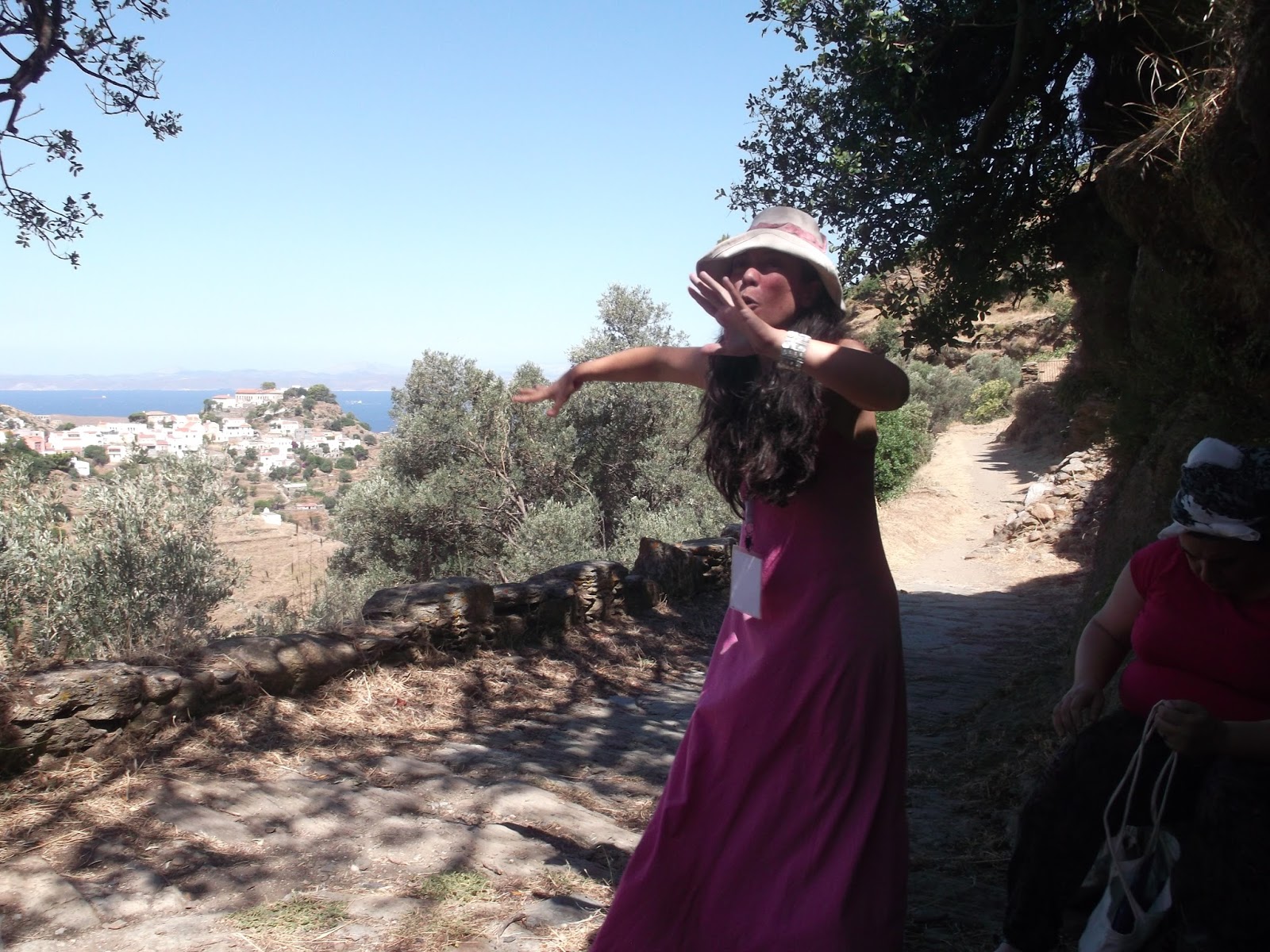
Tuesday morning we started with a long story walk up on the mountain in Iulida. We were split into three groups; my group was led by two lovely Greek storytellers, Georgia Lazarou and Katia Kantouri (left). We walked around town and along the mountainside, and occasionally stopped to hear local legends and folktales. It was both gorgeous and fascinating.
My favorite stop was the Lion of Kea, an old, old statue lying in the mountainside, smiling its enigmatic smile. It reminded me of the stone lion from the Neverending Story, one of the books that made me a storyteller. I touched its back - although it was lying in the burning sun, it was cool to the touch.
The walk ended under a great old plane tree, where we all gathered to take pictures, drink from the fountain, and have a picnic together. Before the food we had an open forum discussion about how landscape affects the stories that are born from it. We heard very interesting opinions, examples, and even stories (obviously). The common ground seemed to be that yes, stories are affected and shaped by landscapes, but that in itself is not enough to make them interesting to a foreign listener. Speaking for myself, I was glad I got to hear the tales of Kea in the place where they were born. It added a lot to the experience.
After a great lunch, we returned to Korissia for siesta before we began the afternoon sessions. Everyone could choose two from four round table discussions (Festivals, Performance, Healing, and Inclusion). First I attended the discussion on festivals (moderated by David Ambrose from Beyond the Border), in which we talked about practices and ideas about translation, commissioning new work, residencies for storytellers, and outreach for new audiences. Some people in the group were veteran festival organizers, while some of us were fairly new, and drinking in information like a sponge.
In the second round I joined the group titled "Storytelling and Inclusion - Social, political, economic immigrants." This was a very timely topic for me as a Hungarian person, for all the wrong reasons, and I was eager to hear about projects and ideas that help storytellers contribute to building bridges and counteracting hate and prejudice. The discussion was moderated by Guy Tilkin (Alden Biesen, Belgium), and we heard about things like the Human Library Project, integration of immigrant children into German-speaking schools through storytelling, and other great things. It made me feel hopeful to hear that storytellers had an important part to play in this cultural shift.
Tuesday evening the Greek hosts passed the torch of FEST on to the French representatives - next year's conference will be in France! We celebrated with drinks, singing, and dancing, and conversations late into the night.
The conference's last day contained all the actual organizational work. We had to vote on several things. One of them was the location of the conference in 2017; both the Irish and the Dutch delegation brought excellent presentations to pitch their own sites. It was a tough choice; we had to break a tie, and in the end, Ireland was chosen by the representatives of FEST members for the 2017 conference. I am personally very excited about it! I also hope the Dutch apply again. Their plans sounded amazing as well.
We also voted on FEST 2018; 4 countries proposed, and in the end, after another elaborate voting process, Slovenia gathered the most votes. In my personal opinion, this is great for several seasons: One, Slovenia is a gorgeous place; two, Ana, the Slovenian representative, made a very good point about the need to bring FEST to Eastern European and Slavic speaking storytellers, in order to bring them into the FEST community (she was the only Slavic speaking person at the conference). I am looking forward to the next three years!
Finally, we also voted on new members of the FEST Executive Committee. I was among the nominees, which surprised me, but also made me think seriously about what I could contribute to the work of FEST. While I spend the school years in the USA, I could offer my experience with digital and social media, and networking. In the end, I was among the three new members elected for the Executive Committee, along with Ana Dusa (Slovenia) and Sonia Carmoma Tapia (Spain). The next three years are looking to be an adventure! I am deeply honored and excited for having been chosen for this position, and looking forward to all the work.
All in all, it was a great conference: Friendly, well organized, educational, and not too hurried. I will be processing all I heard and learned for a very long time.
With all the voting done, we were free to relax and enjoy the 13th Kea Folktale Festival. But I'll leave that for the next post.