Showing posts with label ghosts. Show all posts

Friday, April 5, 2019

E is for Eggplants vs Ghosts (A to Z Challenge 2019: Fruit Folktales)

No, this is not the sequel to Plants vs Zombies, but it's close.
Also, yes, eggplant is technically a fruit.

Among many, many folktales collected from Japan's Niigata Prefecture, and compiled by Fanny Hagin Mayer, there is an especially fun story about mushroom ghosts.

Story goes that behind a certain village shrine, every midnight the sounds of music and singing could be heard. No one was brave enough to investigate, until one night a young man decided to pluck up the courage and see what's up. Walking behind the shrine at midnight, he came across a crowd of Little Folk singing and dancing merrily. He asked them who they were, and the little figures told him they were mushroom ghosts. The young man, thinking quickly, told them he was a human ghost. Having established ghost rapport, they started to chat, and the little folk asked the man what he was especially afraid of. "Gold coins," he told them, without missing a beat "And you?" Turns out, the mushroom ghosts were deadly afraid of salty eggplant juice.

As the party got wilder, the mushrooms started having fun by throwing gold coins at the young man, who pretended to be terrified, amusing the little folk to no end. In the morning, the young man collected the gold, went home, and made a bucket of salty eggplant juice. The following night he returned to the party, and threw juice at the ghosts with a ladle. In the morning, all that was left of them was a bunch of shriveled up mushrooms.

(You can also find the story in this book)

As fun as eggplant-allergic, money-throwing mushroom party ghosts are, I am a little sad about how this story ends. What do you think?

Wednesday, October 31, 2018

Kindness against darkness: Halloween folktales of caring

I like Halloween stories that go beyond mere fright. Maybe because I used to be an anxious child, and jump tales made me cringe in advance; maybe because I never liked horror for horror's sake. When I started developing a Halloween repertoire as a storyteller visiting the USA, I was drawn towards stories that were less about the creatures of darkness, and more about how we face them.


This year, since the world is increasingly full of darkness anyway, I decided to post a selection of stories where scary things are balanced out with kindness and understanding. So, here is my Top 5.

The black kitty
W. B. McCarthy: Cinderella in America (University Press of Mississippi, 2007.)
Polish-American folktale about a boy who is believed to be simple by his brothers, and yet he ends up breaking a curse on a castle and its residents. He does so by hugging a black kitten (an enchanted princess named Katie), and whispering "my kitty, my black kitty" even when dragons, storms, ghosts, and devils descend on the castle to scare him.

The wee little tyke
Ruth L. Tongue: Forgotten folk-tales of the English counties (Routledge, 1970.)
A girl finds a small black stray dog, and takes him home. The entirely family is cursed by a witch, and the home is a horrible place; cow doesn't give milk, hens don't lay eggs, etc. The wee little dog breaks the curses one by one, and chases the witch away. The family decides to adopt the pup, despite his heartbreaking worries: "But... I'm small!" "But you have sharp teeth!" "But... I'm black!" "So is our cat!"

(Bonus: These two tales can also be used to encourage people to get over their superstitions about adopting black pets.)

The skull
Ruth Manning-Sanders: A book of ghosts and goblins (Dutton, 1969.)
Folktale from Tirol. An orphan girl runs away from her cousin's, and comes across a castle in the woods. The castle is inhabited by a woman's skull that she makes friends with despite all the eerie things going on around it. At night, the girl hugs the skull and holds on to it even when the headless skeleton of an evil man tries to tear it away from her. Her bravery and caring breaks the curse on the woman's ghost, and the girl inherits the castle.

Drinking companions
Pu Songling: Strange stories from a Chinese studio (London, 1880.)
Chinese story of possible traditional origins. A fisherman makes friends with a mysterious person who turns out to be the ghost of a drowned man. After a long time of sharing drinks every night, the ghost tells him that the next person to drown in the river is about to take his place. But when the next person turns out to be a mother and child, the ghost saves them, extending his own time in limbo. As a reward, he is assigned to be a minor deity in a nearby village, and continues his friendship with the fisherman. 
My storytelling mentor, Cathryn Fairlee, has a lovely version of this story that features husband and wife.

The count and the servant
(Source in Hungarian)
Hungarian folktale. A count dies, but his ghost haunts the family home every night. A servant who loved him while he was alive decides to find out why his master can't rest in peace. He pretends to be a ghost as well, and spends the night haunting and talking together with the count's ghost. The count confesses that he has hidden treasure that he wanted to leave to his family. When the servant helps him uncover the treasure, the ghost thanks him, and goes to his eternal rest.
I heard Heather Forest tell this one in Jonesborough once.

Have a great Halloween, everyone!

Monday, July 30, 2018

A legend on every corner (Following folktales around the world 76. - Czech Republic)

Today I continue the blog series titled Following folktales around the world! If you would like to know what the series is all about, you can find the introduction post here. You can find all posts here, or you can follow the series on Facebook!


Prágai regék
Václav Cibula
Móra Ferenc Könyvkiadó, 1979.

This book contains 139 legends and tales from Prague, a city so full of stories I would not recommend visiting it without a similar guide. Every street, every square, every bridge, district, and building has its own legend; one can stand and look at them while listening to (or reading) the stories. Believe me, it's great fun, I have done it myself. In addition, now you can visit the Museum of Ghosts and Legends, and see an exhibit based on the most famous stories of the city! Cibula has done excellent work collecting, researching, and retelling the stories, organized by district. While his original collection doesn't seem to be available in English, other editions have used it as a resource. Try to find this book, or this one, and take them with you when you visit Prague!

Highlights


The book opens with the life, rule, and prophecies of Libuše, the legendary first queen of the Czech nation - including the one when her subjects demanded a male ruler, and she told them they would regret the decision, because a man's rul would be cruel and bloody (but ended up selecting her own husband, Premysl, anyway). After her death the Women's War broke out; her court ladies built a castle and recruited women and girls, waging a war on the men of the kingdom, until they were outnumbered and slaughtered (according to legend, anyway). A brave woman also featured into the story of The king and the bath girl; a maid name Zuzana rescued King Wenceslaus from captivity, and rowed him across the Vltava River. Another female hero, a Clever princess, designed and built a machine that was capable of lifting the giant bells of the Saint Vitus cathedral. Allegedly, the ropes were made of the court ladies' hair, but we'll never know: The princess destroyed her invention after using it.
Another classic Czech tale is that of the knight Bruncvik, whose statue you can see by Charles Bridge on the left side of the river. It has everything a great fairy tale needs: Sea voyages, magnetic mountains, giant birds, monster-princesses, loyal lions, magic swords... the works.
Prage and its surroundings have many stories involving water sprites - a creature of folk belief that is very essentially Czech. My favorite was the story about a sprite whose lake was destroyed by an ox cart, and it followed the driver (with a water lily on his hat) all the way to Prague to drown him in revenge. The sprite befriended a mortal man on the way to the city, and told him the story.
I also loved the tale of The bride from Gold Street, in which a Jewish girl named Hanina fell in love with a water sprite, and ran away with him despite her father's wishes. Later a midwife got to visit her in her underwater home, and help her give birth to her water-children. Another tale also featured children, but it a different light: A woman whose child had been drowned by the sprite cursed the water-children to get stuck on land and dry out. Eventually, a wise woman persuaded her not to punish children for their father's crime, and she let go of the curse, along with her own child's little shirt.
Water sprites were not the only inhabitants of the river: There were also tales about mermaids, and even the old god Perun, who still drags people under around Charles Bridge.
Another popular topic of legends was art. It is a well known story that the council of Prague ordered the creator of the Orloj, the famous astronomical clock, to be blinded, so that he could never make another one. A woodcarver, on the other hand, murdered a beggar himself to use him as model for the face of the dying Christ for a Crusader church. The curious Jesuit got a funnier fate: Since he spied on the artist who was painting the ceiling of Saint Nicholas', the painter put him in the picture, peeping from behind a column.
Like many other cities, Prague is also brimming with ghosts (maybe even more than others). There is the Burning man of Charles Street (who used to be a money-lender, and saved his money rather than his neighbors from a housefire), the Gingerbread Knight (who was known as headless until he appeared to complain about his gingerbread depictions), the Sad Indian (left behind by a traveling circus and never found the way back home), the Sad Nun (who was killed by her father for falling in love, and helps hopeless lovers when they need it), and the Large Lady of Kozí Square (whose curse was broken by a female cook after she put up with the raging ghost for three nights, hiding under a blanket) (see, blankets do repel ghosts!). Then there was the chilling legend of the Strange dream, in which a girl got to have a wedding with the ghost of her fiance, and that of the Gravedigger and the cards, in which three friends (two dead and one alive) got to play one last game of cards during the Black Plague. Another famous legend is the Shredded painting, in which a secret society gathered in a house every night through their portraits, leaving their bodies behind (one of their wives cut up a painting, and found her husband cut up back in his own bed).
And let's not forget about all the stories of the Jewish ghetto! They deserve their own story collections (if you go to Prague, you can buy some). There are the legends of the famous Rabbi Löw, whose wisdom and miracles are legendary. In one, he made a machine that kept Death away from him (until Death disguised itself as a dewdrop inside a rose). In another, he talked to the spirits of children in the Jewish cemetery, and found the source of the Black Plague. And, of course, there is no Prague story collection without the most famous Prague legend of all - that of the Golem!

Connections

I once again encountered sleeping knights; this time, under the Vysehrad, waiting to be awakened by Libuše. They were mostly recruited by a water sprite who dragged swimmers underwater, and took them to the hidden army. According to another legend, there is a secret crypt in the basement of a house in Konviktská Street, where vigilant corpses guard treasure meant for the next great Czech king.
The tale of the Man who sold a dream was familiar from other cultures as well (here, the two dreamers met on Charles Bridge, and shared the found treasure. The story of the bear and the water-sprite was a variant of the famous Norwegian Cat of Dovrefjell. I also found an Oedipus-legend (The House of Death), a haughty countess who made shoes out of bread (and burned in hell for it), and even a story where the Devil helped with the construction of a church (but dropped a column, stolen from Rome, on the Vysehrad).
Local tricksters were King Wenceslaus' court magician, Žito, and King George of Poděbrad's court jester Paleček. Doctor Faust also made an appearance, having his famous house on Charles Square, along with various other magicians and alchemists who moved into the same building later.

Where to next?
Austria!

Monday, November 6, 2017

Land of Magic and Enchantment (Following folktales around the world 50. - Iceland)

Today I continue the blog series titled Following folktales around the world! If you would like to know what the series is all about, you can find the introduction post here. You can find all posts under the Following Folktales label, or you can follow the series on Facebook!

We have reached Europe! It will take almost a whole year to get through all of its countries. Settle in!


Hildur, Queen of the Elves
And other Icelandic Legends
J. M. Bedell
Interlink Books, 2007.

The book contains fifty-one Icelandic tales; most of them are legends, stories about events people believed to be true, featuring beliefs and creatures that are very prominent in Icelandic folklore. The stories are grouped according to these themes: There are separate chapters for Elves, Trolls, Ghosts, Water Monsters, Magicians, and other folktales. The tales have been translated from the Icelandic, and then re-told by the author; they provide and enjoyable reading experience, while retaining all the names and details that give them their unique flavor. There is an extensive Introduction by Terry Gunnell, who talks about the context of Icelandic legends, their cultural background, origins and collections, and the beliefs and customs they represent. He points out that Iceland was a culturally diverse country even in the middle ages, and therefore the stories show elements from Scandinavian, Celtic, and several other traditions. There is a list of sources at the end of the book, and each story comes with a citation of its original text.

Highlights


Bjarnarey, one of the Westman Islands
I have to say that Iceland is exceptionally great at wizard stories. There are countless legends about magic schools (Saemundur in the Black School), and priests and wise men who have magical powers. My absolute favorite was the tale of the Magicians of the Westman Islands, in which eighteen magicians fled to the small islands from the Black Plague, and some time later sent one of them back to check if anyone survived. The magician only found one survivor, a young woman, with whom he fell in love, and never returned to the others. In revenge, the other magicians sent ghosts to destroy him - ghosts which the girl managed to outwit, in order to save the man she loved.
Knowledge of magic was usually gained from books of magic. For example, Loftur the Enchanter summoned the ghosts of Iceland's old bishops, to gain their books of secrets from them. Eiríkur of Vogsós, on the other hand, tested his prospective students by seeing if they were willing to kill an old woman for knowledge (and if they were, he kicked them out). Björn the Fiddler was tested by his uncle through summoning up talking corpses and other demonic visions - but handled all of them with patience and good humor, earning his uncle's respect. Some enchantments were more chilling than others. The darkest was Thorgeir's Bull, a creature created by bored magicians and brought to live with the use of nine souls (one of them human). The monster haunted the countryside for a long time, and eventually killed its own master.
Similarly chilling was the legend of the Elf-Steeple. It told about two brothers, one strong and brave and the other quiet and gentle. The quiet brother spent time with his Elf friends a lot, and was to be initiated into the Elf priesthood - but his sibling broke in and interrupted, for which the Elves killed him. The young priest traveled far, for the Elves promised he would die if they say each other again. One day as he celebrated mass, a storm broke the church doors open at the same time as the Elf church opened - and the moment the priest looked into the eyes of the Elf priest, he dropped dead.
Picture from the ABC blog,
which I highly recommend to
everyone interested in creatures
Redhead the Whale, one of Iceland's most famous monsters, was also a victim of Elf revenge. He stayed with the hidden people, and got a girl pregnant; but refused to acknowledge the child. He was turned into a whale in revenge, and terrorized the waters until an old priest-magician lured him up a river, where he died.
The title story is also quite beautiful. Regarded as a variant of the Dancing Princess tales, it tells about Hildur, an Elf queen who was exiled from home by her mother-in-law, cursed to work as a servant among humans. She could only return home one a year at Christmas, and only freed when someone was brave enough to secretly follow her.
Some of the troll tales were also great. I especially liked the ones where priests left some rocks and cliffs on every shore unblessed, so that trolls would have somewhere to live too.

Connections


Huldufolk homes. Picture from here.
Celtic connections were very obvious in the tales about the hidden people / fairy folk. There was a Fairy Midwife story (I already found one in the USA, and it is very popular in Ireland), a changeling legend (Father of eighteen elves), and a Selkie story (Better a seal skin than a child), among others.
I found the Icelandic variant of the Magic Flight titled Búkolla endlessly endearing. In it, a boy rescues a cow from a troll, instead of a girl; Búkolla moos to bring her savior to her, and then they escape together by throwing things behind them to slow down the troll. I was also happy to find one of my favorite strange folktales, The Dreamer and the Money Chest, in this book. In it, a traveler follows the soul of his friend as it escapes during sleep, and sees where it wanders.

Where to next?
Denmark!

Monday, September 18, 2017

Horror from Honduras (Following folktales around the world 43. - Honduras)

Today I continue the blog series titled Following folktales around the world! If you would like to know what the series is all about, you can find the introduction post here. You can find all posts under the Following Folktales label, or you can follow the series on Facebook!


Cuentos y Leyendas de Honduras
Jorge Montenegro
Litografía López, 1976.

One hundred and fifty ghost stories, urban legends, folk beliefs, and other tales from Honduras, representing some of the most popular spooky tropes around the world - from tormented souls to vanishing hitchhikers, from witchcraft to demonic possession. It is real, living-breathing 20th century folklore, peppered with motifs from more ancient traditions.
This extremely popular collection was gathered by author and journalist Jorge Montenegro, who has been sharing them in a radio program since 1964, and published the first volume in 1972. The book now has a 50th anniversary edition. Most of the stories can be found all over the Internet (including the La Prensa newspaper's archive here); since I don't have access to ILL anymore, I read them online.
And the cherry on top: Some of these stories were turned into a horror movie in 2014!

Highlights


Ocote, or Montezuma pine
My favorite story in the book (and one of the few non-spooky ones) was that of the Ocote Tree, in which a young boy learned from his grandma that people should talk to trees, and invited a giant pine to their house for Christmas.
My little feminist heart also loved the Old Man in Love, who was not in love at all, but rather a notorious cat-caller, at least until a pretty young girl seemed to give in to his propositions, and asked him to meet by the river at night. Of course she was not a girl at all, but rather the La Sucia female demon, there to teach the old lech a lesson about "compliments"... A similar lesson was taught to the Mocking Girl, who liked to scare people at night, hiding behind a window and pretending to be a ghost or the devil. One day, she accidentally scared someone to death, so the real Devil showed up, and turned her into an old woman as punishment. And while we are on the topic of morals: the legend of the Grumpy Gravedigger (heh) told the story of how a mean old man was taught a lesson about the spirit of Christmas by being scared half to death by the souls of the dead (Christmas Carol much?).
The story of The Worms was an interesting reverse take on Bluebeard or Mr. Fox: This time, the young wife found hidden treasure in the basement of her husband, and decided to kill him for it... but when she succeeded, the Devil turned all the money into worms in front of her. Similarly, there was an interesting variant of the Vanishing Hitchhiker (the Moramulca cliffs) where someone rescued a girl from a car wreck, only to find out later that the wreck had happened ten years earlier...
Tegucigalpa, site of most stories
Some stories were dark, but also meaningful. In the tale of the Cruel father, a young man was abused physically and verbally. When he fell in love, the father killed his girlfriend to keep her from taking the boy away. Of course her ghost returned - she beheaded the father, and took her lover with her. Similarly, in the story of the Girl from Catacamas, a child was beaten regularly by both parents, until she subconsciously cursed their home, and turned it into a place full of terrifying occurrences.
Some ghosts, however, were nicer than others. For example, there was the Nurse that kept visiting and treating patients in the hospital where she worked, long after her death; and also the Girl with the flowers, who befriended a lonely woman who visited the cemetery every day.

Connections


There are few "real folktales" (magic tales) in the book, but several stories contained recognizable motifs from older traditions - for example, that of the Serpent Bride, where a young pianist fell in love with a woman, just to see her turn into a serpent on their wedding night (reminiscent of Melusine, and other serpent bride tales). There were several versions of classic urban legends and ghost stories, such as The Ring (where grave robbers try to cut off a dead woman's ring with her finger, just to find out she was not actually dead); grateful ghosts pointing out the place of buried treasure; Vanishing Hitchhikers (several of them); and even a ghost bus, this time filled with nuns for some reason...
I have already encountered stories about loyal dogs that protected their owners even after death; Angelina's Dog was one of them, attacking and mangling men who had killed it to get close to the defenseless girl.

Where to next?
El Salvador!

Monday, September 11, 2017

The Amazons of Corn Island (Following folktales around the world 42. - Nicaragua)

Today I continue the blog series titled Following folktales around the world! If you would like to know what the series is all about, you can find the introduction post here. You can find all posts under the Following Folktales label, or you can follow the series on Facebook!


Cuentos, leyendas y mitos de Nicaragua
Pedro Alfonso Morales
Ediciones Distribuidora Cultural, 2014.

This volume contains a total of 24 stories: 12 folktales, 11 legends, and 1 myth. Nine out of the folktales have been collected by students from their families; three are re-tellings by various authors and researchers. Similarly, the legends are longer or shorter depending on the version. The volume itself is visually eclectic: It was printed on color paper, so the stories are told in pastel blues, yellows, greens, and pinks, and complete with illustrations that range from simplistic to annoyingly childish. The book comes with an introduction about Nicaraguan oral tradition, as well as a study guide for students; all in all, it is more an educational project than a folklore publication. With that said, I am still a fan of having children collect stories from their own family traditions - and in this case they came up with some really great ones.

Highlights


The most memorable story in the book is, without a doubt, the legend of The Women of Corn Island. It is a classic Amazon tale, in which the island is ruled by a women-only society; they hunt, fight, work the land, and only allow men to visit once a month, in order to make babies (amazing detail: Women know they are pregnant because at the moment of conception a glowing butterfly emerges from their belly button).
Women and men marching for
indigenous rights, source here
Male babies are sent to their fathers, while the girls are raised by the women, and their roles are determined by moles that are found on their body (on the back for farmers, on the thigh for hunters, and on the belly for potential mothers).
Legend says that when the white colonizers arrived, the women, rather than being killed or taken as slaves, all walked into the ocean, and turned into sea foam, leaving their island abandoned.
I also had a soft spot for the story of a girl who loved swimming in the ocean so much that she even did so on Holy Week, despite her mother's warnings. In the water, she turned into a mermaid, and swam away, singing. I am not sure it was a punishment for her.
On a darker note, there was the bone-chilling tale of María Angustia, a young wife who refused to cook, and kept pestering her neighbor for food and for feeding her husband. In the end, the neighbor lady told her that she should bring some intestines from the cemetery to supplement pork in the dinner - which María did, except the deceased owner of said intestines began haunting her, and dragged her away in the dark of the night.

Connections

Similar to most other South- and Central American countries, there was a legend about the La Llorona; and similar to many Caribbean islands, there was also a legend about a woman that peeled her skin off to shapeshift. In this case, she turned into a coyote every day, until her husband sprinkled salt inside her discarded human skin, and she could not put it back on.
I also encountered familiar tale types such as Cricket the Fortune-teller, the Loquacious Princess, and the Extraordinary Helpers (with a flying steamboat!). And of course there was another Devil husband with golden teeth, who in the end got lured into a bottle by his mother-in-law, the way djinn are usually tricked... Ever since then, when the Devil shows up in the shape of a whirlwind, people just have to yell that his mother-in-law is coming with a bottle.
Picture from here
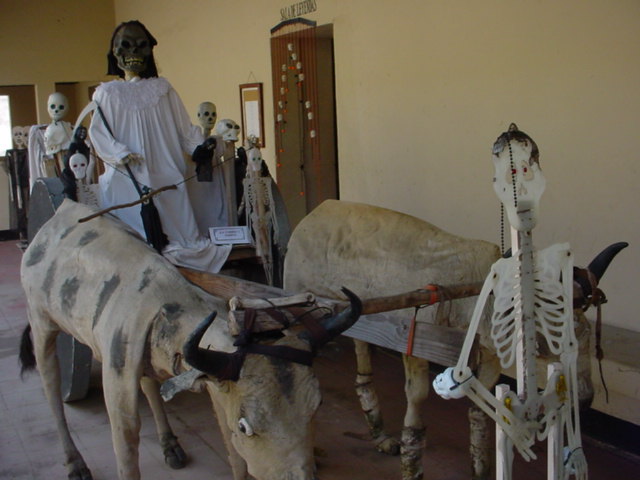
Another classic legend also made an appearance: That of the Procession (or in this case, Cart) of the Dead, which appeared in three or four stories in the book. It is a ghostly procession of skeletons, penitent souls, and other dead things. In one story, a man who lived a sinful life made fun of the procession, saying it was a hoax - but then it came for him, and he had to follow them, carrying a candle made of a human bone, for all eternity.

Where to next?
Honduras!

Monday, August 28, 2017

Zombies in a matchbox (Following folktales around the world 40. - Panama)

Today I continue the blog series titled Following folktales around the world! If you would like to know what the series is all about, you can find the introduction post here. You can find all posts under the Following Folktales label, or you can follow the series on Facebook!


Leyendas chiricanas
César Samudio
Imprenta Universitaria, 1994.

This book is a collection of stories from one province of Panama, called Chiriquí. Unlike most of the previous books in the series, this one does is less a volume of folktales, and more a display of various urban legends and folk beliefs, often with names, dates, and places proving that people telling them believed firmly that they really happened. Usual creatures of belief, such as ghosts, witches, fairies, gnomes, and the Devil make appearances, as well as curses and hauntings. Not much information is provided for the stories other than a short introduction, and the illustrations are quite disturbing - and yet, the book was definitely an intriguing read.

Highlights


Picture from here
I enjoyed the tale of Orik and the Washer Girl, in which a poor girl who went to  the river to do laundry made friends with a fairy/gnome creature named Orik. Orik gave her a gold coin every day, which she used to help her family, but eventually her relatives became worried that the mysterious benefactor would take their child, and used some tricks suggested by an old aunt to chase Orik away.
There were also some classically creepy, horror-like stories, such as the Ghost Bus, which appeared and disappeared on the roads at night, sideswiping other buses (I heard about a ghost street car in New Orelans) - and also Zombies in a matchbox, a series of tales about people who owned a matchbox with seven small zombie creatures in it that fulfilled their every command (including hijacking and airplane), and fed on the blood and tongues of live cows.

Connections

I once again met the Crying Woman here in Panama; she is known as the TuliviejaAccording to the legend, she was a young woman fond of dancing and parties, and she left her crying newborn at the side of a water gorge so that she could sneak out to a dance. Her horse stumbled, she fell, died, and turned into the Tulivieja, who goes around every night along waterways, looking for her child. Another classic legend also made an appearance: The tale of The man who danced with Death told of a guy who danced with a beautiful young woman at a party and then walked her home, only to find out the very next day that she had been dead for years - a car-less variation of the infamous Vanishing Hitchhiker. (Anyone reminded of the pilot episode of Supernatural yet?)
The Man with Golden Teeth (aka. the Devil) also made an appearance. This time, he pretended to be a well digger, and made a bet with a widow that if he could dig a well in one night, she would marry him. Noting that he was the Devil, she put her rooster in front of a mirror, and the rooster became so agitated that it crowed well before dawn, breaking the Devil's deadline.


Where to next?
Costa Rica!

Thursday, April 6, 2017

E581.6. Ghost rides giant demijohn (WTF - Weird Things in Folktales)

Welcome to my A to Z Challenge blog series titled WTF - Weird Things in Folktales! Find the introduction post (explaining the theme) here. Find all other participating blogs in the comments of each day's post on the main blog! You can also follow us on Twitter and Facebook.

E in the Motif Index stands for... *ominous sounds*... the Dead. And all the tales, beliefs, and rumors attached to them, such as "E80. - Water of Life," or simply "E251. - Vampire." (If anyone ever asks you "what's the folktale number of a vampire?" now that is a thing you know. You're welcome. Use it as an Easter egg in your next urban fantasy novel.)
And on a less terrifying note, there is also:

E581.6. Ghost rides giant demijohn

The legends surrounding Dosoris Island (Long Island, NY) claim that the small patch of land is "a common resort of elves and goblins," and it has "three vexatious spooks" (gotta love 19th century sources for the language): 
Derrick Wilkinson, a "hard-riding jockey" who broke his neck and is now haunting late night travelers to "larrup them with a strangely ponderous cudgel;"
Billy Cowles, who died of asthma, and is running around searching for his breath with his cravat in hand; 
and

A bibulous miller, who was "often seen flying up the lane like a belated member of the Wild Hunt, astride a monster demijohn that he lashed and spurred until it had carried him to the foot of the Drinking Tree" (the tree under which he had drunk himself to death). 
Well, if you gotta spend eternity somewhere, you could do worse than riding a monstrous demijohn around Long Island, I guess...

(Read the story here.)

**Classic Hungarian joke time**
Young soldiers on guard at night; one of them hears a noise.
"Halt! Who goes there?"
"Your mother with a demijohn!"
"Mother, halt! Demi John, step forward!"

Runner-ups
E17. Resuscitation by licking corpse
E18. Resuscitation by tickling
E29.3. Resuscitation by pricking anus
E251.4.1. Vampire with elephant face
E402.1.1.5. Ghost snores
E616.5. Reincarnation as bedbug
E692.4. Jealous woman reborn as chilly